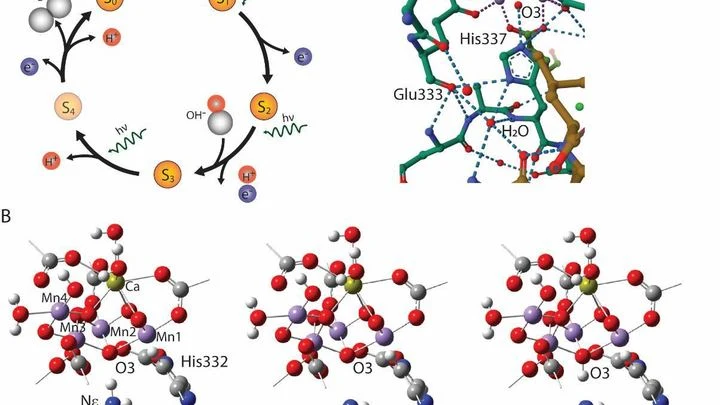
Water splitting is the chemical reaction that breaks water molecules (H₂O) into oxygen (O₂) and hydrogen (H₂). In nature, this is the heart of photosynthesis, where plants use sunlight to power the reaction, releasing the oxygen we breathe and storing energy in chemical bonds. The process is also central to the emerging field of artificial photosynthesis, which aims to produce clean hydrogen fuel directly from water and sunlight.
History
The discovery that water can be split by light was made in 1789 by Jan Ingenhousz, who showed that plants produce oxygen in sunlight. The detailed mechanism of the photosynthetic water-splitting complex was only fully mapped in the 21st century, with the crystal structure of Photosystem II solved in 2011.
How it works
The reaction is endothermic, meaning it requires an energy input. In photosynthesis, light energy is absorbed by pigments and used to strip electrons from water molecules at a catalytic site containing manganese and calcium. This releases protons and oxygen gas. The electrons are then shuttled through a chain of carriers to drive further reactions. In artificial systems, the same principle is applied: a catalyst lowers the energy barrier, and an external energy source (light or electricity) drives the separation of water into its components.
In practice
Water splitting is used in electrolyzers to produce hydrogen fuel, and in artificial photosynthesis research to create solar fuels. It is also the basis of the oxygen-evolving cycle in all oxygenic photosynthetic organisms.
Fun fact
The oxygen we breathe comes from water, not from carbon dioxide—a fact established by C.B. van Niel in the 1930s using isotopic labeling.
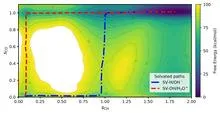
Picture a tiny hole in a sheet of graphene: a single missing carbon atom. It used to be thought that a water molecule splits apart at this defect only on its own, in dry gas. But if liquid water is sloshing all around, everything changes.
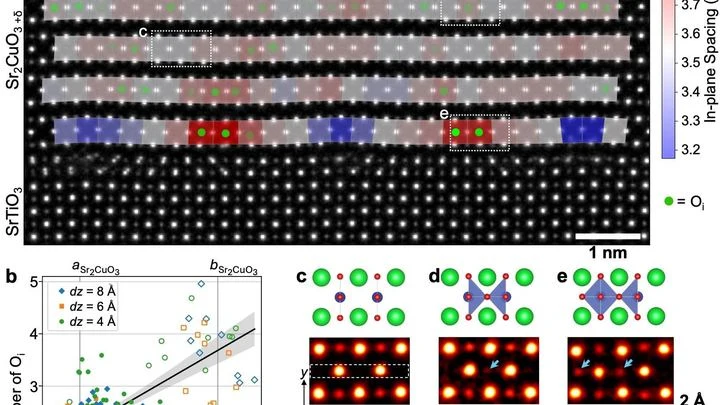
A superconductor is a material that conducts electricity without loss, like water flowing through a perfectly smooth pipe. In copper-based superconductors, tiny oxygen additions act like a volume knob: a bit more and the material starts superconducting; a bit less and it stops. But the oxygen atoms themselves are so small that seeing them directly was impossible.
Turn off the stove, and water stops boiling almost instantly. In the world of catalysis, researchers expected a similar picture: stop the reaction, and all intermediate particles vanish right away. But fresh observations of platinum nanoparticles tell a different story.
The lifetime of the entangled triplet pair in the protein is about 60 picoseconds, which is eight times longer than in solution.
Sunlight is like a continuous stream of balls flying at a wall.
In a glass of water, oil gathers into droplets: that's equilibrium separation dictated by chemistry. But there are systems where order arises not from rest but from a constant flow of energy.
A camera flash that fires in a thousandth of a second doesn't heat the subject — unlike a regular flash that lasts a full second. A similar trick has been found in radiotherapy: when a radiation dose is delivered in milliseconds instead of minutes, healthy tissues suffer less. This is called the FLASH effect.
Spectroscopy has always been a way to hear the unheard. Back in the 19th century, Johann Balmer deciphered the elegant lines of hydrogen — a simple numerical harmony that foreshadowed quantum theory.
If you squeeze water between two glass plates so that only two layers of molecules fit, it becomes something between a liquid and ice. At room temperature, molecules in such a trap still move but arrange themselves into a semblance of a crystal lattice.
In a crystal of water and caustic cesium, oxygen and cesium atoms sit in place like beads in a rigid lattice. Hydrogen atoms behave differently: they are like passengers constantly changing seats. In this layered material, each oxygen is linked to three neighbors via hydrogen bridges, forming a honeycomb-like pattern.
A deuterium molecule, two atoms of heavy hydrogen, falls apart under a laser pulse. One electron is ripped away, leaving an ion behind. At that moment, they are still linked: the direction of one immediately tells you which way the other went. This link is called quantum entanglement.
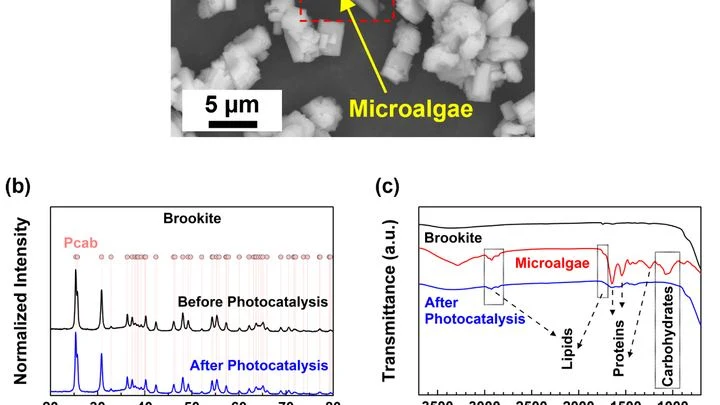
Dirty water laced with antibiotics isn't just waste: it's a hidden energy source. Chemists built a material from two components: titanium oxide nanorods (the white pigment in paints and sunscreens) and carbon nitride nanosheets.
Conventional solar panels convert light into electricity, but here light splits water into hydrogen and oxygen. Hydrogen is a clean fuel, but the process is slow. To speed it up, helper substances that donate electrons are added. Often this is alcohol, but it's a shame to waste it.
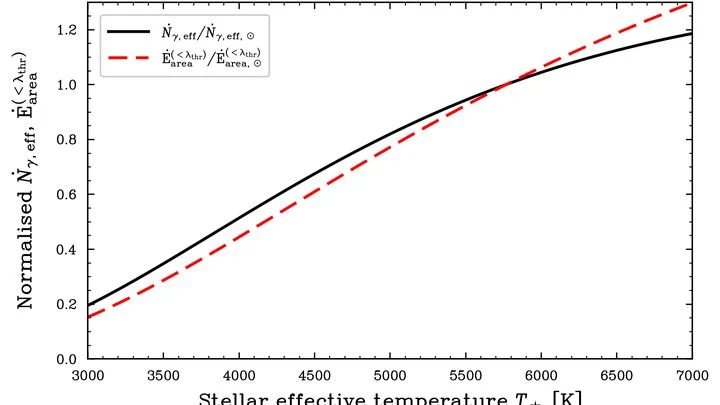
Oxygenic photosynthesis requires splitting water. It's kind of like a water wheel: to make it spin, you need a strong current. Light acts as the current, and light particles are the streams. For red dwarfs, the most common stars, the light is "cool" and weak — the streams barely move the wheel.
When a sunbeam hits a leaf, a relay race begins inside it. The energy of light passes from one chlorophyll molecule to the next until it reaches the reaction center — the place where the chemistry of life kicks off. This relay runs with astonishing accuracy: nearly every quantum of light finds its way.
Deep beneath our feet, at the very center of Earth, lies a solid iron core. But it's not pure iron — there are lighter elements too, such as hydrogen. Exactly how hydrogen is distributed within the core has long been a mystery.
Light from an ordinary bulb is a stream of individual photons, like drops from a faucet. But there is also light where photons come in pairs, like twins walking together. Such grouped light has long been desired for measuring distances and imaging objects hidden around corners. But sources of this light were either too dim, or their flashes too short for ordinary detectors to catch.
Chemistry has two worlds: in one, the catalyst is a solid particle and the reaction happens on its surface; in the other, it's a dissolved molecule where everything occurs around a single metal center. These worlds rarely meet. But in a new study, they collide.
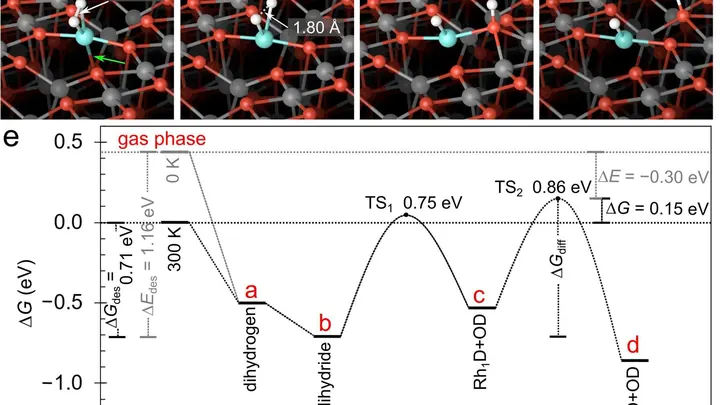
The researchers took iron oxide, a black powder used in magnetic tapes, and scattered single rhodium atoms across its surface.
In the air we breathe, invisible chemical events are constantly unfolding. One of them is the birth and instant death of a particle with the formula H₂COO. Known as an 'intermediate,' it appears for a split second when ozone molecules collide with organic compounds, then immediately shatters into simpler fragments.
A drop of oil in water behaves like a tiny ball: it seeks the spot with the least energy. If a wall is nearby, the drop often sticks to it, just as a raindrop spreads on glass. In a mixture of two immiscible liquids, such as polyethylene glycol and dextran, tiny droplets of one liquid form inside the other.
A cosmic dust grain is covered in ice, and on this ice, like in a tiny kitchen, molecules are cooked. One of them is methanol, an alcohol that serves as a building block for more complex compounds in space. Previously, it was thought that methanol only forms when hydrogen atoms stick one by one to a carbon monoxide molecule.
In every leaf, in the light, a factory works that splits water into oxygen and hydrogen. The oxygen goes into the air we breathe, and the plant uses the hydrogen for food. The heart of this factory is a protein complex with four manganese atoms and one calcium atom.
Two beams of light, red and blue, enter a tiny ring made of silicon nitride. The ring is smaller than the thickness of a human hair. At the input, both beams are equally bright. But inside the ring, one of them suddenly starts to outshine the other, like two equally matched people in a debate where one unexpectedly gains the upper hand.
In superfluid helium, a state where liquid flows without friction, quantized vortices spontaneously arise: microscopic funnels resembling whirlpools in ordinary Water, but governed by quantum mechanics.