Superconductivity and 'liquid-crystal' electrons express
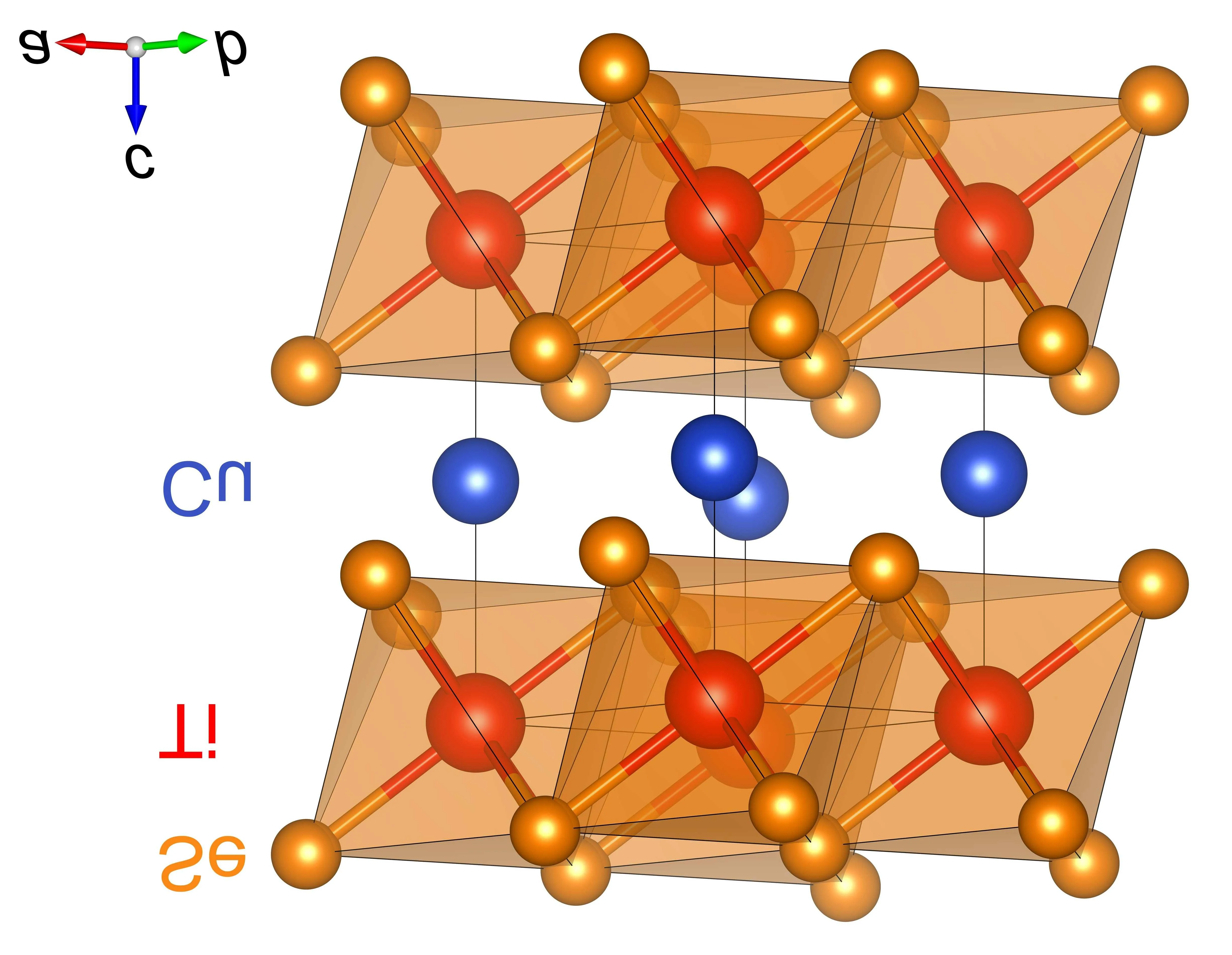
In the TiSe2 crystal, electrons behave like compass needles that suddenly start pointing in the same direction. This is called a nematic state — by analogy with liquid crystals, where molecules align along a common direction even though the material itself remains liquid.
Researchers measured how the crystal's electrical resistance changes when stretched in different directions. It turned out that at high temperatures, the electron 'needles' fluctuate, but upon cooling, these fluctuations intensify, as if the system is about to pick a single direction. The temperature at which this happens is denoted T*. Adding copper shifts T* downward, and when T* approaches zero, superconductivity becomes maximal. If more copper is added, T* changes sign, and superconductivity disappears.
It turns out that nematic fluctuations are not just a side effect but a possible 'glue' that helps electrons pair up and flow without resistance. The CuxTiSe2 crystal becomes a unique platform for studying such superconductivity.
Original abstract
as written by the authors arXiv:2601.00723
The interplay among electronic nematicity, charge density wave, and superconductivity in correlated electronic systems has induced extensive research interest. Here, we discover the existence of nematic fluctuations in TiSe2 single crystal and investigate its evolution with Cu intercalation. It is observed that the elastoresistivity coefficient mEg exhibits a divergent temperature dependence following a Curie-Weiss law at high temperature. Upon Cu intercalation, the characteristic temperature T* of nematic fluctuation is progressively suppressed and becomes near zero when the superconductivity is optimized. Further intercalation of Cu leads to the sign change of T* and the suppression of superconductivity. These results strongly indicate that nematic phase transition may play a vital role in enhancing superconductivity in CuxTiSe2. Therefore, CuxTiSe2 provides a unique material platform to explore the nematic-fluctuation-mediated superconductivity.
The word 'nematic' comes from the Greek 'nema'—thread: molecules in a nematic liquid crystal align like threads in fabric.