substance

metal

A class of materials characterized by high electrical and thermal conductivity.
27 related articles

Description

Metals are a class of materials distinguished by their high electrical and thermal conductivity, along with characteristic luster and malleability. This definition underpins their ubiquitous role in technology, from electrical wiring to structural components. The corpus titles explore metals in extreme conditions, such as superconducting thin films, metallic nitrogen under pressure, and nanoscale heat transfer, revealing that metal behavior can deviate from classical expectations at small scales or under extreme pressures.

History

The understanding of metals as conductive materials dates back to ancient times, but the electron theory of metals was developed in the early 20th century by physicists like Paul Drude and Hendrik Lorentz, who modeled free electrons in a metal lattice.

How it works

Metals conduct electricity and heat due to the presence of free electrons—electrons not bound to individual atoms but delocalized across the material's lattice. These free electrons can move easily under an electric field or temperature gradient, facilitating charge and energy transfer. The density and mobility of these electrons determine the metal's conductivity, which can be altered by factors like temperature, impurities, or structural dimensions, as seen in the nanofilm paradox where thinner films do not always conduct heat faster.

In practice

Metals are essential in electronics, construction, and energy systems; research on metal alloys and thin films drives advances in chip cooling, superconductors, and high-pressure materials.

Fun fact

Under extreme pressure, nitrogen—normally a gas—can transform into a metallic state, as described in the article on metallic nitrogen, creating quantum wires from air.

Concept graph →

Related articles · 27

Materials2026-09-103 minarXiv:2609.11862
A Magnetic Orchestra from Precipitates: How Fe6GeTe2 Nanoparticles Set a Record Curie Temperature
Picture an orchestra in which violins and trumpets play different parts but together create a powerful sound. In a crystal of the layered magnet Fe5GeTe2 doped with nickel, tiny regions of a different phase, Fe6GeTe2 nanoprecipitates, take on the role of those instruments. It is they, not the nickel itself, that keep the material magnetic at 478 kelvin, that is, at 205 degrees Celsius.
The metal that refused to change its shape
A thin film of neodymium nickelate, fifteen nanometers thick, sits on a neodymium gallate substrate. Below one hundred eighty kelvin it behaves as an insulator: electrons are locked inside their atomic cells and cannot move freely.
Atomic Route of the Insulator–Metal Transition Under a Light Strike
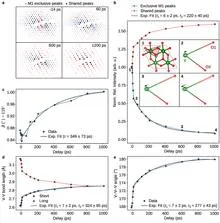
The camera captures not a race but a dance of atoms. In vanadium dioxide, the transition from an insulating to a metallic state occurs within trillionths of a second, yet until now no one had seen exactly how the vanadium and oxygen atoms move. Now, ultrafast electron diffraction has captured this route frame by frame.
A Treasure Map for Superconductors: How Two Numbers United Different Families
Old treasure maps were drawn from hearsay: someone found gold by a river, someone else in the mountains, and each person dug in their own spot. High-temperature superconductors went the same way: cuprates were found in some compounds, iron pnictides in others, nickelates in yet others, and there was no common map.
Superconductivity2026-08-211 minarXiv:2608.21273express
An Alloy That Won't Give In to Magnetism
A metal made of five different atoms is like a soup with bits of carrot, peas, potato, onion, and meat floating in it. Each bit is its own element: chromium, vanadium, titanium, niobium, and tantalum. Such an alloy is called high-entropy: there is no single order, and the atoms are mixed almost randomly.
Materials2026-08-091 minarXiv:2608.08534express
Diamond Film on Silicon: Heat Escapes Through Carbon
A microchip the size of a fingernail gives off as much heat as a small light bulb. Getting rid of that heat is like trying to cool a cup of hot tea with a teaspoon: the insulating material around transistors is usually a poor heat conductor.
eess.SY2026-07-151 minarXiv:2607.13797express
How Sound Charges Batteries Through Metal
Crystals glued to the outside and inside of a metal wall act as an invisible channel. One, receiving current, starts to tremble, and these vibrations, like ripples on water, spread out in all directions through the metal. The inner crystal catches this tremor and generates electricity again.
Materials2026-07-032 minarXiv:2607.02918express
Metal from a Failed Reactor: What the Uranium-Iron Alloy Hides
Inside the destroyed Fukushima reactors lie hundreds of tons of melted fuel — a mixture of uranium, zirconium, iron, and fission products. This debris is called fuel debris. It must be extracted, transported, and securely packaged for decades. But how will this volatile mixture behave under heat, compression, or accidental impact?
Materials2026-07-031 minarXiv:2607.03578express
How AI hunts for chameleon materials
Some crystals behave like a switch: nudge the temperature or pressure, and they turn from a conductor into an insulator. This is called a metal–insulator transition (a change in the ability to conduct electricity).
Materials2026-06-222 minarXiv:2606.23508
Electric Dance at the Atomic Edge: How Ultrathin Films Retain Memory
The thinner the ferroelectric film, the stronger the depolarizing field — a dictate of classical physics. Imagine a pencil balancing on a fingertip: the shorter it is, the harder to keep it upright. Nanoscale polarization likewise strives to vanish.
Superconductivity2026-04-252 minarXiv:2604.23378express
The Crystal That Won't Be Thrown Off Course
A crystal is like a city: if the streets are crooked, traffic jams. In a crystal, the streets are atomic rows, and the traffic is the flow of electrons. Any tiny imperfection, impurity, or atomic displacement makes electrons scatter. Scientists from several labs have learned to grow crystals so that the "streets" are almost perfectly straight. The method is called horizontal vapor transport.
Materials2026-04-162 minarXiv:2604.15491express
Light Brings Order to Metal
A copper wire hit by a laser is like a kitchen where the chef turns on the stove and watches the stopwatch at the same time. Copper atoms start to dance, losing the order of the crystal lattice, while electrons, like waiters in the dining room, instantly feel the change. But how much disorder do they need to notice?
Materials2026-04-131 minarXiv:2604.11397express
How Metal Gets Stronger: The Dance of Defects
When you pull on a piece of metal, it changes shape and simultaneously becomes stronger. The secret lies in tiny defects in the crystal lattice called dislocations. They are like wrinkles in a rug: moving a wrinkle shifts the rug more easily than dragging the whole rug.
Materials2026-03-251 minarXiv:2603.24776express
Gold breathes in liquid
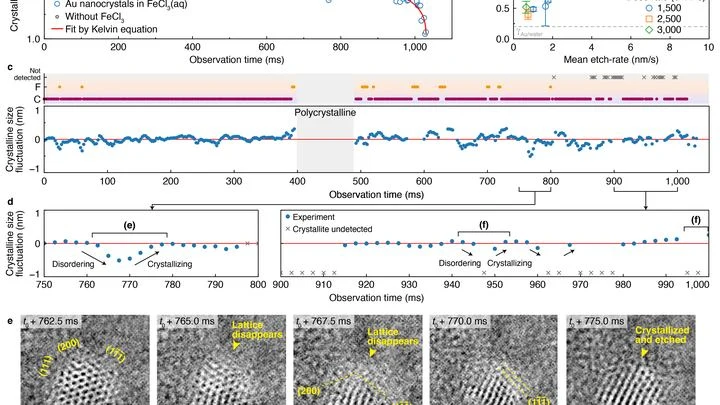
Gold nanoparticles in liquid are like tiny living creatures: they constantly change their internal structure, as if breathing. Scientists managed to peek into this process using an electron microscope that takes snapshots every millisecond, and a neural network that cleans the images from noise.
Materials2026-03-221 minarXiv:2603.21076express
A Thin Film Takes the Hit
A film as thin as a spider's web, made of five metals, took the hit from a laser. Inside, the pressure soared to 55 gigapascals — imagine a hundred elephants balanced on your thumbnail. The alloy withstood it, compressing for a fraction of a nanosecond without breaking. One gigapascal is a thousand megapascals.
Applied Physics2026-03-191 minarXiv:2603.18705express
Liquid Metal in a Maze
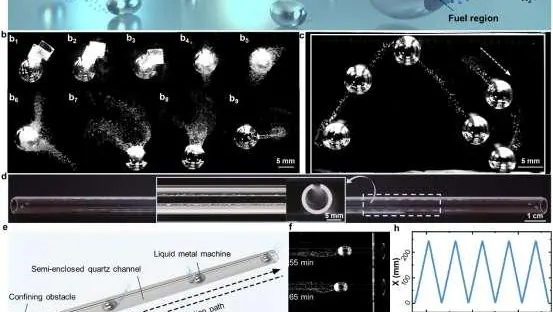
A droplet of liquid metal glides along a narrow channel like mercury from a broken thermometer. It needs no motor — the fuel is a chemical reaction with the surrounding liquid. But what happens when the droplet hits a wall? Previously, such machines were studied in open spaces, and in tight channels they behave differently.
Galaxies2026-03-051 minarXiv:2603.05434express
The Galaxy Thermometer Is on the Fritz
The gas in a galaxy glows like a neon sign, and by the color of that glow, astronomers can tell how hot it is. The logic is simple: the more heavy elements (which astronomers call metals) in the gas, the better it cools. So galaxies rich in metals should have cooler gas. But new observations show the opposite.
Materials2026-03-031 minarXiv:2603.02716express
Metallic Nitrogen: Wires from Thin Air
Turning light gases like hydrogen and nitrogen into metal is a long-standing dream of physicists. In a new experiment, nitrogen was compressed to 130–140 gigapascals (pressure equivalent to 14 million kilograms pressing on a fingernail) and heated to 3000°C.
Materials2026-02-211 minarXiv:2602.18979express
Metal Cocktail: How to Predict Its Heat and Current
A metal alloy is like a cocktail: mix a few elements and you get a material with new properties. But while a bartender tastes the drink, engineers need to know in advance how an alloy will behave in service.
Galaxies2026-02-031 minarXiv:2602.02949express
Turbulence in Space: How Clouds Change the Chemistry of Stars
A boiling cauldron: steam rises, water churns, and the temperature varies from point to point. So it is in space: the gas clouds around young stars are not smooth spheres but a seething mixture with vortices and density fluctuations. Astronomers long treated such clouds as homogeneous, but this simplification can skew conclusions.
Materials2026-01-211 minarXiv:2601.14576express
Printing Electronics from a Single Drop
A printer that prints not with ink but with metal and ceramic is now a reality. Scientists took an ordinary drop of water containing dissolved metal salts and made it deposit copper, zinc oxide, or nickel hydroxide onto a surface — all with precision down to millionths of a meter. The secret lies in electricity.
Materials2026-01-211 minarXiv:2601.14807express
Invisible Holes in a Two-Dimensional Crystal
A crystal one atom thick is like a sheet of paper you can write on with electricity. Such a material promises to become the foundation for tiny, fast microchips. But before putting it into production, you need to know exactly what it's made of. And that's where the usual formula falls apart.
Superconductivity2026-01-202 minarXiv:2601.14500express
Why Some Metals Become Superconductors and Others Don't
The classic BCS theory of superconductivity, developed by John Bardeen, Leon Cooper, and Robert Schrieffer, describes the mechanism by which electrons pair up into Cooper pairs and move without resistance.
Diamond: The Mystery of Scattered Speeds
Diamond is not just a gemstone. This crystal can conduct electricity when free charge carriers, electrons and holes, appear in it. But how fast do they move? In scientific papers, numbers vary by tens of times. One lab reports a mobility of 1000 cm²/(V·s), another 4000.
Strongly Correlated2026-01-141 minarXiv:2601.09847express
Metal Locks Magnetic Flux
Metals are full of free electrons: they dart between atoms like a swarm of bees around a hive. If you poke such a metal with a thin magnetic filament, the electrons start to feel its field. A new calculation shows they don't just go around the field; they trap it inside, like a cork sealing water in a bottle.
Superconductivity2026-01-021 minarXiv:2601.00723express
Superconductivity and 'liquid-crystal' electrons
In the TiSe2 crystal, electrons behave like compass needles that suddenly start pointing in the same direction. This is called a nematic state — by analogy with liquid crystals, where molecules align along a common direction even though the material itself remains liquid.
A Sprint Without a Run-Up: How Heat Flies Through Aluminum Nitride Films
Thirty nanometers is the distance over which a phonon sprinter hasn't yet had time to accelerate. In thin aluminum nitride films, thermal resistance remains almost unchanged up to this thickness: heat transport proceeds in the ballistic regime, where phonons (quanta of crystal lattice vibrations) fly…