In 1895, while heating oxygen, palladium, and paramagnetic salts, Pierre Curie discovered a pattern: the hotter the sample, the weaker it responds to a magnetic field. The reason is the opposition between the external field, which aligns atomic magnetic moments, and thermal motion, which disorders them. At low temperatures, the field 'overpowers' the thermal chaos, but as it heats up, disorder wins, and magnetization drops. Formally, the dependence is simple: χ = C/T.
History
Pierre Curie in 1895, systematically investigating the magnetic properties of substances over a temperature range up to 1400°C, formulated this law, showing that for paramagnets, susceptibility decreases with heating, unlike diamagnets, where it is constant. In 1905, Paul Langevin provided a statistical-mechanical explanation, linking the Curie constant to the ions' magnetic moment. Subsequently, Pierre Weiss generalized the law by introducing a correction for inter-moment interaction, leading to the molecular field theory and the description of ferromagnetism.
How it works
Curie's law is used for calibrating low-temperature thermometers, determining magnetic moments of ions in crystals, and analyzing magnetic phase transitions. Boundaries of applicability: only for paramagnets with negligibly weak exchange interaction, in weak fields, and at temperatures above possible ordering. For noticeable interaction, the Curie–Weiss law is used; at very low temperatures or in strong fields, quantum models are necessary.
In practice
Based on this law, magnetic thermometers for ultra-low temperatures (below 1 K) have been developed, where traditional sensors are powerless.
Fun fact
If Curie's law worked down to absolute zero, the susceptibility would become infinite — an infinitely small field would cause infinite magnetization. In reality, at very low temperatures, quantum effects and interactions between atomic magnets come into play, smoothly transitioning to the Curie–Weiss law.
In nature's workshop, there is a strange lathe: it cuts threads on screws but forbids left-handed ones. You can tighten a screw as much as you like, in any clockwise direction, but counterclockwise is not allowed. This lathe is not a fantasy but an exact quantum rule that physicists have just built for magnetic materials.
Deep underground, in the thickness of granite, detectors catch rare visitors from space — muons. These particles are born high in the atmosphere when cosmic rays slam into air nuclei. They make it to the underground lab thanks to their enormous speed, close to the speed of light.
A superconductor is like a perfect electron dance: electrons move in pairs without losing energy, like dancers who never miss a beat. But add a few magnetic impurities, and strangers crash into the dance, disrupting the synchronized motion. The temperature at which this dance begins drops.
If you squeeze an ordinary piece of metal, it heats up — even those who have pumped a bicycle tire know that. But what happens if you squeeze a magnet in which atomic arrows refuse to freeze even at absolute zero?
A metal bar suddenly becomes stiff when heated, and at the same time loses or gains magnetic properties. In alloys based on nickel and manganese, such transformations occur not smoothly but abruptly — atoms rearrange into a new order, and the material changes its behavior.
In the crystal Rb1-xV2Te2O, the spins of vanadium atoms arrange in a checkerboard pattern: each spin is surrounded by opposite spins. This pattern is called G-type antiferromagnetism. Neutrons passing through the sample scatter off this pattern and reveal its geometry, like light from a flashlight shining through blinds casting stripes on a wall.
A tiny magnet, made from just two molecules, was placed on a metal surface, and it behaved like a temperamental conductor. Normally, electrons in a metal move in a coordinated way, like a crowd on an escalator. But when cooled significantly, this order breaks down, and the motion becomes unpredictable.
Water boils at 100 degrees Celsius, but if you squeeze it hard enough, it behaves differently. Similarly, quarks and gluons, the building blocks of protons and neutrons, change their properties in a strong magnetic field.
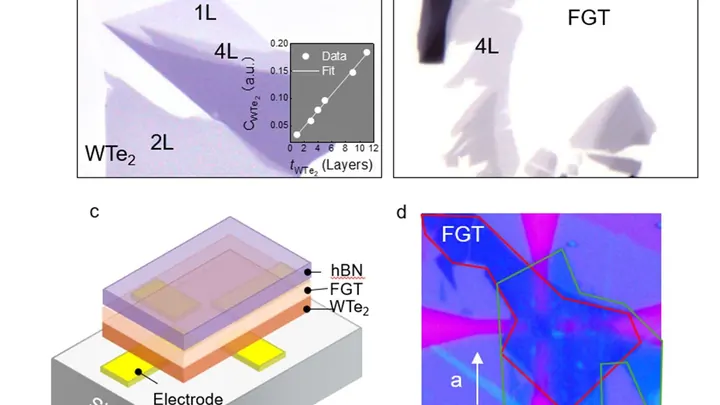
Usually, current in a metal acts like boiling water on ice: it heats the material and destroys magnetic order. But in a layered structure of tungsten ditelluride and the ferromagnet Fe3GeTe2, current behaves differently.
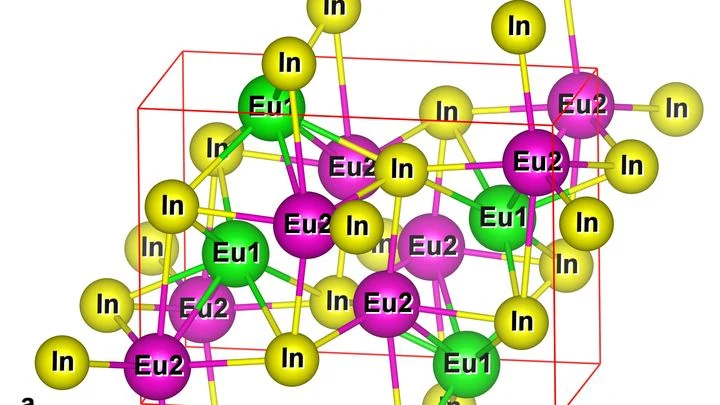
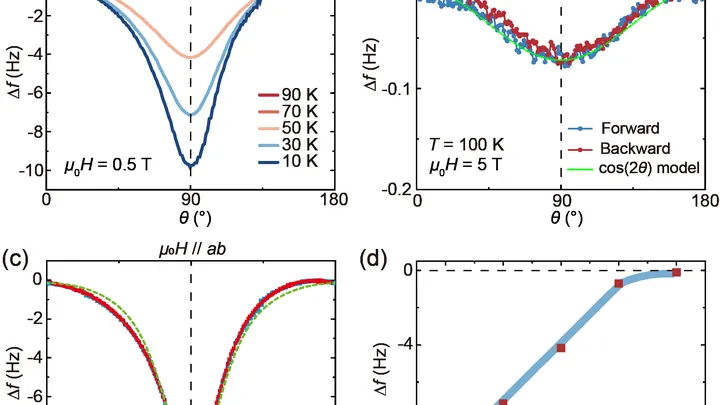
A piece of europium-indium alloy, when cooled in a magnetic field, behaves like water that does not freeze all at once but first in one corner of the glass, then in another.
A magnet, like a compass needle, likes to point in a certain direction. But what if the material is layered, like a stack of pancakes? Scientists took just such a magnet made from a compound of chromium, germanium, and tellurium and set out to find out how stubbornly it resists having its magnetization turned.
A branching network, like a river delta or a tree crown, is built on the principle of economy. The classic law, derived back in 1926, stated that the cube of the parent vessel's diameter equals the sum of the cubes of the daughter diameters. This rule worked beautifully for ideal tubes, but real arteries stubbornly gave a different exponent — around 2.7 instead of 3.
The authors of the new study found the reason.
A chunk of nuclear fuel inside a reactor is not just a solid. When heated, the uranium atoms in it start to 'wiggle' their magnetic moments, and this motion changes thermal conductivity and other properties.
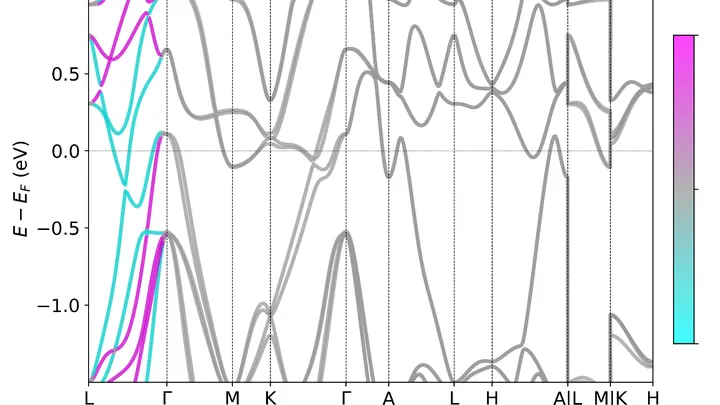
Electrons in a CrSb crystal behave like a school of fish: inside the material, they dart along their "corridors," and at the boundary with vacuum, they arrange themselves into intricate patterns. These patterns are the Fermi surface — a map of all allowed electron velocities. You can't reach out and touch it, but you can "feel" it with a magnetic field.
In layers of molybdenum telluride twisted at a specific angle, electrons behave unusually: they can split into parts. This is akin to a whole pie suddenly being cut into perfectly equal slices, even though there's only one knife. In ordinary materials, the electron's charge is indivisible, but in these layers, under strong cooling, states emerge where the charge splits into three parts.
Two metal plates in a perfect vacuum attract each other. Even Richard Feynman compared emptiness to a boiling foam: particle pairs are born and immediately vanish, creating the Casimir effect. If the plates are asymmetric, they also start to twist — that's a vacuum motor.
But rotation doesn't require oddly shaped parts.
The crystal was cooled to minus 228 degrees Celsius, and a pattern emerged on its surface, like frost on a window. But it's not moisture that draws it; it's the magnetic field: tiny iron particles suspended in a liquid settle on magnetized regions, revealing their location. That's the method the researchers used.
The pattern turned out to be two-tiered.
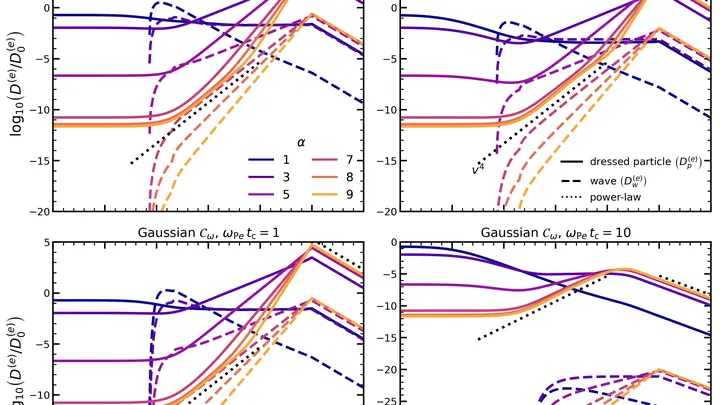
In a hot gas of charged particles — plasma — chaotic electric fields work like a sieve. A slow particle gets surrounded by a cloud of opposite charges, which cancels the external field. A fast one sheds this armor and gets accelerated.
In the TiSe2 crystal, electrons behave like compass needles that suddenly start pointing in the same direction. This is called a nematic state — by analogy with liquid crystals, where molecules align along a common direction even though the material itself remains liquid.
The tiny magnetic arrows inside a crystal of terbium-iridium oxide behave strangely: instead of lying along their preferred axis, they stand across it. This state fully forms when cooled to 1.5 Kelvin — colder than outer space.
Researchers probed the crystal with neutrons and observed how these flipped arrows oscillate and exchange energy.
Niobium diselenide is a layered material that conducts current without resistance at low temperatures. If you weave nickel atoms between its layers, like extra threads in a fabric, superconductivity vanishes.
Two translators listen to the same symphony. One hears only the fundamental tone: a clean, predictable melody. The other catches the overtones that color every note.
The temperature in a room drops by a few degrees while the refrigerator runs without a single moving compressor. Inside, there is no Freon, but a piece of metal that is alternately magnetized and demagnetized.