Laser, Magnet, and Wireless Current express
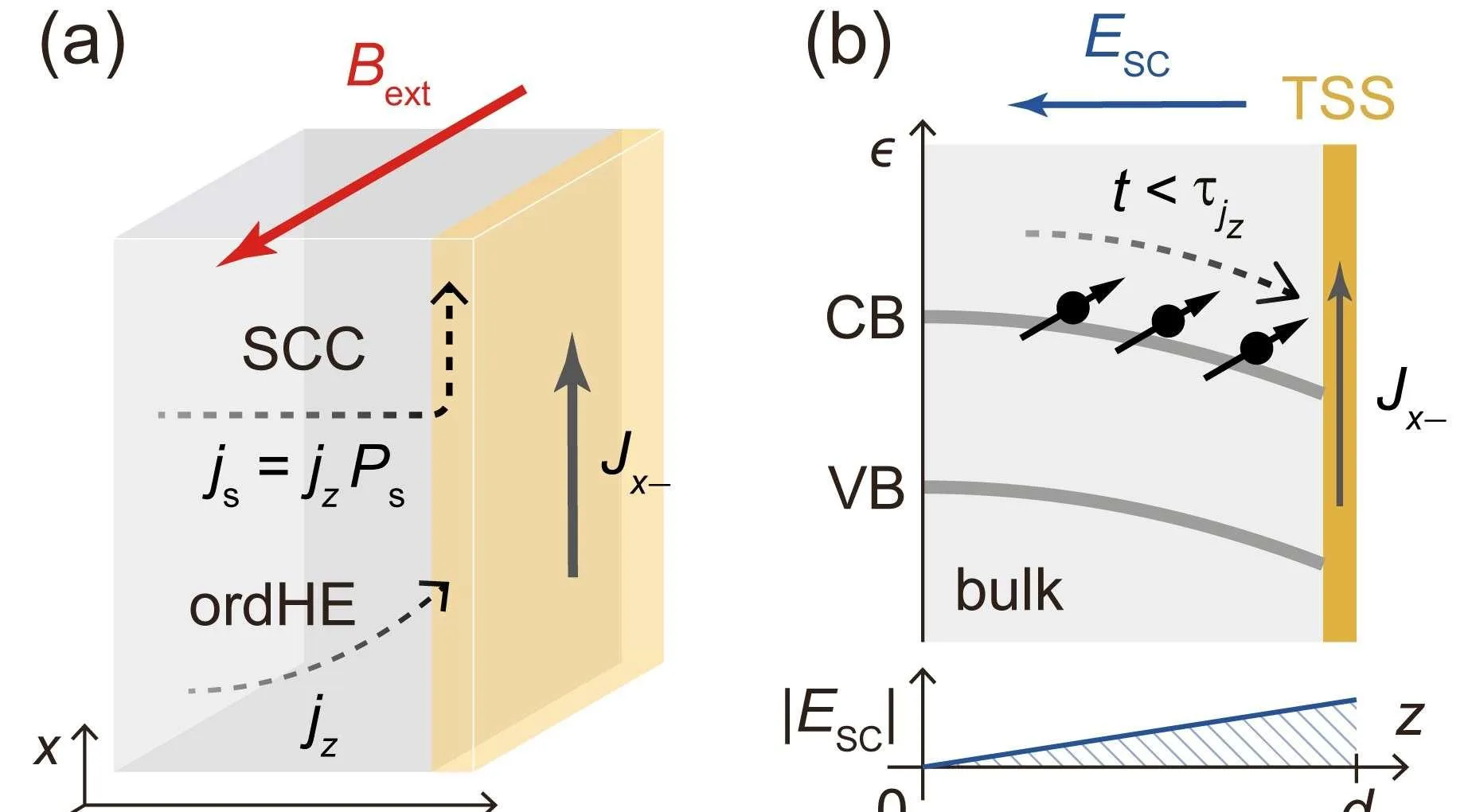
A thin film of a bismuth-selenium compound sits on a substrate. A laser pulse lasting a millionth of a billionth of a second strikes it. Nearby, a magnet is switched on, with a field weaker than that of a fridge magnet. And at that moment, an electric current spontaneously appears in the film, perpendicular to the magnetic field.
This current doesn't flow through wires: its birth is detected via a terahertz wave emitted from the sample. The stronger the magnetic field, the larger the current. This is how materials with topological surface states behave: on their surface, electrons move like on a highway, where the direction of motion is strictly linked to spin — the electron's intrinsic rotation.
When the laser pulse knocks electrons out of the film's depth, they fly to the surface. Those with spin 'up' accumulate at one edge, those with spin 'down' at the other. Due to the rigid spin-motion coupling, this charge separation turns into a current along the surface. The magnetic field controls how the spin rotates along the way, so the current grows with the field.
But adding just four percent indium to the material made the current drop sharply. Indium destroys those surface highways: electrons no longer stick to the surface, and the spin pumping vanishes. This confirms that the current is born on the surface, not in the film's bulk.
This approach (light, magnet, wave measurement) allows peering into spin-charge conversion without ever touching the sample. For future electronics, where information is carried not only by charge but also by spin, it's like an X-ray for materials: you can see where spin is lost and where it works properly.
The terahertz radiation emitted by the sample sits between infrared light and microwaves. It passes through paper, clothing, and plastic, but not through metal — which is why it's used in airport security scanners.