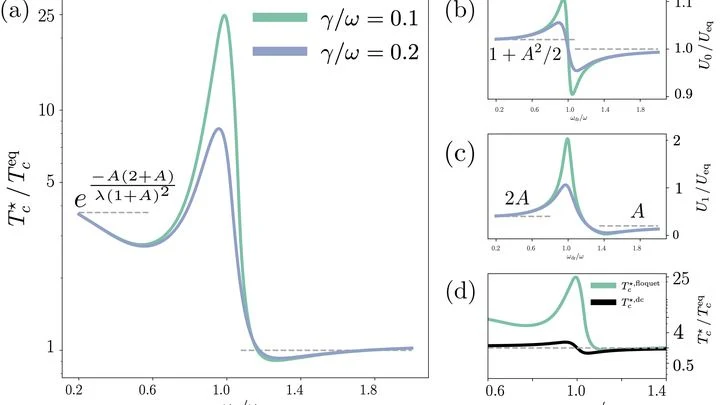
Light-induced superconductivity is a phenomenon where shining intense, ultrashort laser pulses onto certain materials temporarily turns them into superconductors — materials that conduct electricity with zero resistance. This is remarkable because it allows researchers to explore superconducting behavior in materials that do not superconduct under normal conditions, and sometimes even at temperatures far above their usual critical temperature. The effect is typically transient, lasting only picoseconds, but it provides a powerful tool to study the fundamental physics of superconductivity and potentially points toward new pathways for achieving room-temperature superconductivity.
History
The first clear demonstrations of light-induced superconductivity were reported in the 2010s, notably in experiments on cuprate materials by Andrea Cavalleri and colleagues at the Max Planck Institute for the Structure and Dynamics of Matter. The field builds on earlier work in ultrafast spectroscopy and the study of photoexcited states in condensed matter.
How it works
The mechanism involves light exciting the lattice vibrations (phonons) of the material, which in turn modifies the interactions between electrons. In some materials, this can strengthen the electron pairing that is responsible for superconductivity, or even induce pairing in materials where it does not naturally occur. The laser pulses create a non-equilibrium state where the electrons transiently form Cooper pairs, the bound electron pairs that carry supercurrent. This state persists only as long as the lattice remains excited, which is why the effect is short-lived.
In practice
While not yet directly applicable in technology, light-induced superconductivity is used in research to probe the mechanisms of high-temperature superconductivity and to test theoretical models of non-equilibrium quantum matter.
Fun fact
In some experiments, light-induced superconductivity has been observed at temperatures above 100 kelvin, which is much higher than the conventional superconducting transition temperature of many materials.
A thin film of neodymium nickelate, fifteen nanometers thick, sits on a neodymium gallate substrate. Below one hundred eighty kelvin it behaves as an insulator: electrons are locked inside their atomic cells and cannot move freely.
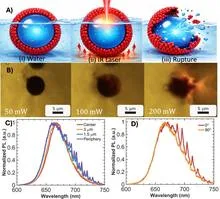
A tiny capsule, like a soap bubble but with a shell of glowing crystals, behaves like a laser. While its wall is intact, light circulates, amplifies, and escapes as a narrow, bright beam. Once the wall bursts, the beam turns into a dim spot. Such a capsule is a colloidosome, and it can change its glow on command.
A microwave oven heats food, but in the lab, microwaves have done something different: they turned a superconductor into a permanent magnet. A 300-nanometer-thick film of yttrium barium copper oxide, cooled to 80 kelvin, responded to 5-gigahertz radiation.
A superconducting detector usually works like an honest ruler: absorb a photon, get a pulse whose amplitude is strictly proportional to the energy. This mode is convenient, but it has a ceiling: a weak signal easily gets lost in the amplifier noise.
Now imagine a swing.
An empty dance floor where people occasionally appear. Each moves on their own, chaotically, with no connection to the others. But when the right music starts and the hall cools down a bit, the dancers suddenly begin to form long chains and move in unison. That's roughly how electrons behave in a dilute three-dimensional gas.
A light field, like a neat waffle iron, presses a regular pattern of bright and dark regions into space. Atoms get stuck in the brightest spots as if in tiny dimples: that's an optical lattice. It's a favorite tool for physicists who want to study quantum behavior of matter in its pure form.
Usually, light does not turn an insulator into a conductor: that requires powerful laser pulses that break the material's structure. But in twisted bilayer graphene at the magic angle, things are different.
In superconductors, electrons pair up and flow without resistance. Usually, these pairs are distributed uniformly, like water in a calm lake. But sometimes ripples appear in the material — pairs bunch up and thin out with a certain period. This state is called superconductivity with pair-density waves.
Organic light-emitting materials are like a busy intersection without traffic lights. Molecules receive energy but, instead of honestly giving it back as light, they often turn into dead ends: they form dark pairs (exciplexes — short-lived complexes that do not emit) or collide with each other, losing charge.
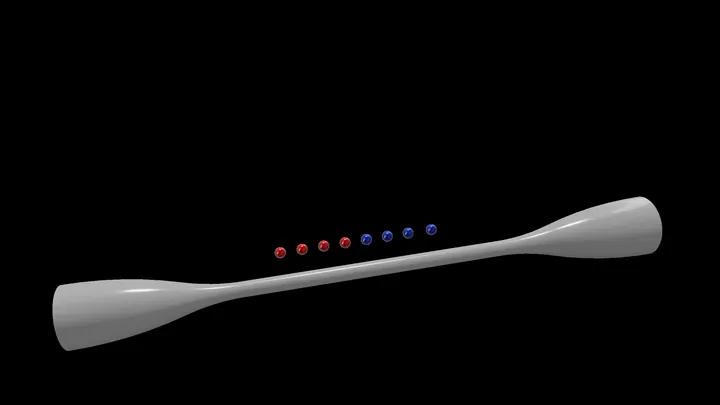
An orchestra without a conductor, where musicians hear each other through a shared wall. That's roughly how the new type of laser works: a few atoms (emitters) sit along a waveguide — a thin track for light on a chip. Light from each atom runs along this track and affects its neighbors.
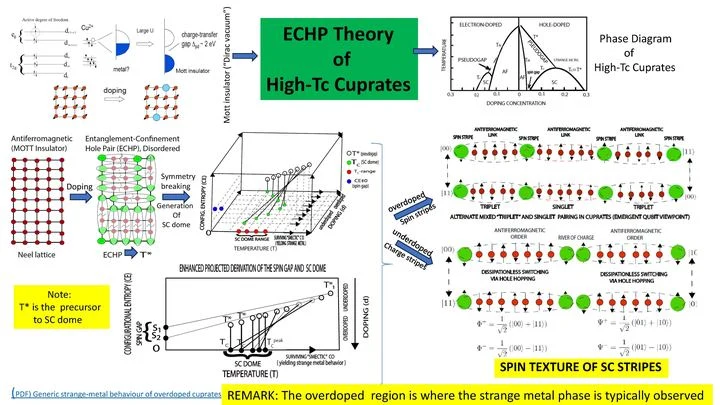
Superconductivity is often pictured as a frozen dance of electrons: they pair up and move without resistance, like figure skaters on perfect ice. But in high-temperature superconductors, that ice turns out to be not so smooth.
Graphene, a two-dimensional carbon crystal, has long tantalized physicists with the hope of high-temperature superconductivity. Its electrons obey the relativistic equation of Paul Dirac, racing at tremendous speed, barely noticing each other.
In some materials, electric current can flow without any loss: this is superconductivity. But before becoming a superconductor, a substance often passes through a strange state: electrons already sense each other and form pairs, yet they cannot move in unison.
A regular rangefinder sends a single light pulse and waits for it to return — like a person shouting into the void and listening for an echo. But if you use multiple sources that glow in unison, and analyze not the volume but the rhythm of the echo of reflected flashes, the picture becomes sharper.
An ordinary diode in electronics works like a one-way street: current flows in only one direction. In superconductors, where electricity flows without resistance, such behavior has long been elusive — current is usually symmetric.
The authors of the new work found a way to create a perfect superconducting diode using light.
Light leaves a trace even when there is almost none of it. A single photon, a tiny bundle of energy, strikes a silicon wafer and knocks out a handful of electrons. The trouble is that the handful is too small to notice. You need an amplifier.
Usually, the signal is amplified by applying a voltage to metal contacts on the detector's surface.
The light bulb turns on only in the room where you need it. That's roughly how photoactivatable drugs work: they 'switch on' only where light is directed, leaving the rest of the body untouched. This is especially important in cancer treatment: conventional chemotherapy hits all dividing cells indiscriminately, causing severe side effects.
A laser hits a target of thin wires, and within tens of femtoseconds (billionths of a billionth of a second) knocks out a stream of protons. These protons fly into a converter made of lithium and deuterium, where neutrons are born.
A conventional laser is like an orchestra where musicians must warm up before playing in unison. You first need to pump enough atoms with energy so they 'flip' and are ready to emit light: this is called population inversion. Only then does the beam flash. A polariton laser plays by different rules: its 'musicians'—a mix of light and matter — join in almost without preparation.
An ordinary kitchen knife made of niobium would suddenly start conducting electricity with zero loss at −258 °C. That's how superconductivity works, and you can "switch it on" right at the metal's surface by blasting it with a laser in a nitrogen atmosphere.
A copper wire hit by a laser is like a kitchen where the chef turns on the stove and watches the stopwatch at the same time. Copper atoms start to dance, losing the order of the crystal lattice, while electrons, like waiters in the dining room, instantly feel the change. But how much disorder do they need to notice?
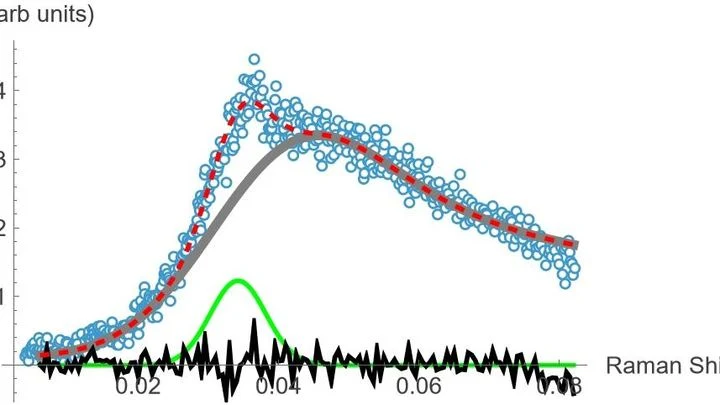
In a dark room, an infrared laser flashes, and a speck of black K3C60 powder conducts electricity without resistance for a split second. The light strikes at 10 terahertz — a thousand times faster than a microwave oven. The effect is a hundred times stronger than at other frequencies. Why this particular frequency?
Imagine a tap that doesn't pour a stream but releases water strictly one drop at a time: that's the single-photon source the authors describe. In ordinary light, photons travel in a crowd, like water from an open tap.
A sheet of graphene is a mesh of carbon atoms one atom thick. Even the slightest contamination shows up on it, like dust specks on eyeglass lenses. Ten years ago, researchers learned to hide graphene between layers of boron nitride, like placing a fragile sheet between two pieces of plastic wrap.
A laser flash lasting 50 femtoseconds is like a shot that lasts one billionth of a second. In that time, light travels only 15 micrometers — less than the thickness of a human hair. But if you send such a flash through an amplifier, it starts to stretch like a rubber band and loses its sharpness.
Electric current in a superconductor is like a crowd running down a frictionless corridor. But in type-II superconductors there are obstacles, tiny vortices of magnetic field, that the current shoves out of place. Once a vortex moves, resistance appears and the current drops.
A tiny laser beam touches a crystal for an instant, and inside, as if by magic, single quantum sparkles light up. This is no trick but a new way to create qubits, the working cells of future quantum computers. The material is silicon carbide, the same one already used in power electronics and LEDs.
Ordinary computer memory constantly uses energy to store ones and zeros. Superconductors, on the other hand, carry current with zero loss — if you could build memory from them, it would barely draw any power. The catch is that superconductors can't remember: their state changes too easily.
Uranium ditelluride crystals turned out to be the exception.
A sheet of graphene is a lattice of carbon atoms arranged like a honeycomb. Electrons in it zip around so fast they seem to have no mass, just like light. When a powerful laser pulse hits such a sheet, the electrons get a kick and start accelerating. Their path can be compared to a road with occasional barriers — the forbidden zones.
An ordinary superconductor works only in nature's freezer — at temperatures below minus one hundred degrees. The carbon-ball material K₃C₆₀ is no exception: without cold, it resists current like a crowd in a narrow corridor. But physicists noticed something strange: if you shine a laser on it, it starts conducting without loss even in warmth.
Empty space is never truly still. It teems with tiny energy fluctuations, like a sculptor's raw clay. In a new experiment, a thin film of superconducting material was placed inside a cavity designed to trap terahertz light, a form of invisible radiation. The cavity acted as a mold, shaping the vacuum fluctuations around the film.
In a conventional superconductor, electrons team up into pairs that stay put: their total momentum is zero. But sometimes it's different: pairs gain a shared momentum and start moving, like a school of fish swimming against the current. This state is called a pair density wave, and it's very finicky: it needs special conditions.
A thin film of a bismuth-selenium compound sits on a substrate. A laser pulse lasting a millionth of a billionth of a second strikes it. Nearby, a magnet is switched on, with a field weaker than that of a fridge magnet.
Superfluorescence is a crystal’s synchronized exhale of light. Researchers just witnessed its mirror image: superabsorption, a coordinated inhale. They zapped cheap perovskite nanocrystals with laser pulses (spectroscopy) and saw a time-reversed absorption burst.