How Young Stars' Rotation Destroys Their Magnetic Field express
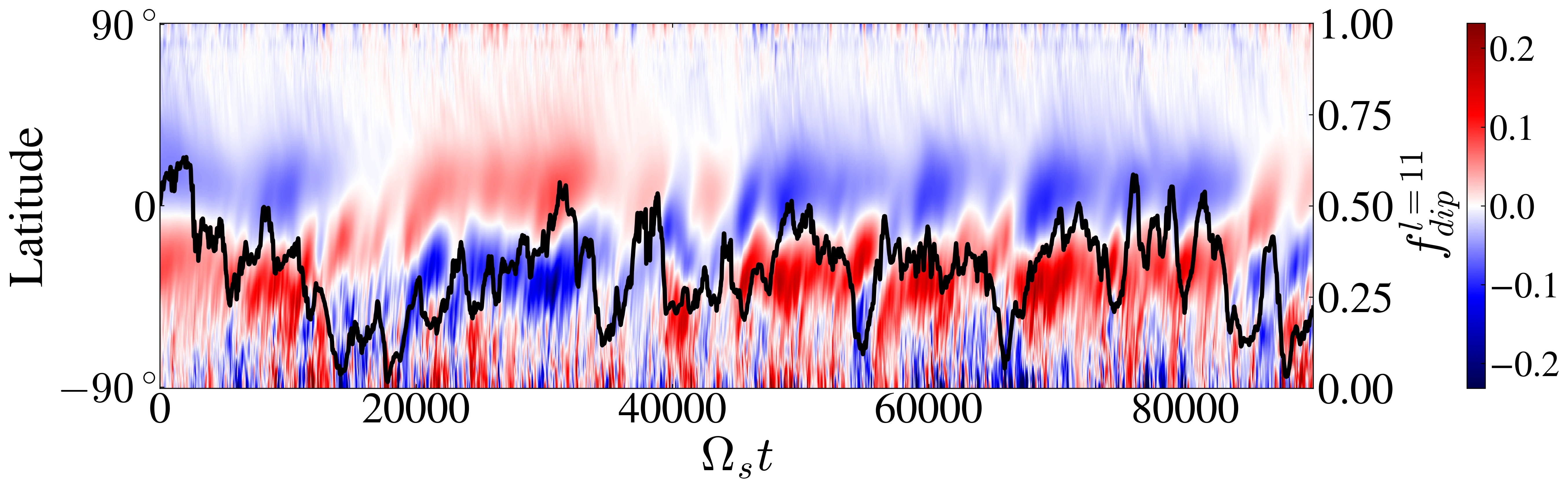
A young star is like a layered spinning top: its outer layers rotate slower, its inner ones faster. The magnetic field here acts like sturdy threads binding these layers together. When the speeds differ, the threads begin to twist and stretch more and more. Eventually they snap, and the simple dipolar field (like that of a bar magnet) is destroyed, replaced by a weak, chaotic one.
That's exactly what happens inside stars, mostly made of hydrogen and helium. Analysis of their light (spectroscopy) confirms the fields are chaotic and unstable. The paradox: fast rotation, which should strengthen the magnet, actually breaks it.
For sun-like stars, this link between spin rate and magnetic chaos is a key to their past: from the current field, we can deduce how fast the star spun in its youth.
Original abstract
as written by the authors arXiv:2601.05980v1
Despite progress in the observations of stellar magnetic fields, their physical mechanisms remain poorly understood. During the pre-main sequence (PMS) phase, the inner layers of stars contract and a radiative core gradually develops. In contrast, the convective envelope is gradually braked through magnetic interactions with the accretion disk and winds. With developing differential rotation inside the star, PMS phase is thus a critical period for magnetic properties of stars when strong initial dipoles can get perturbed, leading to the observed diversity in the magnetism on the main sequence (MS). In this work, we study the impact of differential rotation on such fields. We perform three-dimensional anelastic convective dynamo simulations of rotating spherical shells with an imposed differential rotation (shear) between the boundaries. Density, gravity profiles and convective zone thicknesses were set close to those predicted in PMS low-mass stars by one-dimensional stellar evolution code Cesam2k20. Our results show that radial differential rotation can induce dipole collapse leading to weaker, oscillatory magnetic fields. Differential rotation seems to perturb $$\alpha^2$$ dynamo mechanism, responsible for dipolar magnetic fields, by shearing poloidal field lines and by affecting turbulent magnetic transport processes. This collapse is moderated by the relative importance of shear compared to the vigor of convective motions, with exact stability criterion depending on the field strength and the size of the radiative core. Applying DNS-based stability criterion in PMS stellar evolution models, we qualitatively reproduce the trends observed in the magnetic topologies of low-mass stars when assuming an efficient internal angular momentum redistribution. This suggests that stellar magnetic properties are intimately related to the PMS angular momentum evolution.
The Sun flips its magnetic field every 11 years, like a giant switch. But for many stars, internal twisting disrupts this cycle, and the field leads its own unpredictable life.