Binary star dynamics is the study of how two stars orbit each other under gravity, and how that orbital dance shapes their evolution, their surroundings, and even the fate of any planets they host. Most stars in the Milky Way are in binary or multiple systems, so understanding these interactions is essential for explaining phenomena like stellar mergers, X-ray binaries, and the production of gravitational waves. The gravitational pull of a companion can distort a star's shape, drive mass transfer, and dramatically alter the star's rotation and magnetic activity.
History
The study began with William Herschel's discovery of binary stars in 1802, and the first orbit calculation was done by Félix Savary in 1827. Modern understanding of mass transfer and Roche lobe overflow was developed in the 1960s by researchers like Bohdan Paczyński.
How it works
The dynamics are governed by Newtonian gravity, with corrections from general relativity when the stars are compact or close. The two stars orbit their common center of mass, and their mutual tides can synchronize rotation and circularize the orbit over time. When a third body — like a planet — is present, the binary's gravitational perturbations can excite eccentricity in the planet's orbit, sometimes ejecting it entirely. In close binaries, one star can overflow its Roche lobe, spilling gas onto the companion, which can ignite nova eruptions or, if the accretor is a neutron star or black hole, produce bright X-ray emission.
In practice
Binary star dynamics is used to detect exoplanets in binary systems, to predict gravitational wave sources for detectors like LIGO, and to calibrate stellar evolution models by measuring precise masses and radii.
Fun fact
In a binary system, a planet can be ejected at speeds exceeding the escape velocity of the galaxy, becoming a free-floating 'rogue planet' that wanders interstellar space.
A galaxy is like a city: bright lights and dense buildings at the center, sparse lights and emptiness toward the outskirts. But if you watch how gas rotates in a galaxy's disk, you see that its speed barely drops at the edges. As if invisible neighborhoods keep the motion going. Astronomers have found a way to map this invisible city.
Two figure skaters on a lake frozen to the horizon. They are so far apart that their silhouettes turn into dots, and their mutual attraction becomes almost an article of faith. By Newton's law, they should circle in an unimaginably slow waltz. But telescopes see otherwise.
A quarter-century ago, Michel Mayor and Didier Queloz discovered the first hot Jupiter, and shattered all the rules of planet formation. A gas giant on a days-long orbit couldn't have formed next to the star: it's far too hot and lacks building material. So, it must have been born far away and then migrated.
When two neutron stars circle each other, they don't remain rigid spheres. The partner's gravity stretches each star, creating tidal bulges — much like the Moon raises ocean tides on Earth. But unlike water, here it's superdense matter that deforms: a teaspoon of this stuff weighs billions of tons.
Drop a pebble into a pond — ripples spread across the water. In much the same way, a massive body circling a black hole perturbs the fabric of spacetime, generating gravitational waves. But what if the pond itself isn't flat, but has hidden folds — extra dimensions invisible to the eye?
Two black holes smash head-on at full speed — while a third one circles nearby. In ordinary life, such a crash would produce a burst of gravitational waves (ripples in space, like the ripples from a stone thrown into a pond). But here, part of the ripple passes by the massive neighbor, and changes, like light in a funhouse mirror.
A galaxy is like a cosmic highway where stars, like cars, race along circular orbits. Their speed is set by the invisible "cargo" of mass enclosed within the orbit: the more massive the central region, the faster the stars at the periphery.
Strike a bell, and it hums at a single pitch. But if you place a second clapper inside, and they ring without touching each other, the sound becomes more complex. That's roughly how the neutron star from the new study is built. It's not just a hot sphere: inside, two immiscible fluids can flow — for instance, superfluid neutrons and ordinary plasma.
A lighthouse blinks every few seconds, but then begins to slowly brighten and dim over the course of a year. That is exactly what about a third of red giants do — huge stars in the late stages of life. Their normal pulsations take days or weeks, but on top of that, long secondary periods are visible: months and years.
Stars on the outskirts of galaxies rotate unexpectedly fast. According to Newton, the farther from the center, the slower the motion should be, like in a round dance, where the outer dancers move more slowly. But in reality, stellar outskirts race along almost as fast as the core, resembling a giant carousel: on it, the outer horses fly faster so as not to fall behind the inner ones.
Two dim stars whirl so close together that one siphons material off the other, like a spoon delicately skimming foam from broth. Astronomers have for the first time calculated the fate of such pairs — ultracool and brown dwarfs, the coldest and dimmest inhabitants of the galaxy. Previously, it was thought that mass exchange between them was impossible: they were too fragile.
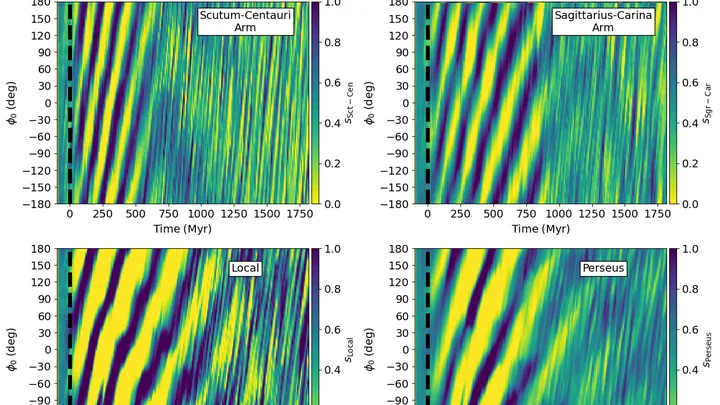
The Sagittarius galaxy plunged into the disk of the Milky Way and passed through again and again, like a stone thrown into a still pond. Each strike left ripples: waves and warps in the star field.
A giant planet circles too close to its star. With each orbit, it tugs on the star with its gravity, and waves are born deep inside the star, like ripples from a stone dropped into water. These waves damp the planet's orbit, and it spirals into the star. The star swallows the planet and starts spinning faster.
Stellar rotation is the key clue.
Two stars orbit so closely that their outer layers merge into a shared envelope. Matter flows from one to the other, like water spilling from an overfull cup into its neighbor. In this cosmic dance, where stars literally touch each other, astronomers have for the first time detected magnetic fields in large numbers.
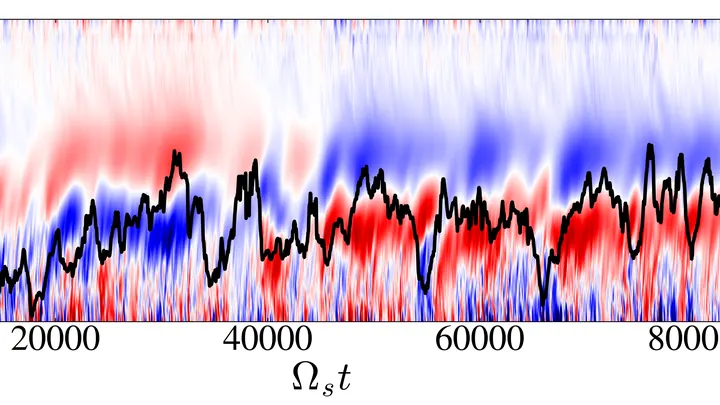
A young star is like a layered spinning top: its outer layers rotate slower, its inner ones faster. The magnetic field here acts like sturdy threads binding these layers together. When the speeds differ, the threads begin to twist and stretch more and more.