Icy Visitor from Another System express
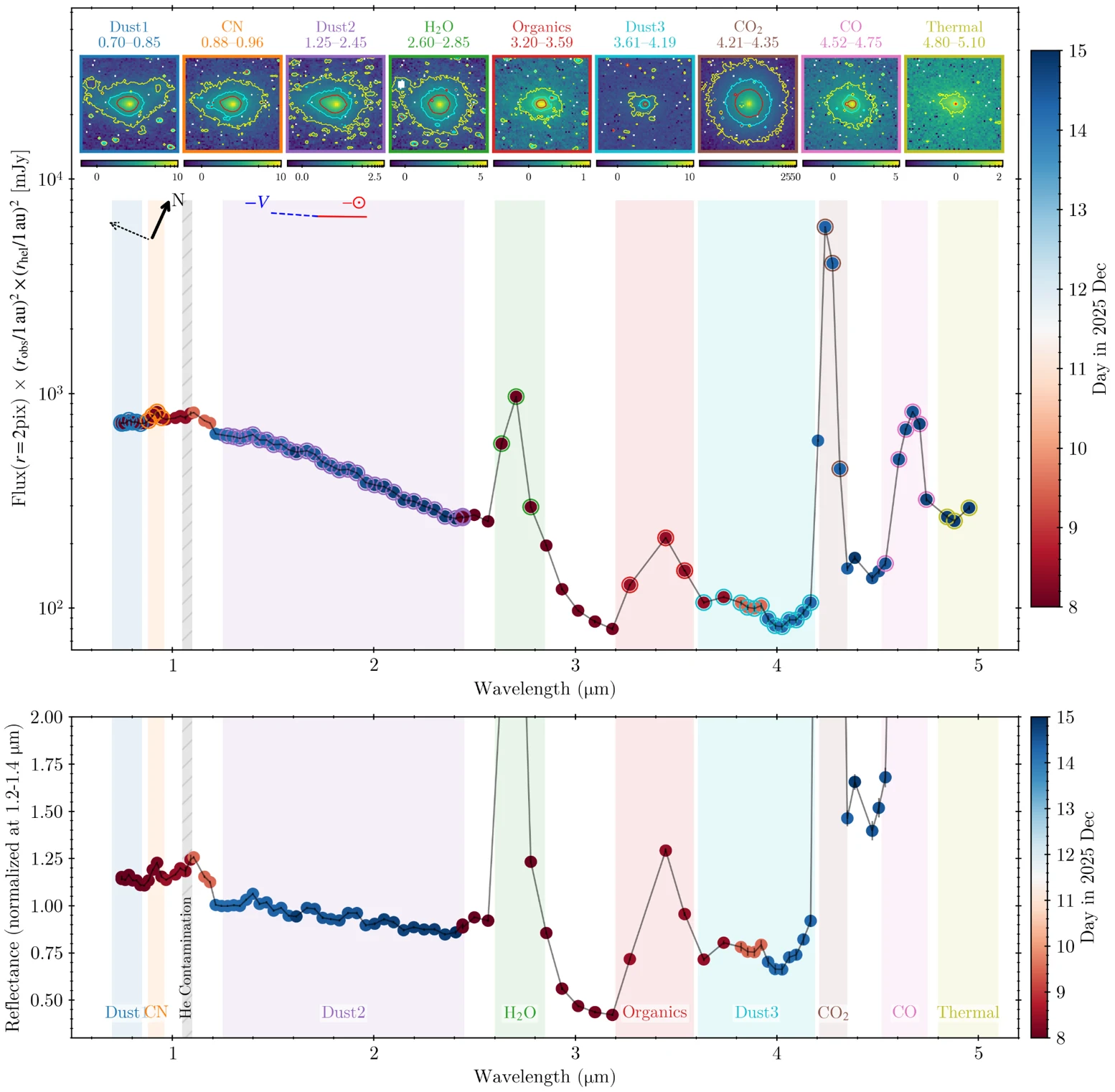
In December 2025, the SPHEREx telescope, using spectroscopy (breaking light into chemical 'fingerprints'), re-examined object ISO 3I/ATLAS — a wanderer from another star system. Under the rays of the Sun, it behaved like a 'dirty snowball': frozen gases vigorously evaporated, and clouds of water vapor, carbon dioxide, and cosmic dust formed around it.
The water vapor became 40 times brighter, the icy crust melted away, exposing hidden carbon compounds — from carbon monoxide to complex molecules like CN, precursors to amino acids. But the main surprise was the shape of the gas clouds: they didn't stretch into a tail but remained nearly round, as if the object had wrapped itself in a symmetrical cocoon. This pointed to the presence of unusual carbon-rich layers beneath the ice.
It's now clear: interstellar drifters may not be just icy chunks, but carriers of organics, just as Fred Whipple, the creator of the 'dirty snowball' theory, had suggested.
Original abstract
as written by the authors arXiv:2601.06759v2
In December-2025, the NASA SPHEREx spacecraft re-observed ISO 3I/ATLAS post-perihelion, finding a much more active object compared to August-2025 SPHEREx pre-perihelion observations, with marked evidence for development into an cometary body fully sublimating all its ices. The new imaging spectrophotometry was dominated by spatially resolved features due to light scattered by dust, along with thermal emission, plus gas-line emissions from CN (0.93 um), H2O (2.7 um), organic C-H (3.2 to 3.6 um), CO2 (4.25 to 4.27 um), and CO (4.6 to 4.8 um). The CO2 gas-coma continues to be extended out to a 3 arcmin radius. The continuum spectral signature of H2O-ice absorption had mostly disappeared, replaced by scattered-light plus thermal-emission from organo-silicaceous dust grains while the H2O gas-emission is 40x times brighter. The CO- and CO2-gas comae were circularly symmetric, while the other comae appear morphologically similar to the dust-coma with its pear-shaped, solar-pointing, large icy dust grains dust tail. The new appearance of CN and C-H features suggests that these carbon-rich ice species were contained either in H2O phases or were trapped under them.
ISO 3I/ATLAS is one of only two known interstellar visitors to date (the first being 'Oumuamua).
Sci-fi writers have long sent ships and asteroids on interstellar journeys, like in Arthur C. Clarke's 'Rendezvous with Rama.' But the real object turned out far dirtier and chemically richer than any fiction.