Sublimation is the phase transition in which a substance goes directly from a solid to a gas without passing through a liquidstate. In astrophysics, this process is crucial for understanding cometary activity: when a comet approaches the Sun, its icy nucleus warms, and volatile ices such as water, carbon dioxide, and carbon monoxide sublimate, releasing gas and dust that form the coma and tail. This process also affects the surfaces of asteroids, the evolution of planetary atmospheres, and the behavior of ices in interstellar clouds.
History
The term 'sublimation' has been used since alchemical times, but its modern scientific understanding was established in the 19th century with the development of thermodynamics. In cometary science, the role of sublimation was recognized in the early 20th century, notably by Fred Whipple in his 1950 'dirty snowball' model, which explained cometary activity as the sublimation of volatile ices.
How it works
At the molecular level, sublimation occurs when the vapor pressure of a solid exceeds the ambient pressure at a given temperature. In a vacuum or low-pressure environment, even at low temperatures, molecules at the surface can gain enough kinetic energy to escape directly into the gas phase. The rate of sublimation depends on temperature, surface area, and the binding energy of the molecules. In comets, solar radiationheats the surface, driving sublimation that shapes the nucleus and ejects material into space.
In practice
Sublimation is used in freeze-drying (lyophilization) to preserve food and pharmaceuticals, and in the production of certain materials like iodine crystals. In space research, understanding sublimation is essential for designing spacecraft thermal protection and predicting the lifetimes of icy bodies.
Fun fact
On Mars, both water ice and carbon dioxide ice sublimate directly into the thin atmosphere, creating features like 'spiders' (araneiform terrain) when the gas escapes from beneath the surface in spring.
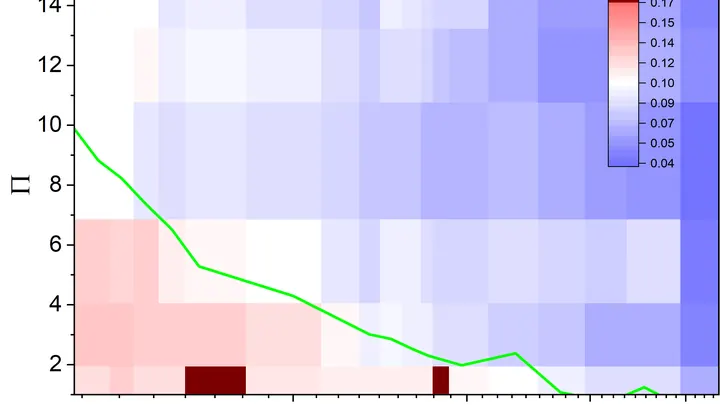
In the dark chamber of the trap, thousands of charged particles dance under electric fields. At first they move freely, like a crowd in a square, but cool the cloud and the dance slows: ions begin to sense each other, their steps become constrained.
In the furnace of star formation, the heat reaches 900 degrees Celsius, like a glowing blast furnace. It is in this hellish heat that cosmic crystals are born. Astronomers have for the first time caught the moment when crystalline dust appears right during an accretion flare (when the star gobbles up surrounding gas) at the very young star EC 53, still cocooned in dense gas.
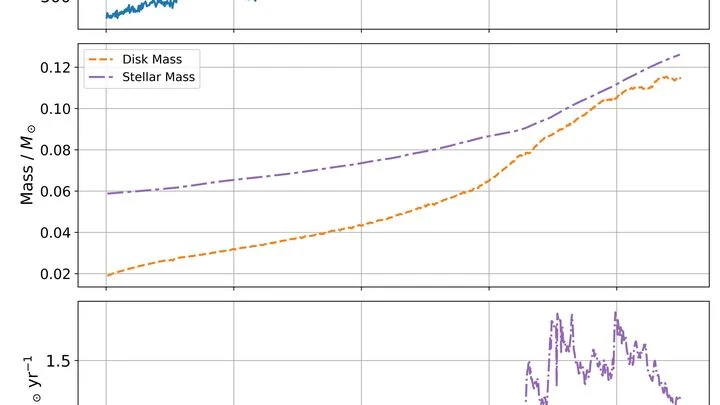
The star AB Aur is young, about 4 million years old. Around it swirls a dense disk of gas and dust. Recently, a long gas stream, a flow of material from the surrounding cloud, crashed into it.
Quantum matter rarely treats us to the spectacle of self-motion. Where the classical world teems with starling murmurations, fish schools, and bustling bacteria, quantum thermodynamics long remained serene.
Using the JWST space telescope, astronomers conducted a chemical analysis of the centaur Chiron, an icy body from the fringes of the Solar System. It turns out its gas activity resembles a layered cake. Carbon dioxide evaporates from the surface, forming a top crust.
An old chest of family heirlooms opens, and inside lie jewels that were thought to be as old as great-grandmother. But suddenly it turns out: the gold was remelted, the stones were recut, and this happened much later than thought. A similar story happened to the oldest particles in meteorites — calcium-aluminum inclusions, or CAIs.
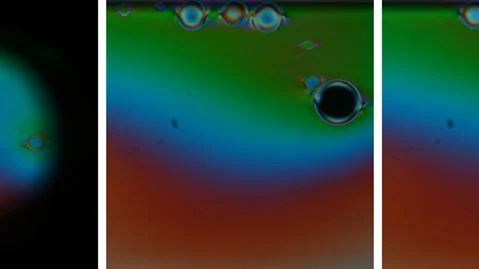
Molecules in a solution behave like a crowd in a square: they can jostle randomly or line up in neat rows. An aqueous solution of disodium cromoglycate is a well-known model for chromonic liquid crystals, where such 'rows' form spontaneously. But if you shine ultraviolet light on the solution, order collapses: molecules start breaking apart.
A crystal of calcium ions in a trap, illuminated by a laser, is a tiny model of the matter inside a white dwarf. There, in the depths of a dying star, atomic nuclei arrange into a rigid lattice as the temperature drops.
Vanadium oxide is a material that can act as an insulator, not conducting electricity, or as a conductor, like a metal. The switch takes trillionths of a second, and that's what makes it a candidate for ultrafast electronic devices.
But exactly how it happens has long been a mystery.
A thin stream of water flows down a cold inclined board and, before your eyes, turns into an ice ridge. At first, the water paves itself a straight icy path, as if reinforcing its own banks. Then the trickle starts to meander, and the ice quickly spreads sideways. Finally, the ridge stops growing outward and begins to thicken, smoothing out irregularities.
The second interstellar guest, comet 3I/ATLAS, shines unusually due to rusting metal grains in its icy core. As it gets closer to the Sun, it behaves like an old tin can tossed into a fire: the heat melts the ice, water seeps into the metal, and vigorous corrosion begins.