Space is Colder Than We Hoped express
Any device, from a toaster to a smartphone, heats up when operating. This is the inevitable result of energy conversion — there's always a heat trace left, like a hot stove burner after cooking. The law of entropy applies to galaxies too: if advanced civilizations live there, reprocessing the light of entire stars, they should 'glow' with infrared heat — like a kitchen where something is stewing around the clock.
Astronomers pointed the heat-sensing WISE telescope at thousands of neighboring galaxies. Using photometry — measuring brightness in different shades of thermal radiation — they compared the actual glow with what ordinary old stars produce. Natural 'hot spots', like dust around black holes, were excluded in advance. The result: not a single galaxy showed a clear excess.
The strict conclusion: no more than 0.016% of nearby galaxies can contain civilizations that turn at least a fifth of starlight into heat. The universe seems suspiciously cool, like a kitchen after the residents have moved out, leaving us in solitude.
Original abstract
as written by the authors arXiv:2601.07297v2
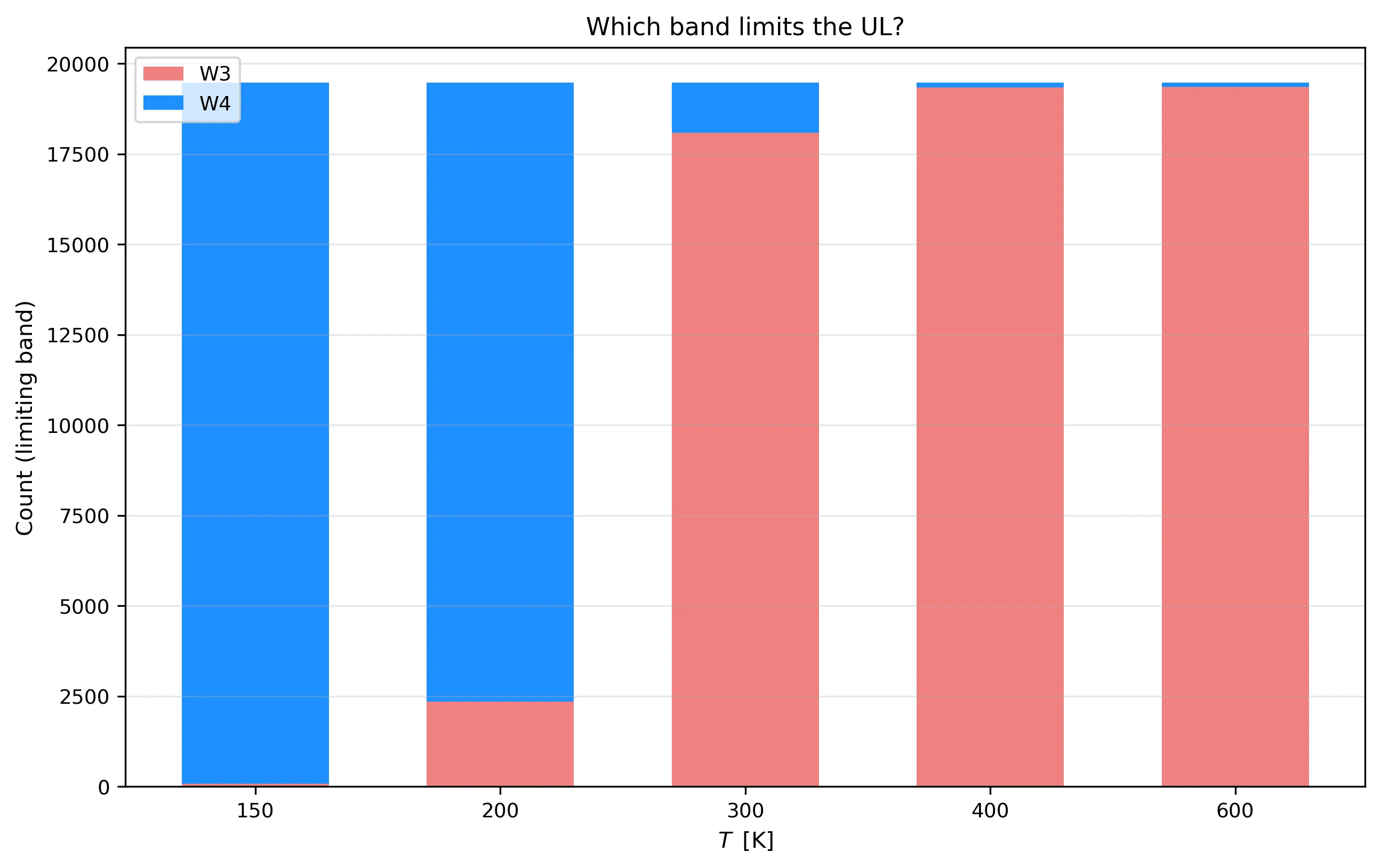
We search for galaxy-scale (Dysonian) waste heat in the mid-infrared using WISE. Starting from the 2MASS Redshift Survey (2MRS), we cross-match to CatWISE2020 and AllWISE, apply standard MIR AGN/starburst vetoes (Stern, Assef R90, Jarrett), and treat W1 and W2 as stellar baselines and W3 and W4 as constraining bands. For each galaxy and for blackbody waste heat temperatures T=150-600 K, we convert W3/W4 photometry into conservative 3-sigma per-galaxy upper limits on the bolometric waste heat luminosity using the WISE bandpass (RSR) color correction. The resulting distributions have median caps of ~(5-9) x 10^8 L_sun across T=150-600 K. Aggregated at the population level, the one-sided 95% upper bound on the fraction of nearby galaxies that could host waste heat above a given threshold monotonically decreases with threshold and asymptotes to ~1/6500 at high thresholds (set by the sample size). Sensitivity transitions from W4 at T <= 200K to W3 at T >= 300K. Interpreted with the AGENT formalism, a fiducial Milky Way like stellar luminosity L_=3 x 10^10 L_sun implies typical per galaxy caps of alpha = L_wh/L_ <= 1.7-2.9% over T=150-600 K (e.g., alpha <= 1.8% at T=300 K). At T ~= 300K, no more than f_95 ~= 1.61 x 10^-4 (~= 0.0161%) of nearby galaxies can host KIII-scale systems reprocessing >= 21% of a Milky Way-like stellar luminosity into ~ 300K waste heat.
The temperature of 300 Kelvin they were looking for is a comfortable 27°C. Remarkably, the human body radiates about as much heat as a 100-watt light bulb. From a galactic civilization, however, they expected a glow hundreds of trillions of times more powerful.
The search for engineering structures of alien races is a popular sci-fi plot. For example, in Ivan Efremov's novel 'Andromeda Nebula', the characters find a vanished civilization by its residual radiation.