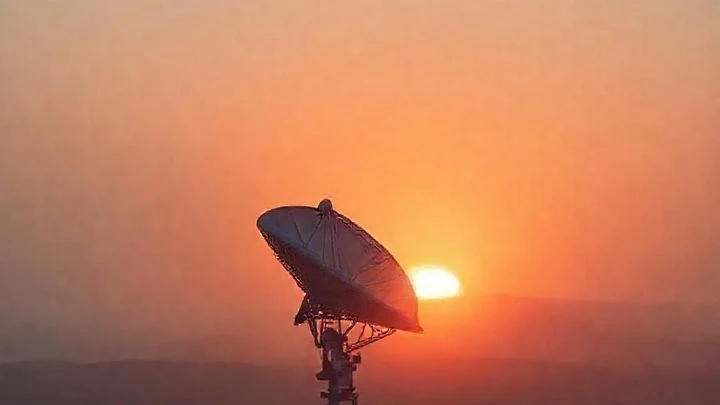
Thermal radiation is electromagnetic radiation emitted by any object because of its temperature. Every piece of matter with a temperature above absolute zero emits this radiation, from the glowing filament of a light bulb to the faint infrared glow of your own body. The spectrum and intensity of this radiation depend strongly on temperature: hotter objects emit more radiation and shift their peak emission to shorter wavelengths, which is why a heated piece of metal first glows red, then yellow, and eventually white-hot.
History
The theoretical foundation was laid by Max Planck in 1900, when he introduced the concept of energy quantization to explain the observed spectrum of black-body radiation, marking the birth of quantum mechanics.
How it works
At the microscopic level, thermal radiation arises from the random thermal motion of charged particles, typically electrons, within the material. As these particles accelerate and decelerate due to thermal agitation, they produce fluctuating electromagnetic fields that propagate away from the surface as photons. The statistical properties of this emission are described by Planck's law, which gives the exact spectral distribution of radiation from an idealized 'black body' — a perfect absorber and emitter. For real objects, the emission is modified by a factor called emissivity, which depends on the material's surface properties.
In practice
Thermal radiation is used in infrared thermometers and thermal imaging cameras for non-contact temperature measurement, in night-vision devices, and in the design of spacecraft thermal control systems that manage heat through radiative surfaces.
Fun fact
The cosmic microwave background radiation, which fills the entire universe, is thermal radiation with a temperature of 2.725 Kelvin, a relic of the hot early universe.
The blue glow in water around a nuclear reactor is light born when a charged particle outruns light in that medium. The effect was discovered by Pavel Cherenkov in 1934, with the theory provided by Igor Tamm and Ilya Frank.
In a distant galaxy, light from hot gas should reveal its composition. The James Webb Telescope split that light into a spectrum, and astronomers saw: oxygen lines too weak.
In the layered crystal CrSBr, the magnetic moments of atoms are arranged like notes in a score: within each layer they point in the same direction, but between layers they point in opposite directions. This antiferromagnetic melody plays up to 132 kelvin, beyond which thermal motion destroys the order.
A laser beam strikes a thin target hidden inside layers of another material. Within billionths of a second, the material is compressed to a density of 25 grams per cubic centimeter, as if a piece of lead became more than twice as heavy without moving an inch.
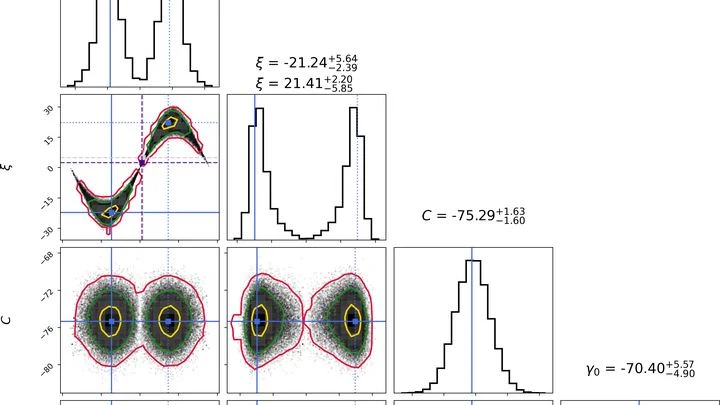
The universe is like a vast invisible scaffold. We don't see it directly, but we know it's there: galaxies and clusters hold together thanks to it. This scaffold is dark matter. The most popular version says it is "cold," made of heavy, slow-moving particles.
Dark matter is the invisible scaffold that holds galaxies together. But how did it come to be? The standard answer: particles of dark matter once stopped colliding and "froze out" in the amount we see today. However, there's a trickier path — UFO, or ultra-fast freeze-out.
Here, everything is like coffee that cools down and then heats up again as you carry it through a cold corridor.
Dark matter detectors are essentially incredibly sensitive microphones, capable of hearing a whisper amid the roar of a rock concert. Their job is to catch the rare nudges from hypothetical dark matter particles, which are thought to occasionally collide with atomic nuclei of ordinary matter.
The Sun is a boiling cauldron of hydrogen and helium, where scorching gas is caught in magnetic snares. When invisible ropes reconnect, energy comparable to billions of thermonuclear explosions is released. Where does it go?
When an electric charge moves with acceleration, it emits electromagnetic radiation, i.e., light — a familiar phenomenon in physics. However, researchers have found that when moving along a specially chosen trajectory, the radiation acquires unusual properties.
A regular rangefinder sends a single light pulse and waits for it to return — like a person shouting into the void and listening for an echo. But if you use multiple sources that glow in unison, and analyze not the volume but the rhythm of the echo of reflected flashes, the picture becomes sharper.
At the edge of the solar system, far beyond Neptune's orbit, something is knocking icy chunks off their paths. Their orbits are stretched and tilted in the same way, as if an invisible hand arranged them in a pattern.
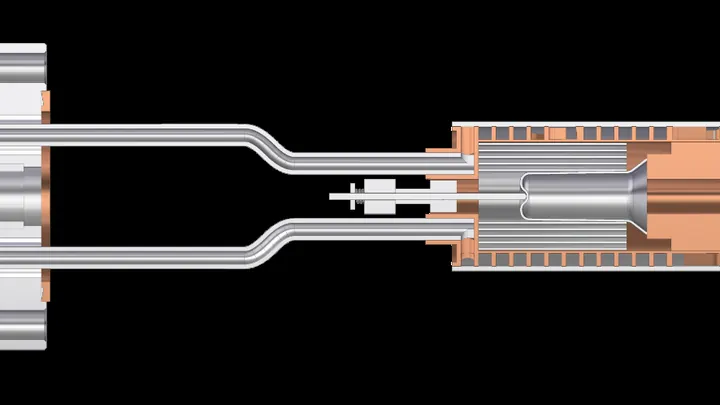
An ordinary aluminum pot on a stove doesn't emit molecules you can catch with light. But if you take aluminum and an aluminum salt, heat them together in a small oven, you get a stream of aluminum fluoride molecules, like steam from a kettle's spout, except instead of water droplets, tiny particles fly out.
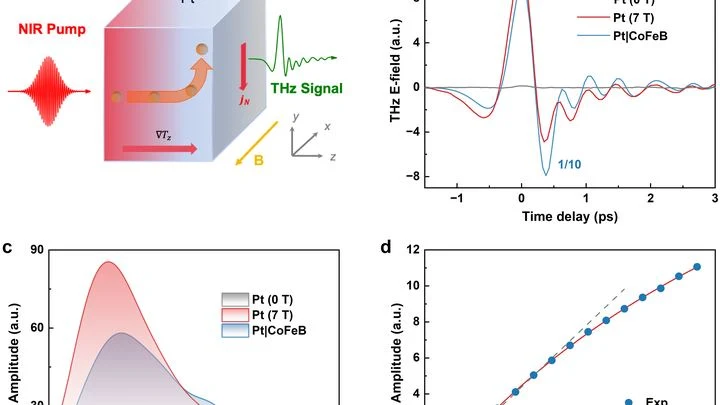
Usually, to generate terahertz waves (light between microwaves and infrared), researchers build a sandwich of different metals. One layer acts as the source, another as the receiver of charges. In such designs, platinum was assigned the role of a simple conductor. But it turns out it can work alone.
Gas is nearly invisible, but it has a temperature, and you can read it from how the gas 'shadows' the thermal background. In the experiment, a camera looks at a warm screen through a jet of carbon dioxide. If the gas is cooler than the background, it appears as a dark spot; if warmer, it appears bright.
A semiconductor diode normally conducts current in only one direction, like a spring-loaded door: it opens easily one way but pushes back the other. But if you dope the crystal heavily, the door starts behaving strangely: under reverse bias, the current doesn't just flow: it shoots up.
The gas in a galaxy glows like a neon sign, and by the color of that glow, astronomers can tell how hot it is. The logic is simple: the more heavy elements (which astronomers call metals) in the gas, the better it cools. So galaxies rich in metals should have cooler gas. But new observations show the opposite.
Twenty-eight seconds: that's how long it took for an automated camera to lock onto a flash in a constellation whose light had traveled for more than nine billion years.
When a bright spot flares up on a star, astronomers want to know how much energy was released into space. They used to picture a flare as a growing campfire: the area of the fire increases, but the heat remains the same. That made calculations simpler, but reality turned out to be different.
A boiling cauldron: steam rises, water churns, and the temperature varies from point to point. So it is in space: the gas clouds around young stars are not smooth spheres but a seething mixture with vortices and density fluctuations. Astronomers long treated such clouds as homogeneous, but this simplification can skew conclusions.
A solar flare is like an explosion in a star's atmosphere: in minutes, it releases energy comparable to billions of nuclear bombs. On May 4, 2022, the RT-7.5 radio telescope in Moscow was watching an M5.7-class flare. The instrument was catching millimeter radio waves: those shorter than a centimeter and invisible to the eye.
Neutron stars are ultra-dense remnants of supernovae the size of a city. In the 1930s, Fritz Zwicky hypothesized their existence, and later Jocelyn Bell Burnell discovered pulsars — rapidly rotating neutron stars.
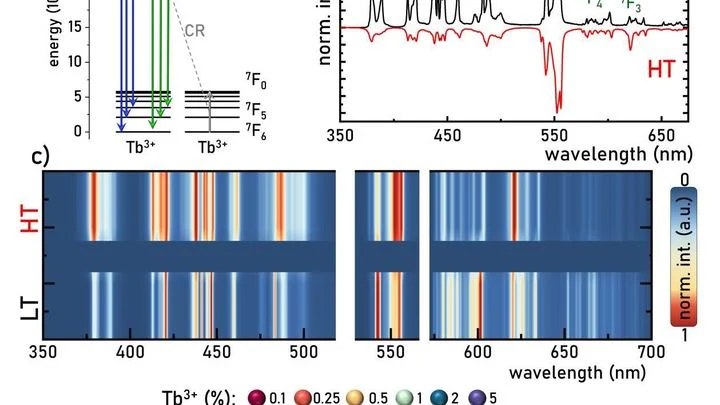
A piece of material glows blue. Heat it up, and the glow turns green, as if someone flipped a switch at a traffic light. That's how the new luminescent thermometer described in the paper works.
Inside the material are terbium ions — a rare-earth metal that knows how to shine. At room temperature, they emit blue light.
Light from distant galaxies passes through telescope lenses like through a stack of window panes. Each pane is coated with a thin film to reduce glare. But this film acts as a polarizing filter: one component of the light wave passes a bit more freely, the other a bit worse. As a result, the wave rotates slightly, and the telescope sees a different picture than what is in the sky.
Visible matter is a drop in the sea of cosmic soup. The foundation of the Universe is made of invisible dark matter, whose gravity keeps galaxies from flying apart. The best candidate for this role is sterile neutrinos, ghost particles connected to us only by the thinnest of bridges.
Hot Jupiters, exoplanets giants snuggled up to their stars, are mysteriously puffed up. Their radii often exceed standard models by 50–100%. New models, based on transiting data (transit method), flip our understanding: heat doesn't come from the interior but from the upper atmosphere.
Two telescopes look at the same Universe and see different expansion rates. Local measurements from supernovae give 73.04 ± 1.04 km/s/Mpc, while cosmic microwave background data within the standard model predict 67.36 ± 0.54.