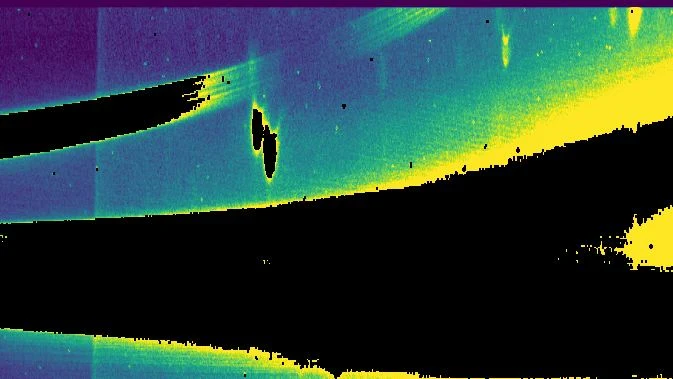
MIRI, the Mid-Infrared Instrument, is one of four scientific instruments aboard the James Webb Space Telescope (JWST). It is the only instrument on JWST that detects light in the mid-infrared range, roughly 5 to 28 micrometers in wavelength. This part of the spectrum is invisible to the human eye and is primarily associated with heat radiation, making MIRI essential for observing cool objects like distant galaxies, forming stars, and exoplanet atmospheres.
History
MIRI was developed jointly by a European consortium of 10 countries and NASA's Jet Propulsion Laboratory, with the design finalized in the early 2000s and the instrument delivered in 2012. It was launched into space aboard JWST in December 2021.
How it works
MIRI combines a camera and a spectrograph. The camera captures images in the mid-infrared, while the spectrograph splits the incoming light into its component wavelengths, revealing the chemical fingerprints of gases and solids. To detect such long-wavelength light, MIRI must be kept extremely cold—below 7 Kelvin—using a dedicated cryocooler, because the instrument's own heat would otherwise swamp the faint signals. The detector is a special array of arsenic-doped silicon that converts incoming infrared photons into electrical signals.
In practice
MIRI is used to study the atmospheres of exoplanets, the formation of stars and planetary systems, and the earliest galaxies in the universe, providing data that is impossible to obtain from ground-based telescopes.
Fun fact
MIRI's detector is so sensitive that it can detect the heat of a single bumblebee at the distance of the Moon.
Beyond Neptune's orbit lies an ocean of icy islands that has remained nearly unchanged for four billion years. These islands, known as trans-Neptunian objects, hold the recipe for planet formation. Until recently, astronomers could only see the large ones, while the small, city-sized ones stayed invisible.
Eight sky maps taken by different detectors of the Planck telescope resemble eight road atlases of the same city drawn by different cartographers. Each atlas is rotated by its own angle: one cartographer held the tablet slightly tilted, another slightly turned. If you overlay the atlases, the streets won't align. But if you know how each atlas is rotated, you can align them perfectly.
Light that never reaches the camera still leaves its mark on it. That's how the new imaging method works: you illuminate the object with one color, and the picture is assembled from another. Inside the crystal, light waves mix, and information about the invisible transfers to a visible beam.
In the experiment, they used a silver thiogallate crystal.
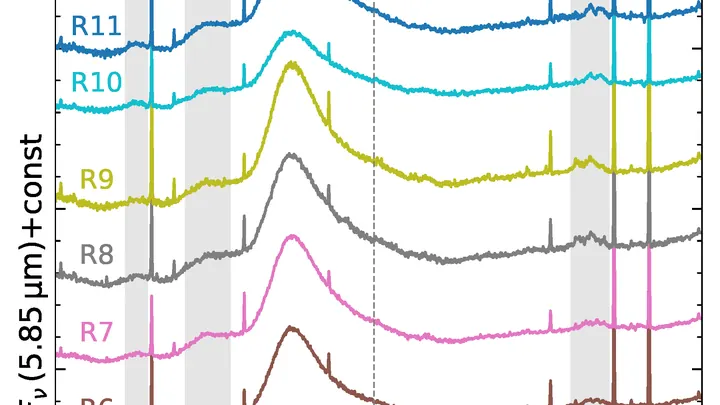
The Tarantula Nebula is a giant stellar nursery in a neighboring galaxy. Hundreds of thousands of stars are born there, and their light illuminates clouds of dust. This dust glows in the infrared, and its spectrum shows mysterious bands. For a long time, astronomers debated which molecules produce them.
Light passing through a glass of murky water dims — some of it is absorbed. That's how many liquid-analysis instruments work: they measure how much light was lost and infer the composition from that. But if the liquid is heterogeneous, like soup with chunks, a single number isn't enough: you need to know where exactly more absorption happened.
The night sky is full of deceptive lights. Astronomers were searching for galaxies that ignited in the first few hundred million years after the Big Bang: their light has traveled to us for nearly 13 billion years. Six faint smudges were selected from images taken by the Hubble and Spitzer space telescopes.
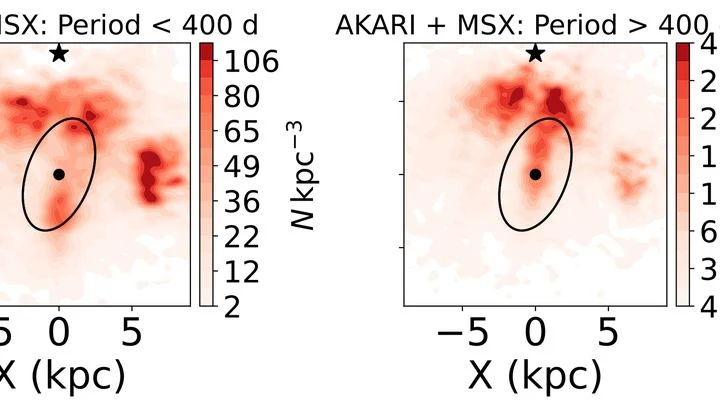
Red giants in the center of the Milky Way resemble distant lighthouses that brighten and dim. Their light pierces through dense dust, but standard distance-measuring methods fail here: the stars are too bright and unstable, and dust distorts the picture.
Astronomers found a workaround.
Every morning, a janitor sweeps leaves into a pile. The Sun, as it travels through the galaxy, does something similar: its gravity gathers diffuse interstellar gas into an invisible cone — a giant funnel.
The orchestra plays, but the musicians can't hear each other. The conductor keeps stopping the music and walking over to each player to tune the instrument. That's roughly how space telescopes with segmented mirrors work.
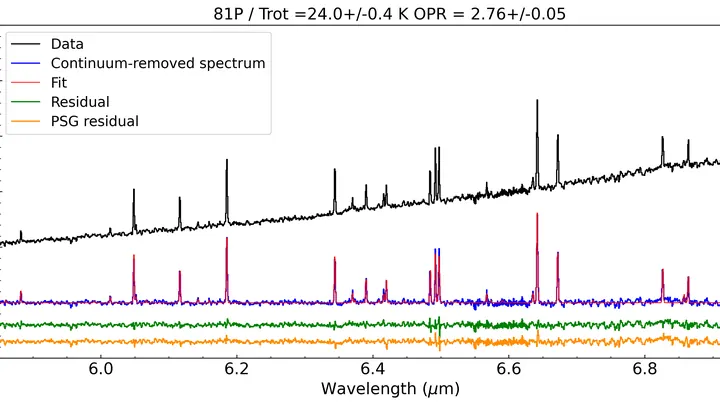
In March 2023, the James Webb Space Telescope pointed its instruments at the short-period comet 81P/Wild 2. This celestial body, about the size of a small town (nucleus radius around 1.77 km), is already familiar to scientists: in 2006, the Stardust probe flew through its tail and collected dust samples that were later studied in Earth laboratories.
The night sky is like an ocean: the longer you stare, the more faint lights you notice in the depths. That's how astronomers, peering into the outskirts of the Milky Way, found Aquarius IV — a tiny stellar system that had been hiding in the dark until now.
The system was spotted in images from an early survey by the future Vera Rubin Observatory.
When an orchestra of thousands of musicians plays in harmony, the credit goes not only to each player's talent but also to the invisible work of the conductor.
A star wrapped in an invisible blanket warms up more than it should. That's exactly how ten red dwarfs look, which astronomers from the Hephaistos project have been monitoring. These stars lie within 300 parsecs (about 1000 light-years) of us and emit far more infrared energy than their modest sizes can explain.
Edge of the spotlight. Remove the dazzling light of the central star, and a theater of shadows emerges. The James Webb coronagraph, like a dense curtain, hid the star TW Hydrae — and on a stage 120 astronomical units long (four times the distance to Neptune), its protoplanetary disk came alive.
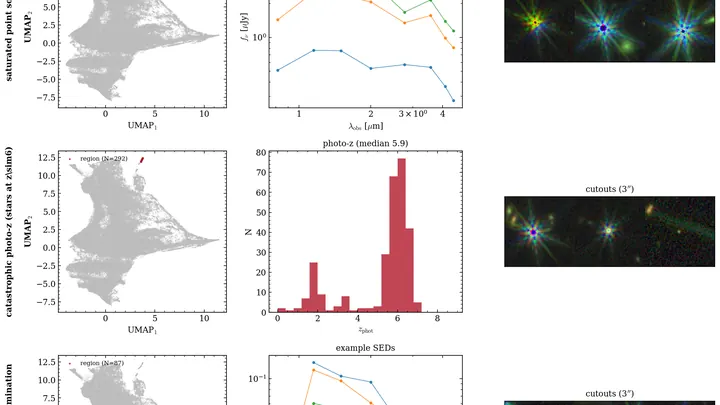
Two hundred forty-two thousand three hundred twenty-seven galaxies — like grains of sand on a beach. But astronomers turned this chaos into a map: the UMAP algorithm (a machine learning method) took from each galaxy eleven parameters — seven colors from optical to mid-infrared (that's photometry), magnitude…
Seventy-two protoplanetary disks, swirling cocoons of cosmic dust and gas, came under the gaze of the MIRI instrument on JWST. Most of them shoot outflows into space: dense conical structures and narrow, high-speed jets. They blast like fountains. This process is not accidental.
In 2024, the Hephaestus project sifted through millions of stars and flagged a few dozen suspicious ones: they shone brighter in the mid-infrared than a normal red dwarf should. Two of these candidates, labeled D and E, looked especially tantalizing, as if an invisible heater were working next to the star.
The cosmic spectacle unfolds on the stage of Galaxy галактики Centaurus A. In the lead role: a supermassive сверхмассивная чёрная дыра with a powerful jet that pierces space for hundreds of thousands of light-years.
The Universe is less than a billion years old, yet at its centers already sit black holes with masses of a billion suns. According to the conventional picture, they grew by voraciously devouring matter, but calculations show that 'feeding' must have been almost continuous, while visible quasar flares last only a few million years. So where does all the accreting fuel go?
Tiny seeds of life can cross the black void on icy wanderers like comet 3I/ATLAS. The James Webb Space Telescope found water and methane on it for the first time, and light analysis revealed an unusual gas composition.
Some 158 light-years away, around the dim star TOI-6894, a red dwarf, a planet moves leisurely. Its year lasts less than two Earth days, yet it is a cool world with an equilibrium temperature around 420 K, just a bit warmer than a sauna.
The planet WASP-121 b is a gas giant, heated to 2500°C. It always faces its star with one side, like a globe frozen under a lamp. But as it passes in front of the star's disk, its rotation reveals different facets to us — as if that globe were slowly turned, letting us peer into every corner.
The atmosphere of Titan, discovered by Christiaan Huygens, is opaque to ordinary telescopes. But spectral analysis finds 'windows' of transparency — narrow regions where the haze parts.
A tiny coin circles a heavy bowling ball. The coin is a small black hole or a neutron star, and the ball is a supermassive black hole at the center of a galaxy.
Drop two pebbles into a pond at the same time — the ripples will spread evenly and in sync. The same happens in a quantum interferometer: a particle is split into two waves that travel along different paths and then meet. Ideally, their crests align.
A bonfire that no one sees, but everyone feels the warmth: that's how astronomers found a flare in a distant galaxy. Not by its light, but by the infrared radiation of heated dust. The galaxy SDSS J010320.39+140152.5 caught attention when its center suddenly blazed in the infrared, as if someone had thrown logs onto an invisible fire.
The scene is lit by spotlights, but the most interesting action happens in the shadows — where molecules invisible to the eye are hiding. The new camera picks up the heat of these "invisible" objects and turns it into ordinary light.
Steam over a boiling pot slightly tints the light of a flashlight: it blocks some colors and lets others through. That's roughly how we study the air of distant planets.
Astronomers aimed JWST at the rocky exoplanet LHS 3844 b — a world orbiting another star, where a year lasts just 11 hours. The planet is tidally locked: one side always faces the star, with a permanent scorch of 770°C, while the night side is plunged into icy darkness.
A giant planet hangs in space in complete solitude, separated from its star by a distance 160 times greater than the path from the Sun to Pluto. The light from its parent star arrives so faintly that the surface temperature barely exceeds 200 degrees Celsius — about as warm as a well-heated sauna.
Astronomers pointed JWST at a planet near the star Epsilon Indi — a giant gas ball resembling Jupiter, just 12 light-years away. In thermal images, the planet shone like a lantern. But nearby they noticed a faint dot — like a firefly. Calculations showed that two objects describe the picture better than one. However, it's most likely a lens flare — like a ghost of a lamp.
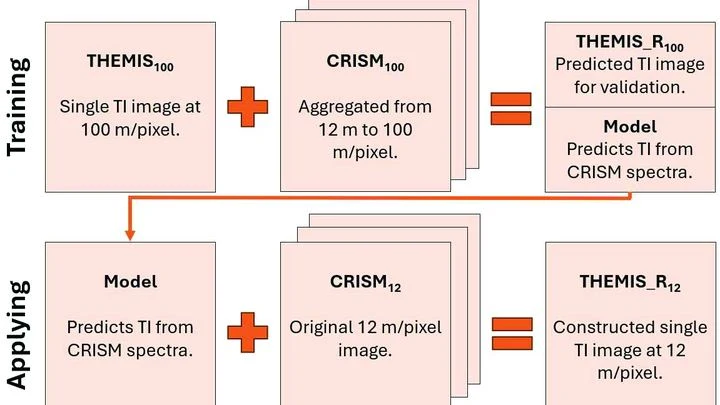
Warm rock and cold sand cool at different rates at night. An instrument orbiting Mars measures this heat, revealing whether the surface is loose dust, a dense crust, or solid rock. But thermal images have a resolution of 100 meters per point: an entire football stadium fits into a single pixel. Fine details (the beds of ancient streams, the edges of lava flows) are simply invisible.
A world that for years refused to show its face. Planet GJ 1214 b is exactly such a case. It is larger than Earth but smaller than Neptune, and its dense envelope made the atmosphere invisible to telescopes: starlight passed through it without leaving clear traces. But astronomers' persistence and a new sensitive instrument provided the first clue.
A newborn star is like a kitchen mixer: it whips up the surrounding cloud, and splatters fly in all directions. Only instead of batter, it's gas and dust. Previously, astronomers had only seen gas jets, and dust was considered too fragile: the shock wave should shatter dust grains into atoms.
A distant quasar appears as four points of light arranged in a cross. This is how the gravity of a galaxy lying along our line of sight distorts the view: it acts like imperfect glass, multiplying the image. Each point is the same object, but its light travels different paths.
Thirty-six years ago, a star exploded in a neighboring galaxy. The flash was named Supernova 1987A, and since then it has been monitored almost every year. Now the James Webb Space Telescope has looked at its remnant in the mid-infrared — the part of the spectrum where dust and heated gas glow.
Five galaxies that long ago stopped igniting new stars look like houses with darkened windows. But the ALMA radio telescope and the James Webb Space Telescope peered inside and saw that in these 'sleeping' houses, a fire still smolders.
A pulsar is a dead star spinning at breakneck speed, sending out radio pulses like a lighthouse. But for PSR J1928+1815, the signal sometimes cuts out for 3.6 hours. Something is blocking the beacon. A companion star orbits the pulsar, and its shadow falls on us.
When an exoplanet briefly eclipses its star, starlight passes through its air and absorbs its chemical taste. This technique, the transit method, is the core of how the James Webb telescope works.