Invisible Particle Decays express
In the BESIII detector, particles put on a show: they collide, are born, and decay, leaving flashes of light. But sometimes an actor can leave the stage unnoticed — through a hidden door that cameras don't see. Physicists were looking for exactly such 'quiet' decays, when a particle turns into something invisible to the instruments.
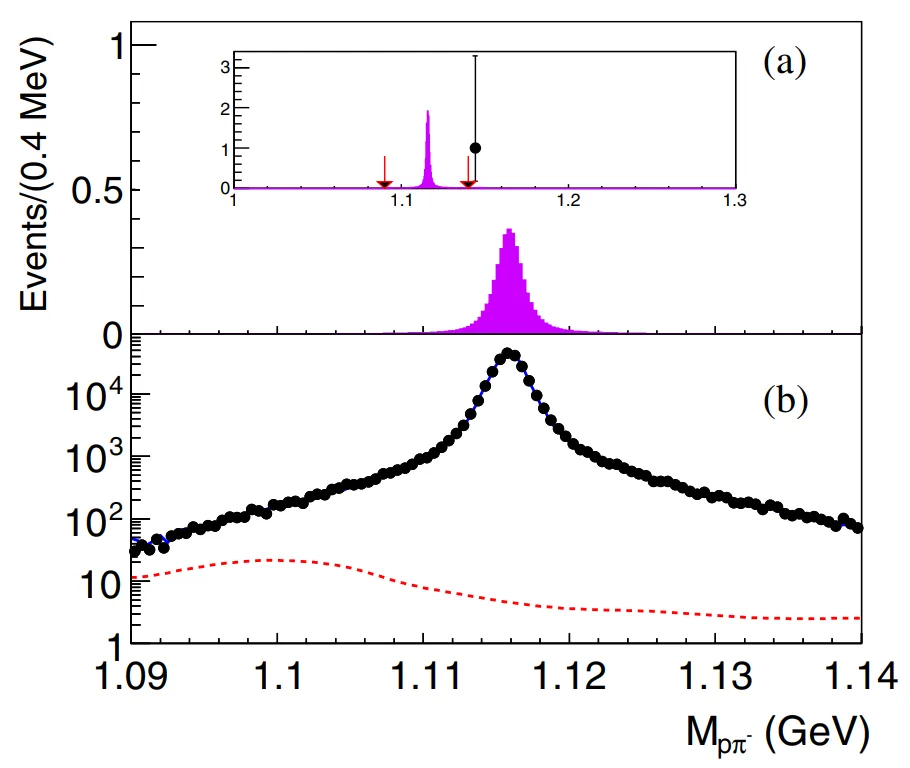
To do this, they used ten billion events with the J/ψ particle, like reviewing ten billion snapshots of the same moment. They searched for three scenarios: the sigma-plus baryon decays into a proton and an invisible particle, the xi-minus decays into a pion and an invisible particle, and the lambda baryon can oscillate into its antiparticle, which violates the conservation of baryon number. In none of the cases did they find anything suspicious.
These limits are the most stringent to date. They tie the hands of theorists who devise models with a dark sector: if invisible decays exist, they must be even rarer than previously thought. If there is a hidden door, it is very narrow.
The J/ψ particle was discovered simultaneously in 1974 by two groups, one in the US and one in China, and its name combines both designations: J and ψ.
In the TV series 'Dark Matter,' people find themselves in a world where familiar physics doesn't work — much like in the search for invisible decays, where energy escapes into an unknown dimension.