Axion detection is the search for hypothetical elementary particles called axions, which are prime candidates for dark matter. Axions are extremely light, weakly interacting particles predicted by extensions of the Standard Model to solve the strong CP problem. Detecting them is challenging because they interact so feebly with ordinary matter, but their existence would explain a significant fraction of the universe's missing mass and open a new window into particle physics.
History
The axion was proposed in 1977 by Roberto Peccei and Helen Quinn to explain why the strong nuclear force preserves CP symmetry, with the particle itself named by Frank Wilczek and Steven Weinberg. Experimental searches began in the 1980s and continue today.
How it works
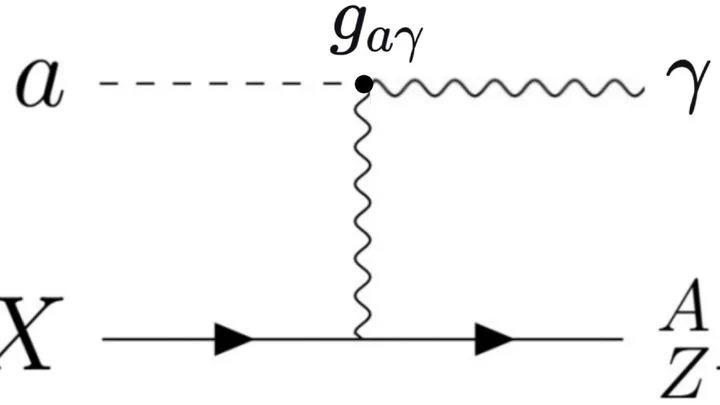
Axions can convert into photons in the presence of strong magnetic fields (the Primakoff effect). Experiments like haloscopes use resonant cavities in strong magnetic fields to detect microwave photons produced by axion conversion. Astrophysical observations look for axion-induced effects, such as anomalous energy loss in stars or polarization changes in light from distant sources. Neutron star polar caps are also proposed as natural axion-to-photon converters.
In practice
Axion detection experiments, such as ADMX, aim to discover dark matter; if successful, they would revolutionize both cosmology and particle physics.
Fun fact
Axions, if they exist, could also explain why neutron stars cool faster than expected, as they would carry away energy from the star's core.
In a gas chamber where fast electrons are usually detected, slow charge carriers suddenly appeared: negative ions. They move like heavy porters who do not scatter to the sides but march in an even column. That kind of tidiness is exactly what detectors hunting for dark matter need: the less a particle's track is blurred, the more accurately its direction can be reconstructed.
Inside the Sun, reactions can produce light, almost undetectable particles called axions. One such reaction yields axions with an energy of 5.49 MeV, as if each one carried the energy of a tennis ball moving at 100 km/h. These particles pass freely through Earth, but occasionally they might collide with a xenon atom.
Dark matter is the invisible scaffolding of the universe. It's there, we know from the motion of stars and galaxies, but what this scaffolding is made of remains unknown. One guess is ultra-light particles similar to axions. They barely interact with ordinary matter, yet occasionally they do get involved.
In the first moments after the Big Bang, the universe was a searing 'soup' of particles. As it cooled, phase transitions occurred — much like water turning to ice. At one such moment, magnetic monopoles of dark matter could have been born: tiny clumps of field with a single magnetic pole.
In the first moments after the Big Bang, the universe expanded at an incredible rate — a phase known as inflation. Even the vacuum was restless back then: quantum jitters shook the fields like wind rustling through a wheat field.
In 1929, Edwin Hubble pointed his telescope at distant galaxies and discovered they were receding. Ninety years later, two measurements of this recession rate, from ancient light and from nearby stars, stubbornly disagree. A 9% discrepancy cannot be chalked up to error. It is as if the Universe in its youth and in its maturity runs on different clocks.
In the galaxy NGC 1052 DF2, stars move at only 8 kilometers per second, as if there were no invisible mass around. For comparison: in our Milky Way, outlying stars accelerate to 200 kilometers per second, held by a massive dark matter halo.
In the first fractions of a second after the Big Bang, the Universe underwent inflation — a monstrously rapid expansion that smoothed out all irregularities. But amid this cosmic smoothness, one "wrong" note could have been hidden: quantum fluctuations of the axion field.
Deep underground, in the silence of a cryostat (a cooled container), lie crystals of lead that once belonged to an ancient Roman ship. This material barely emits background radiation — over two thousand years, unstable isotopes have decayed, leaving it perfectly clean for hunting the rarest events.
Eight bright spots on the radio sky. They are all the same quasar HS 0810+2554, whose light passed through a gravitational lens — a massive foreground galaxy.
Gravitational waves from merging black holes sound like bass chords, pulsars tap out a rhythm, and the cosmic microwave background carries echoes of the Big Bang. But there is a silent player — dark matter, whose presence is betrayed only by gravitational effects.
The standard model of cosmology, based on the field equations proposed by Einstein, describes the Universe as a cocktail of dark matter (discovered thanks to Vera Rubin) and dark energy in roughly a 1:3 ratio.
A large underground tank of liquid xenon waits for a rare event — a nudge from a dark matter particle. Normally, gravity is too weak to notice such a nudge. But if space has hidden dimensions, everything changes: at tiny distances, gravity suddenly strengthens, and the chance of catching an elusive particle grows.
The universe is permeated by invisible mass, dark matter, whose existence was first proposed by Fritz Zwicky in the 1930s, based on his observations of galaxies moving in clusters.
Imagine a perfectly tuned orchestra, where every instrument is adjusted with flawless precision, trying to play in a noisy hall. That noise is quantum gravity — the microscopic ripples of spacetime. It constantly threatens to throw the musicians off.
Think of a baby mobile: figurines dangling on threads, twitching at even a whisper of breeze. In the same way, planets on very wide orbits barely cling to their star's gravity, and they feel the faintest gravitational drafts. Astronomers have proposed turning such planets into detectors of dark matter.
In the kitchen cupboard sits a jar of sugar. If you shake it, the grains will spread almost evenly — no need to place each one with tweezers. In much the same way, tiny black holes could have appeared in the first moments after the Big Bang. Their mass is like that of an asteroid, their size smaller than an atom.
An ocean permeates all of space, yet remains invisible to us. This ocean is dark matter, and the waves on its surface are particles called axions. They are so light and elusive that they pass through Earth without noticing it. But if these waves crash against a shore made of a special material, they might leave a trace — a tiny electric current.
A pebble drops into a pond, and ripples spread across the water. But one wave suddenly doesn't spread out: it clings to an invisible fold on the surface and runs only along it.
The late-stage Universe can be thought of as a crowd dispersing after a concert. In the standard cosmological model ΛCDM, people shuffle away quietly, not bothering each other. But what if thousands of concertgoers suddenly start gently nudging their neighbors?
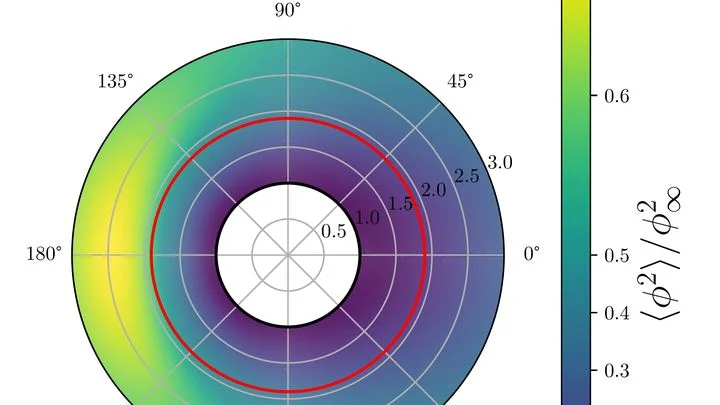
A neutron star is a gravitational lens that focuses our attempts to glimpse dark matter. Through its ultra-dense matter, like exotic glass, we search for the axion — an elusive particle that could explain the hidden mass of the universe.
A stone thrown into water leaves ripples. A satellite orbiting Earth also leaves a trace — not on water, but in the laws of physics. Its orbit is not a frozen line: it slowly rotates, like the hand of a giant clock.
In a dark room, a glass bead the size of a dust grain hangs on a laser beam. Beneath it are two mirrors: one aluminum, one silver. If axions (light, invisible particles that could make up the mysterious dark matter) whiz by, they exchange with the mirror atoms, and the bead shifts ever so slightly.
Tiny invisible bullets pass straight through the Sun, barely noticing its matter. These are axions — hypothetical particles so light and elusive that they are often compared to ghosts.
At the SuperKEKB accelerator, electrons collide with positrons, and among the debris, B-mesons are found. These heavy particles live briefly and break apart into lighter ones. Recently, the Belle II detector recorded a suspiciously high number of cases where a B-meson transforms into a K-meson (kaon) and something invisible—2.7 sigma more than expected.
In the first moments after the Big Bang, the universe was a boiling cauldron. But then, according to a new hypothesis, it suddenly cooled dramatically — far more than previously thought. In this icy world, dark matter particles, like tiny pendulums, froze and did not begin their oscillations.
In the very beginning, moments after the Big Bang, the universe was ridiculously symmetric: particles and antiparticles in equal measure. But a tiny imbalance occurred, like one extra grain of sugar in a kilogram, and the entire familiar world, stars, planets, people, arose from that surplus. How nature created this imbalance remains a mystery.
It all started with a tiny clump that grew faster than light could cross it. Inside this inflating bubble, our future Universe, reigned unimaginable heat. But one field, called the inflaton (the engine of inflation), behaved like a conductor: it controlled both the expansion and how other particles behaved.
In 1987, astronomers saw a supernova flare up in a neighboring galaxy — the Large Magellanic Cloud. It was a rare gift: the explosion was close enough to catch not just light but also neutrinos, those nearly undetectable particles that pass straight through Earth.
A flat crystal of charged atoms suspended in an electromagnetic trap behaves like a perfectly calm pond. The slightest breeze, and ripples spread across its surface. This 'pond' catches the splashes from dark matter particles and the ripples of spacetime — high-frequency gravitational waves.
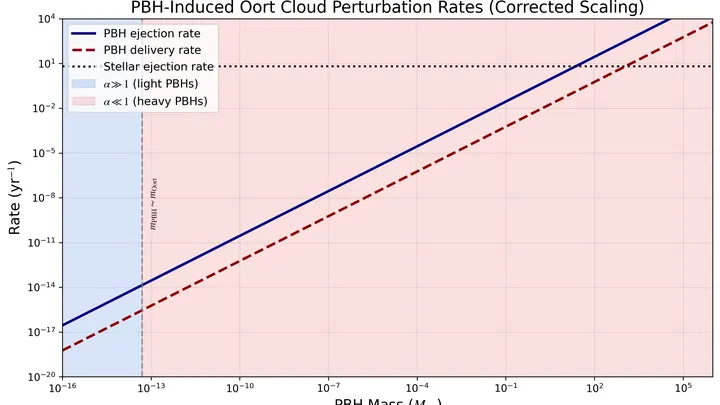
The Oort Cloud is a spherical swarm of trillions of icy bodies at the very edge of the Solar System, about a light-year from the Sun. These objects are almost motionless relative to one another until some gravitational disturbance breaks their calm.
In a distant galaxy, at a distance that light takes 11 billion years to cross, something flashed. The Einstein Probe X-ray telescope caught a brief, needle-prick-like burst: it lasted only a few dozen seconds.
In the first moments after the Big Bang, the universe was not empty and quiet but filled with hot plasma, particles, and magnetic fields. Among the particles, there may have been axions — light, nearly elusive dark matter candidates.
In the kitchen, two flashlight beams pass through each other without noticing. Light barely interacts with light. But if you accelerate particles to enormous energies, two photons can collide and give birth to something new.
A tiny superconductor, levitating above a magnet, is like a cork on the surface of an invisible ocean. The slightest breath of dark matter makes it shudder. Scientists examined two kinds of such 'wind'. The first – gravitational waves, which stretch and squeeze space itself, like ripples on the fabric of the cosmos.
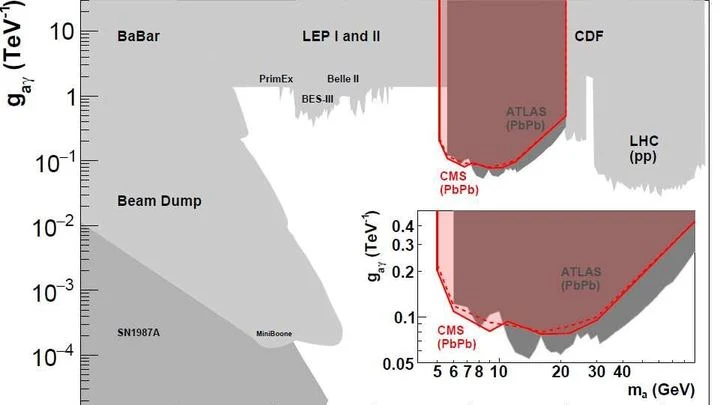
At the Large Hadron Collider, protons collide at nearly the speed of light. Sometimes they don't smash apart but exchange photons — particles of light. These photons can produce a pair: one particle the detector sees, and another that flies off unnoticed.
In a dark mine under the Italian Alps, a tank holds three tons of liquid xenon. When a particle hits it, it knocks faint flashes of light and electron clouds out of the atoms. Following these tracks, physicists hope to see an ultra-rare decay: a xenon-136 nucleus turning into barium-136, emitting two electrons and no neutrinos.
A qubit, the computational unit of a quantum computer, lives for fractions of a millisecond before forgetting its state. One culprit is a tiny contact inside it: two layers of aluminum sandwiching a layer of aluminum oxide just a couple of nanometers thick.
In collisions of heavy nuclei, a fireball of thousands of particles is born. Among them are pions and kaons, two kinds of light particles that look very much alike. To understand what happens in this fireball, physicists need to know exactly how many of each particle flew out.