Beyond Standard Model particle searches are experimental efforts to find particles or phenomena that the Standard Model of particle physics does not predict. These searches are motivated by unresolved questions such as the nature of dark matter, the hierarchy problem, and the matter-antimatter asymmetry. Experiments at the Large Hadron Collider (LHC) and other facilities look for new particles that could be produced in high-energy collisions, often appearing as missing energy or unusual decay patterns.
History
The search for beyond Standard Model particles began in earnest with the formulation of the Standard Model in the 1970s, but gained momentum with the discovery of the Higgs boson in 2012, which confirmed the model's last predicted particle. Since then, the focus has shifted to finding what lies beyond.
How it works
These searches typically involve colliding particles at high energies and analyzing the debris for signatures that cannot be explained by known processes. For example, if a new particle is produced and escapes detection, it would appear as missing transverse energy. Other strategies look for long-lived particles that decay far from the collision point, or for deviations in the rates of known processes. The ATLAS and CMS experiments at the LHC are designed to capture these signatures, while dedicated experiments like FASER search for particles that travel long distances.
In practice
These searches are crucial for discovering new physics, such as supersymmetric particles or dark matter candidates, which could reshape our understanding of the universe. They also drive the development of advanced detector technologies and data analysis techniques.
Fun fact
Some searches look for 'long-lived particles' that travel meters or even kilometers before decaying, which is why experiments like FASER are placed far from the main collision point.
Ultra-sensitive scales try to detect the difference between two nearly identical grains of sand. One is a perfect mirror reflection of the other. In the world of elementary particles, such mirror reflection is called P-parity, and its violation is one of the great mysteries of physics.
Dark matter remains the inaudible bass line of the cosmic symphony — it emits no light, but its gravitational pull shapes galaxies. Vera Rubin first caught this rhythm in the 1970s by observing the rotation of stars.
In the late 1990s, the night sky delivered a surprise: Saul Perlmutter and Adam Riess found that the expansion of the Universe is accelerating. Ever since, the greatest riddle has been dark energy — a substance making up nearly 70% of the cosmos, yet evading laboratory study.
A large underground tank of liquid xenon waits for a rare event — a nudge from a dark matter particle. Normally, gravity is too weak to notice such a nudge. But if space has hidden dimensions, everything changes: at tiny distances, gravity suddenly strengthens, and the chance of catching an elusive particle grows.
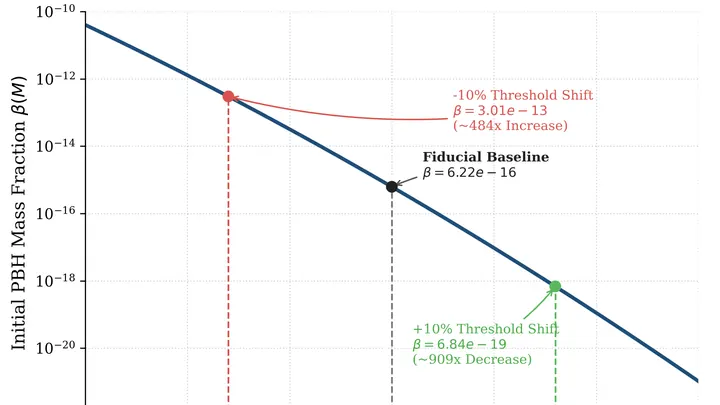
It all began not with emptiness, but with a boiling ocean of plasma. In that primordial broth, sound waves raced through the fiery matter, colliding and compressing it. Sometimes a clump grew so dense that light could no longer escape, and right out of the scorching gas, a primordial black hole was born.
In the kitchen cupboard sits a jar of sugar. If you shake it, the grains will spread almost evenly — no need to place each one with tweezers. In much the same way, tiny black holes could have appeared in the first moments after the Big Bang. Their mass is like that of an asteroid, their size smaller than an atom.
Dark matter is invisible, but its gravity governs the motion of galaxies. What it's made of is a mystery. One idea: it consists of ultra-light particles akin to axions.
After the Big Bang, the Universe resembled a tightly inflated balloon: pressure prevented matter from clumping together. But hypothetical superheavy particles — sort of ‘heavyweights’ of the microcosm — momentarily made the balloon less stiff. Matter easily clumped, giving birth to black holes with masses from a billion to a billion billion tons.
From 2016 to 2018, at the Large Hadron Collider at CERN, protons collided at energies of 13 teraelectronvolts, as if two peas were accelerated to speeds where their impact spawns a whole swarm of new particles.
In the kitchen, two flashlight beams pass through each other without noticing. Light barely interacts with light. But if you accelerate particles to enormous energies, two photons can collide and give birth to something new.
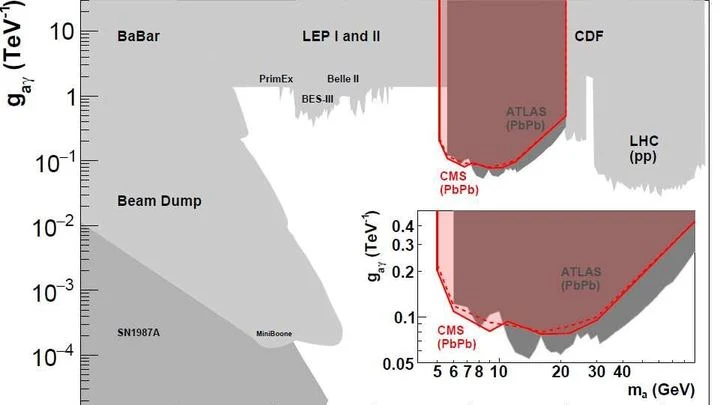
At the Large Hadron Collider, protons collide at nearly the speed of light. Sometimes they don't smash apart but exchange photons — particles of light. These photons can produce a pair: one particle the detector sees, and another that flies off unnoticed.
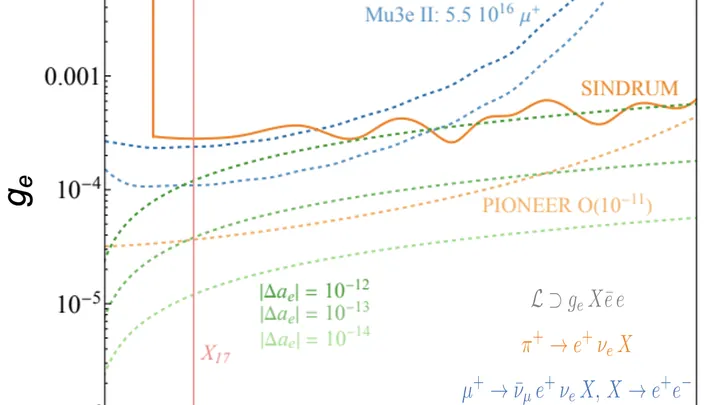
In nuclear transitions of beryllium-8, helium-4, and carbon-12, physicists from the ATOMKI collaboration have been seeing extra events since 2020—as if, when an excited nucleus decays, something else is sometimes born besides the usual photons. The energy of this "something" is always the same: about 17 million electron-volts.
A bullet that doesn't just pierce one target but leaves marks in several layers of armor. That's roughly how superheavy dark matter behaves, and it's what the DarkSide-50 detector was built to catch for the first time. The usual suspects for dark matter (weakly interacting massive particles, or WIMPs) pass through matter almost unnoticed, occasionally bumping into a nucleus.
A metal resonator, chilled to near absolute zero, listens to the radio noise of the universe. Amid the chaos of thermal fluctuations and electronics, a faint peak might emerge — the trace of an axion, a particle that could make up dark matter.
Dark matter is like an invisible glue that holds galaxies together. It emits no light, but if its particles collide, gamma rays can flash. Scientists hunted for such flashes in dwarf galaxies — small stellar clusters with lots of dark matter and almost no ordinary matter.
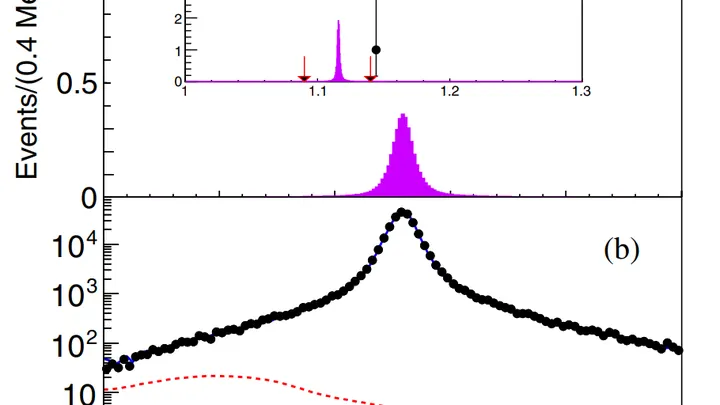
In the BESIII detector, particles put on a show: they collide, are born, and decay, leaving flashes of light. But sometimes an actor can leave the stage unnoticed — through a hidden door that cameras don't see. Physicists were looking for exactly such 'quiet' decays, when a particle turns into something invisible to the instruments.
A pebble drops into a pond, and ripples spread across the water. But sometimes the pebble doesn't sink right away: it skims beneath the surface, travels a few meters, and only then surfaces, creating ripples in an unexpected spot.
Two black holes circle each other, and their dance isn't always a smooth waltz. If the holes spin on their own axes, their orbit can start to tumble, like a top that's been pushed and wobbles on its side while still spinning.
Picture a star waltzing with an invisible partner: its rhythmic wobble, caused by the gravitational pull of a companion, is picked up by instruments, yet the partner itself eludes detection. Usually, such wobbles are the result of a Doppler shift, a change in the frequency of light due to the star's motion, that betrays the presence of a planet.
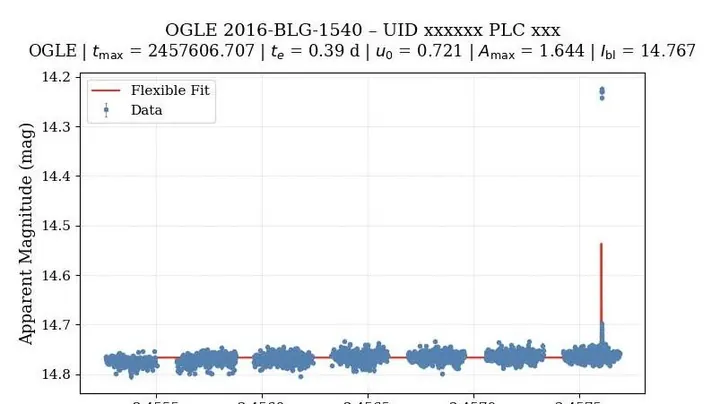
The Universe is filled with invisible mass, dark matter, which reveals itself only through gravity. One hypothesis suggests that dark matter consists of primordial black holes — objects formed in the extreme conditions just after the Big Bang.
The Universe after the Big Bang was almost perfectly homogeneous. Almost, because tiny density perturbations stretched by inflation became the seeds of galaxies. But what if these same perturbations could give birth not only to stars but also to black holes?
A silicon sphere 166 nanometers in diameter floats in a beam of infrared laser light. The pressure is below 10⁻⁸ mbar, and the motional temperature is about 10 millikelvin. That is colder than the cosmic microwave background.