The J/ψ particle is a meson — a particle made of a quark and an antiquark — specifically a charm quark bound to its antiparticle, the anticharm quark. It was discovered independently in 1974 by two teams, one led by Samuel Ting at Brookhaven and the other by Burton Richter at SLAC, in a landmark event that reshaped particle physics. The J/ψ is notable for its unusually long lifetime for a particle of its mass, which arises because its decay is suppressed by a quantum mechanical rule known as the OZI rule. This longevity makes it an excellent laboratory for studying the strong force and for searching for rare processes that could hint at new physics beyond the Standard Model.
History
The J/ψ was discovered in November 1974, independently by Samuel Ting's group at Brookhaven National Laboratory (who called it 'J') and Burton Richter's group at SLAC (who called it 'ψ'). The discovery was announced on November 11, 1974, and was so rapid and impactful that it became known as the 'November Revolution' in particle physics. Ting and Richter shared the 1976 Nobel Prize in Physics for the discovery.
How it works
The J/ψ is produced in high-energy particle collisions, such as electron-positron annihilation, where the energy converts into the charm-anticharm pair. Its decays are studied by detecting the particles it produces, such as muons, electrons, or photons. Because the J/ψ is relatively heavy (about 3.1 GeV/c²), it can decay into many different final states, and the relative rates of these decays — the branching fractions — are sensitive to the influence of new, undiscovered particles that might appear in quantum loops. By measuring these rates with high precision, physicists can look for deviations from Standard Model predictions, which would signal new physics.
In practice
The J/ψ is used as a calibration tool and a probe in particle physics experiments, such as those at CERN's LHC and at B-factories, to test the Standard Model and search for dark matter candidates through invisible decays.
Fun fact
The J/ψ's discovery was so unexpected that it was nicknamed the 'November Revolution' because it overturned the then-prevailing theory of quarks, which had predicted that charm quarks would be much heavier.
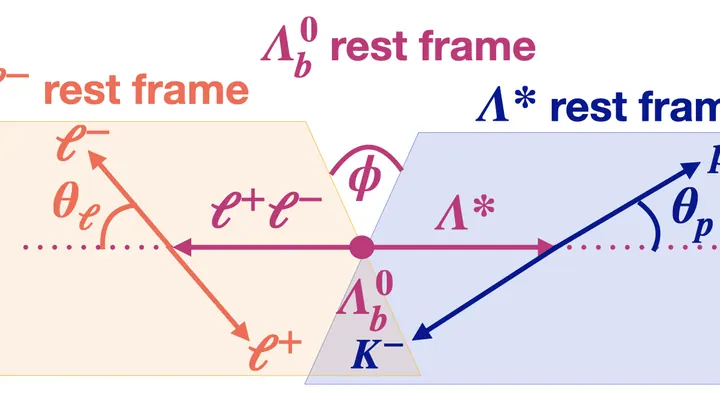
At the Large Hadron Collider, protons are smashed together, and among the debris, a heavyweight particle, the lambda baryon, sometimes appears. It lives for a tiny fraction of a second before decaying into other particles.
An archaeologist carefully brushes away layer after layer, and each new stratum at the charmonium dig is a rare decay captured by the detector. Charmonium — a bound state of a charm quark and its antiquark — lives for mere fractions of a second, yet it manages to tell us about the forces that hold quarks together.
When a ψ(2S) particle decays into a proton and an antiproton, two different mechanisms act simultaneously: the strong interaction, like glue holding quarks together, and the electromagnetic one, like light pushing charges apart. Their contributions add up with a certain phase shift.
A coin landing on its edge is about as rare as a heavy B meson decaying into a light pion and an electron-positron pair. Over a decade of collider operation, only a handful of such events have accumulated, but physicists have finally managed to spot them.
The decay probability is about 2.4×10⁻⁸.
A bridge of aluminum just a few atoms thick is the heart of many quantum devices. Current flows through such a bridge without resistance, and it can be controlled with a magnetic field. These bridges are called Josephson junctions, after the British physicist who described their behavior.
In the LHCb detector, where protons collide, one unusual track was found among billions of decays. The particle, named $$D_{s1}$$(2933)^+, appears for a moment and immediately decays into other particles. Its lifetime is so short that it cannot be observed directly — only through its decay products can its existence be reconstructed.
Quarks are the tiny building blocks that make up protons and neutrons. Usually, they stick together in pairs: a particle and its mirror-image antiparticle. But sometimes quarks form more exotic combinations, which physicists call exotic states.
Protons accelerated to enormous energies slam into a thick metal plate, like bullets into armor. Inside the metal, a J/ψ particle is born for an instant, which immediately decays into two muons — light relatives of the electron. These muons fly out of the target, and detectors catch their tracks.
The scientists compared the number of caught muons with predictions from a computer model.
In proton collisions at the Large Hadron Collider, physicists have for the first time caught a particle with two charm quarks. It is called Ξcc+ (pronounced "ksi-ksi-plus") and resembles a bead with not one but two heavy nuclei.
The J/psi particle lives for an instant and then decays into lighter particles, much like a snapped string scattering into pieces. Physicists from the BESIII collaboration caught over ten billion such decays to figure out exactly what 'pieces' are produced.
When a fast proton slams into an atomic nucleus, new particles are born for an instant. One of them is the phi meson: a short-lived clump of matter that decays into an electron-positron pair. Catching this decay is like hearing the echo of a distant explosion: the blast itself is over, but its trace is still flying.
Two twins look identical, but one is left-handed and the other right-handed. In the world of elementary particles, there are similar pairs: Ξ- and its antiparticle Ξ+. They are born together in the decay of the J/ψ particle and, like entangled twins, maintain a connection even at a distance.
At Japan's KEK laboratory, electrons and their antimatter counterparts, positrons, collide inside the Belle II detector. In such collisions, new particles are born for a fleeting moment. Among them is J/ψ, a bound state of a charm quark and its antiquark.
In the BEPCII accelerator, electrons and positrons collide, producing billions of particles. Among them is the J/ψ meson, which lives for less than a billionth of a second. Its decay sometimes yields an eta meson (ηc), an even shorter-lived clump of quarks.
In a particle accelerator, the anti-lambda particle is a rare guest. It is born on the fly, lives for a tiny fraction of a second, and usually decays on its own. But sometimes it manages to collide with an ordinary proton, and then a whole shower of light particles is born: kaons, pions.
In the BESIII detector, particles put on a show: they collide, are born, and decay, leaving flashes of light. But sometimes an actor can leave the stage unnoticed — through a hidden door that cameras don't see. Physicists were looking for exactly such 'quiet' decays, when a particle turns into something invisible to the instruments.
A pulsar is a dead star spinning at breakneck speed, sending out radio pulses like a lighthouse. Usually these pulses arrive right on schedule, but occasionally there are true monsters among them — giant pulses that are thousands of times brighter than normal.