Pi (π) is the ratio of a circle's circumference to its diameter, a constant that appears throughout mathematics and physics. Its value is approximately 3.14159, but it is an irrational number, meaning its decimal representation never ends and never repeats. Pi emerges naturally in any context involving circles, spheres, or periodic phenomena, from the geometry of a wheel to the quantum mechanical description of an electron's wavefunction.
History
The concept of pi has been known for thousands of years, with ancient Babylonians and Egyptians approximating it. The Greek mathematician Archimedes (c. 287–212 BCE) rigorously bounded its value between 3.1408 and 3.1429 using inscribed and circumscribed polygons. The symbol π was first used by Welsh mathematician William Jones in 1706 and popularized by Leonhard Euler in the 18th century.
How it works
Pi arises from the fundamental relationship between a circle's circumference (C) and its diameter (d): C = πd. This definition extends to areas (A = πr²) and volumes of spheres (V = 4/3πr³). In physics, pi appears in formulas for oscillations, waves, and rotations because these involve circular motion or periodic cycles. For example, the period of a simple pendulum or the wavelength of a standing wave both involve pi.
In practice
Pi is used in engineering for designing circular structures, in GPS and navigation for spherical geometry, and in signal processing for Fourier transforms that decompose waveforms into circular components.
Fun fact
The record for the most digits of pi computed is over 100 trillion, but only about 40 digits are needed to calculate the circumference of the observable universe to within the width of a hydrogen atom.
A thrown stone arcs through the air and falls. A planet orbiting a star is the same stone, but it falls forever, looping around the star in a closed curve. In Newton's world, that curve is a perfect ellipse, and the planet returns to the same point each orbit. In reality, the orbit slowly rotates: its closest point to the star, the perihelion, shifts.
In the infinite river of integers, where whirlpools of primes swirl, mathematicians have been sifting sand for centuries in search of golden nuggets — the zeros of L‑functions. These enigmatic objects, discovered by Riemann in 1859, act like an invisible hand governing the distribution of primes.
Strike a tuning fork. The frequency is 440 Hz. That's the note A — the standard of sound.
In the world of numbers, there's a standard too. It's tuned not to sound, but to prime numbers. Though their distribution seems random, it obeys strict laws. All primes resonate together. There's just one value: λ∞ ≈ 0,674036.
Quarks are the tiny building blocks that make up protons and neutrons. Usually, they stick together in pairs: a particle and its mirror-image antiparticle. But sometimes quarks form more exotic combinations, which physicists call exotic states.
The birth of the Universe is usually associated with the Big Bang — a point of infinite density. But at that point, the laws of physics break down, which bothers scientists. Stephen Hawking and James Hartle back in the 1980s proposed a different view: time has no boundary, like the surface of a globe.
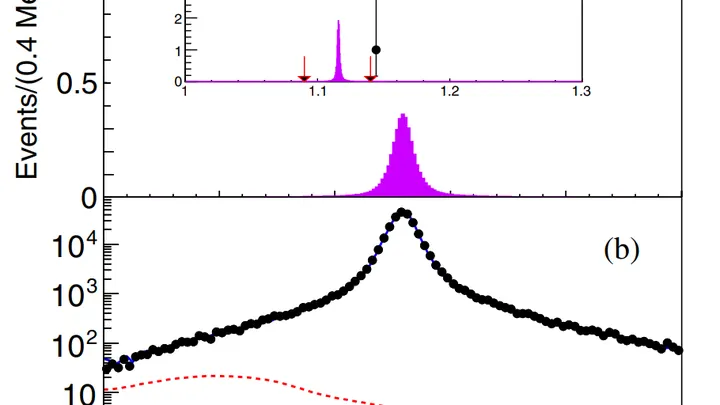
In the BESIII detector, particles put on a show: they collide, are born, and decay, leaving flashes of light. But sometimes an actor can leave the stage unnoticed — through a hidden door that cameras don't see. Physicists were looking for exactly such 'quiet' decays, when a particle turns into something invisible to the instruments.
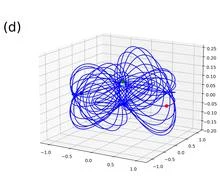
Three bodies attracting each other by universal gravitation: a problem that has stumped mathematics for three centuries. After Poincaré, it became clear that no general solution exists and trajectories are chaotic. But within this chaos there are islands of order: periodic orbits where motion repeats.