concept

dark sector

Theoretical framework describing dark energy and dark matter through unified fields or interactions.
20 related articles

Description

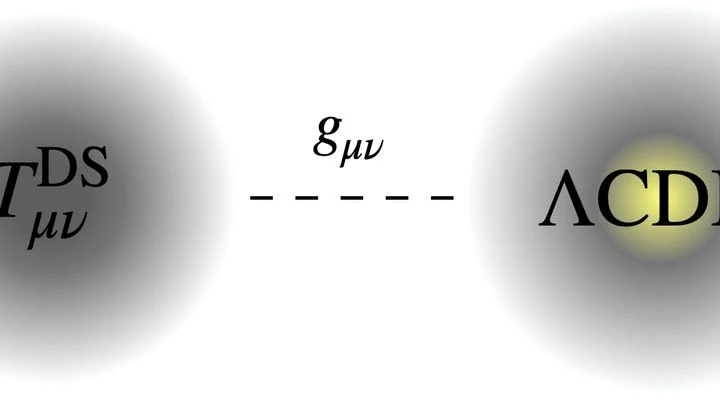
The dark sector is a theoretical framework that unifies dark matter and dark energy under a single, hidden physics. Instead of treating them as separate mysteries, it proposes that they arise from the same underlying fields or interactions, possibly through a new force or a scalar field that couples differently to ordinary matter. This approach aims to explain why dark matter is about five times more abundant than ordinary matter and why dark energy drives cosmic acceleration.

History

The term 'dark sector' became popular in the 2000s as a way to describe extensions of the Standard Model that include hidden particles and forces. The idea of unifying dark matter and dark energy has been explored in various forms, such as quintessence models and interacting dark energy scenarios.

How it works

In dark sector models, a new scalar field or a hidden gauge symmetry governs both dark matter and dark energy. For example, a 'chameleon' field could have a mass that depends on the local matter density, behaving as dark energy in empty space and as dark matter in dense regions. Alternatively, dark matter could be a condensate of particles that also contribute to the vacuum energy, linking the two phenomena. These models often introduce new interactions that can be tested through cosmological observations or laboratory experiments.

In practice

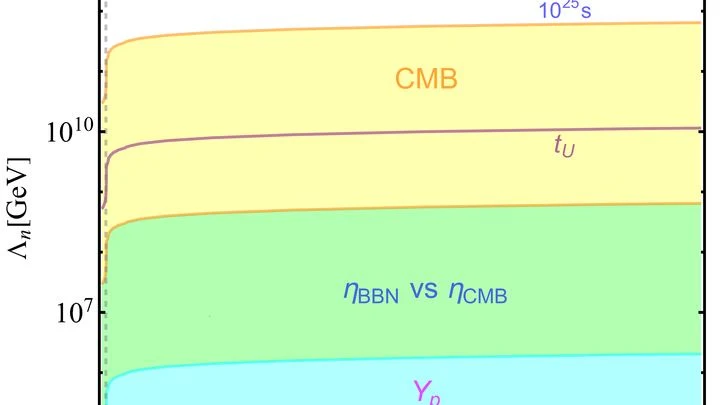
Dark sector models guide experimental searches for new forces or particles, such as those at particle colliders or in precision measurements of the cosmic microwave background, helping to constrain the nature of dark matter and dark energy.

Fun fact

Some dark sector models predict that dark matter and dark energy are not separate entities but two phases of the same field, much like water can be liquid or vapor.


Concept graph →

Related articles · 20

Cosmology2026-08-052 minarXiv:2608.05296express
Cosmic Light Changes Polarization
Light from the hottest stage of the universe has been traveling toward us for nearly 14 billion years. This is the cosmic microwave background — a faint glow filling the entire sky.
Cosmology2026-07-292 minarXiv:2607.27515
Dark-Sector Seesaw: How a Scalar Spring Solves Cosmological Puzzles
In 1929, Edwin Hubble pointed his telescope at distant galaxies and discovered they were receding. Ninety years later, two measurements of this recession rate, from ancient light and from nearby stars, stubbornly disagree. A 9% discrepancy cannot be chalked up to error. It is as if the Universe in its youth and in its maturity runs on different clocks.
Cosmology2026-07-282 minarXiv:2607.26174express
The Dark Side of the Pendulum
The universe is a vast, dark ocean. We see only the glowing foam on its surface — stars and galaxies. But hidden in the depths are two invisible forces: dark matter, which with its gravity keeps galaxies from flying apart, and dark energy, which, on the contrary, pushes space itself apart, making the universe expand faster and faster.
Tamed Phantom: The Axion Spring of the Universe
Since Saul Perlmutter and his colleagues discovered the accelerated expansion of the universe, physicists have been scratching their heads over the nature of dark energy.
Cosmology2026-06-254 minarXiv:2606.27290
Universal Amber: How Petrified Darkness Accelerates the Cosmos
The story began with a missing mass. In the 1930s, Fritz Zwicky, measuring velocities in galaxy clusters, first suspected the presence of invisible matter. Later, Vera Rubin showed that the outskirts of spiral galaxies rotate too fast for the visible matter.
HEP Phenomenology2026-06-232 minarXiv:2606.25014express
Dark Matter from Bubbles
The hot broth of the early universe cooled unevenly. At some point, bubbles of a new phase began to pop within it, like steam bubbles in boiling water. But these bubbles weren't made of steam; they were made of a new state of matter in which particles of the dark sector clumped into larger lumps. That's how dark matter could have been born.
Cosmology2026-06-023 minarXiv:2606.03414
Cosmology2026-05-252 minarXiv:2605.26116express
Dark Energy from a Single Field: Why It's Harder Than It Looks
The universe is expanding, and its history features two puzzling episodes that don't fit into a simple picture. The first is a brief period in its youth when everything flew apart faster than expected, as if someone had floored the gas pedal. The second is today's acceleration, as if the same pedal were pressed again, but more gently.
General Relativity2026-05-242 minarXiv:2605.25071express
Black Holes in Dark Matter Halos
A fluffy ball of invisible web envelops a black hole. This web is dark matter, which doesn't shine but, through its weight, governs the motion of stars on the outskirts of galaxies. Astrophysicists have long seen such 'fluffy' clouds around cosmic objects and have mapped their profiles — how density falls from the center to the edge.
Cosmology2026-05-191 minarXiv:2605.20060express
Dark Energy Twice Went Unstable
When a car on cruise control hits a bump, the speed jumps for a moment, but the engine runs smoothly. Something similar was recently noticed with dark energy — the force that makes the Universe expand faster and faster.
General Relativity2026-05-141 minarXiv:2605.14729express
Inflation and Dark Energy: One Cosmic Spring?
Right after the Big Bang, space swelled at an unimaginable speed — that's inflation. Now expansion has slowed, but galaxies are moving apart faster and faster. The culprit behind the acceleration has been named dark energy.
General Relativity2026-05-141 minarXiv:2605.14977express
Cosmology2026-05-042 minarXiv:2605.03007express
The Shadow Life of the Cosmos: How the Dark Sector Leaves Traces on Ancient Light
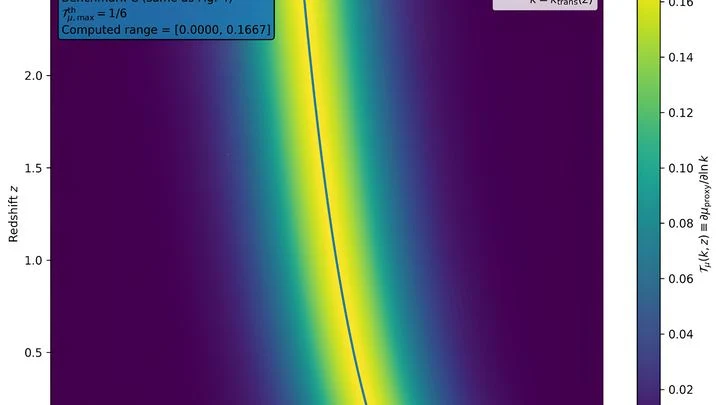
A pond with ripples spreading from a fallen stone. So it is on cosmic scales: a sudden burst of energy in the dark sector, an invisible substance that emits no light, creates ripples in the fabric of space. These ripples alter the path of light particles traveling to us from the very birth of the cosmos. The authors of the new study built a mathematical framework to describe these distortions.
HEP Phenomenology2026-04-232 minarXiv:2604.21168express
Why There Is Exactly Five Times More Dark Matter Than Ordinary Matter
In the kitchen, there's a bucket of water and an identical bucket of sand. Pour the sand into the water, and you get a mixture where there's exactly five times more sand than water. That's roughly how our universe is arranged: one part ordinary matter — the stuff stars, planets, and we ourselves are made of — and five parts elusive dark matter.
Cosmology2026-02-252 minarXiv:2602.21774express
Dark Matter on the Scales of Gravity
In the dark depths of space lurks invisible matter. It doesn't shine, but its pull holds galaxies together. Usually, we assume dark matter obeys the same laws of gravity as tables and chairs. A new study offers a different perspective: dark matter might subtly alter gravity itself.
HEP Phenomenology2026-02-192 minarXiv:2602.17620express
A 17 MeV Ghost Particle
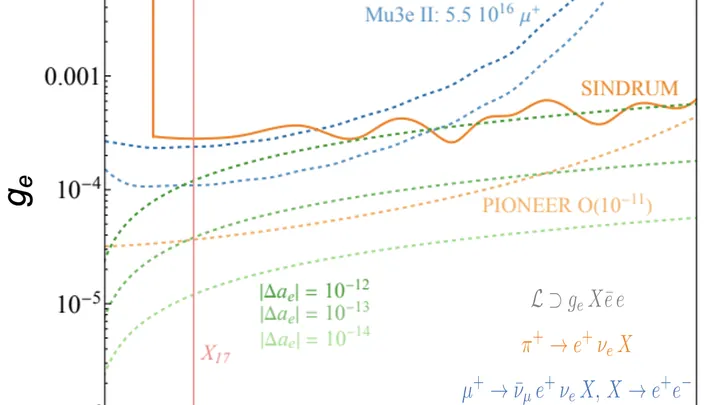
In nuclear transitions of beryllium-8, helium-4, and carbon-12, physicists from the ATOMKI collaboration have been seeing extra events since 2020—as if, when an excited nucleus decays, something else is sometimes born besides the usual photons. The energy of this "something" is always the same: about 17 million electron-volts.
Cosmology2026-01-271 minarXiv:2601.19662express
Dark Dancers: When Dark Matter and Dark Energy Dance Together
Galaxies are flying apart, but the expansion rate measured from the afterglow of the Big Bang and from supernova explosions doesn't match: this problem has been called the Hubble tension. It's like two dancers losing their rhythm because they can't feel each other.
Cosmology2026-01-051 minarXiv:2601.01938express
Dark Energy as a Falling Pencil
Modern telescopes see distant galaxies flying apart faster and faster. The cause is called dark energy, but its nature has been a mystery. On top of that, calculations of the expansion rate in the early and late Universe don't match. The answer might lie in an event much like a falling pencil.
Cosmology2026-01-011 minarXiv:2601.00443express
Dark Matter Gave Rise to Galactic Magnetic Fields
Without the invisible framework of dark matter, galaxies would fly apart. Astronomer Vera Rubin proved back in the 1970s that stars rotate as if held by an unseen mass. But new research shows it's not just passive ballast.
Cosmology2025-08-052 minarXiv:2508.03795
The Dark Sector on a Seesaw: A Scalar Spring Solves Cosmological Puzzles
Two telescopes look at the same Universe and see different expansion rates. Local measurements from supernovae give 73.04 ± 1.04 km/s/Mpc, while cosmic microwave background data within the standard model predict 67.36 ± 0.54.