Sigma (σ) is a statistical measure of significance, indicating how many standard deviations an observed result is from the expected background. A higher sigma means stronger evidence against the null hypothesis. In physics, a 5-sigma result is the gold standard for a discovery, such as the Higgs boson in 2012.
History
The use of sigma in physics was popularized in the 20th century, particularly in particle physics, where the convention of 5-sigma for discovery was established by the 1980s.
How it works
When measuring a signal, scientists compare it to the expected background noise. The sigma value is calculated as the difference between the observed and expected values divided by the standard deviation of the background. A 3-sigma result indicates a 0.3% chance of being a statistical fluke, while 5-sigma reduces that to 0.00006%.
In practice
Sigma is used in particle physics (e.g., CERN experiments), cosmology (e.g., cosmic microwave background), and medical trials to assess the reliability of results.
Fun fact
The 2012 discovery of the Higgs boson was announced with a significance of 5.9 sigma, meaning the chance of it being a background fluctuation was less than one in a billion.
Systems:SICGSPlancknaturalatomicA dimensionless unit representing the number of standard deviations from the mean in a normal distribution.
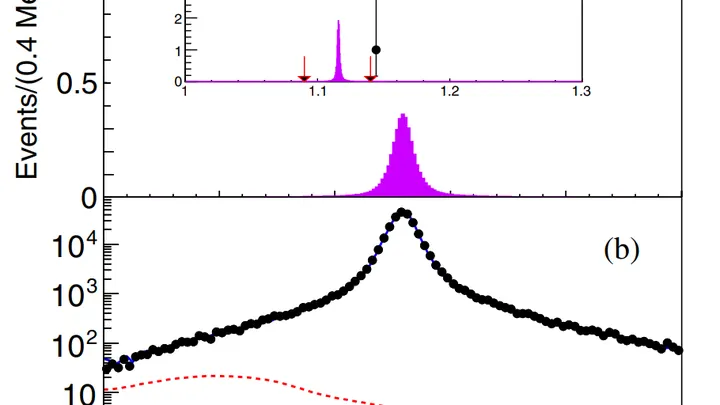
An archaeologist carefully brushes away layer after layer, and each new stratum at the charmonium dig is a rare decay captured by the detector. Charmonium — a bound state of a charm quark and its antiquark — lives for mere fractions of a second, yet it manages to tell us about the forces that hold quarks together.
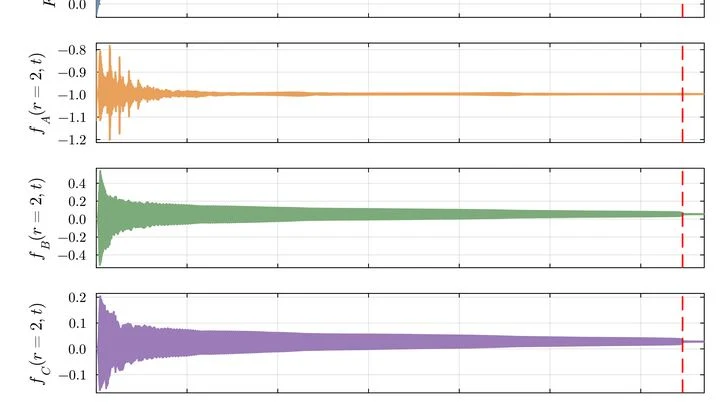
A tightly stretched string keeps vibrating after being plucked. In particle physics, there is a similar object — the oscillon. It is a clump of energy that pulses like a heart without spreading out in space. Such structures arise in the Higgs field — the very field responsible for particle masses.
The Universe is a giant concert hall, where instead of walls and balconies, invisible clouds of dark matter float. This architectural ensemble is not static: it refracts and scatters the 'music' rushing through it — gravitational waves from merging black holes.
Imagine a balance scale with identical weights, yet one pan always tips lower. In the world of elementary particles, this imbalance is called CP violation: particles and their mirror twins (antiparticles) behave slightly differently.
Weighing a cloud of hot gas the size of a million galaxies is no easy task. Astronomers observe how this gas bends light passing by, and from that bending they calculate its mass. But the gas in galaxy clusters is not static: it churns like a boiling pot, and some of the pressure goes into turbulence rather than holding the gas against collapse.
At the Large Hadron Collider, by accelerating particles to nearly light speeds, top quarks are created — the heaviest building blocks of the Standard Model. They live for vanishingly small fractions of a second but manage to exhibit complex quantum connections.
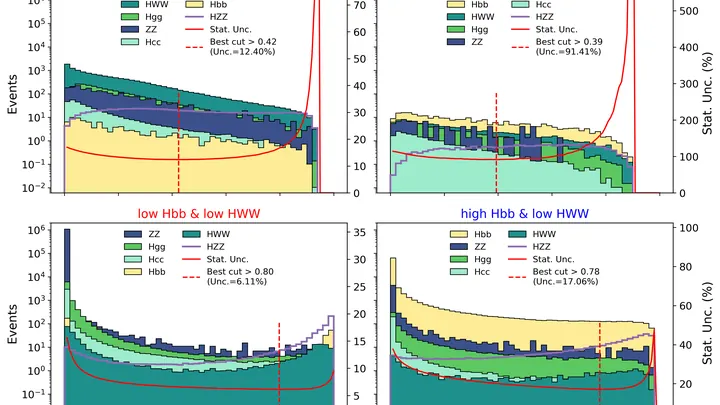
The Higgs boson lives an unimaginably short life — less than a billionth of a second. It cannot be caught directly, so physicists look at what remains after its decay: jets of particles, muons, neutrinos. But some information is lost if you consider only the explicit decay traces rather than the whole event.
Light from distant galaxies passes through clumps of matter, and the gravity of those clumps slightly bends its path, like a lens. By measuring how much the images of distant galaxies are distorted, we can infer the distribution of matter and how gravity affects light.
In the BESIII detector, particles put on a show: they collide, are born, and decay, leaving flashes of light. But sometimes an actor can leave the stage unnoticed — through a hidden door that cameras don't see. Physicists were looking for exactly such 'quiet' decays, when a particle turns into something invisible to the instruments.
The merger of two neutron stars is like a strike on a gong: a ripple in space, a gravitational wave, spreads through the universe. Detectors on Earth catch this ripple and, from its strength, calculate the distance to the source.
Measuring the universe’s expansion is like timing a race when the track stretches. Neutron star mergers act as standard sirens: their gravitational waves ring out with a known “volume,” so fainter signals mean greater distance.
The Universe is expanding, and every galaxy cluster takes part in a grand dance. The tempo of this dance is set by the Hubble constant, first measured by Edwin Hubble nearly a century ago. Pinpointing the number is tough because you need a ruler that spans billions of light-years.