Digital Twins Teach the CT Scanner express
Computed tomography is like an X-ray that takes hundreds of images from different angles and stitches them into a 3D picture of the body. But each image delivers a small dose of radiation, and doctors need to know how much each organ receives. Currently, this is often estimated roughly using average tables rather than for the specific patient.
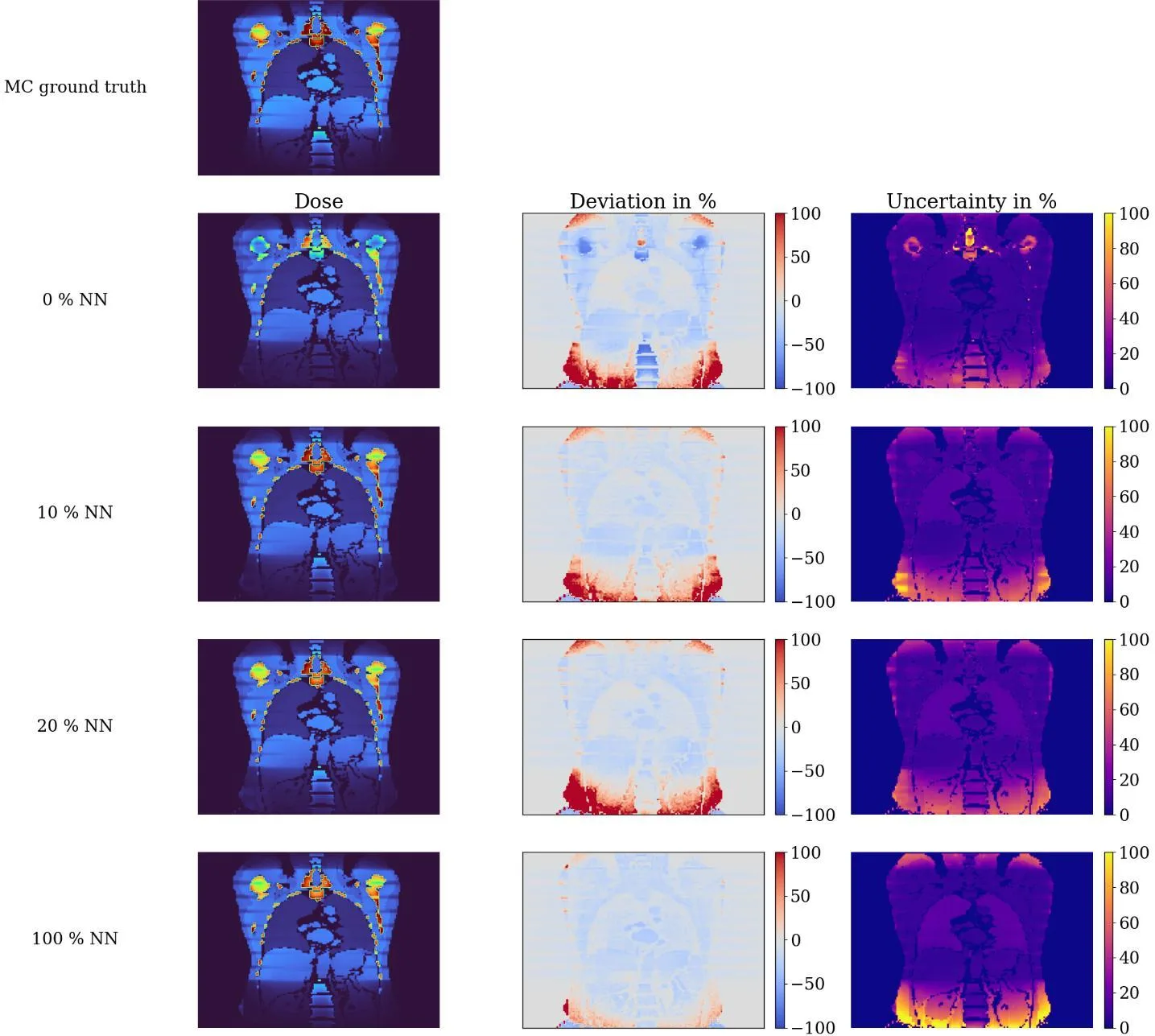
Researchers trained a neural network to predict the dose for each organ. Training requires examples, but real data are scarce: you can't irradiate people just for an experiment. So they created thousands of virtual bodies — computer phantoms with varying organ sizes and body shapes. A model trained only on such synthetic data made errors on small organs like the eye lens or thyroid gland.
This hybrid approach is like pilot training: first hundreds of hours on a simulator, then a few flights with an instructor. Virtual bodies provide variety, while real data anchor the model to reality. This reduces the need for actual medical records and helps make dosimetry personal.
Original abstract
as written by the authors arXiv:2601.09235
Personalized computed tomography (CT) dosimetry has great potential in assessing patient-specific radiation exposure, supporting risk assessment, and optimizing clinical protocols. The aim of this study is to evaluate the potential of synthetic anatomical data for improving machine learning-based personalized computed tomography (CT) dosimetry. It is investigated whether the combination of synthetic human body geometries with real patient data can improve model accuracy and generalization for CT organ dose estimation while maintaining the uncertainty requirements outlined in IAEA TRS-457. Deep learning models for organ dose prediction are trained using datasets with varying proportions of real and synthetic data. Synthetic datasets are generated from computational human phantoms with controlled distributions of organ volumes and body. A dedicated model uncertainty evaluation method is implemented to quantify prediction reliability and verify compliance with TRS-457 accuracy limits. Model performance and uncertainty are compared across different training data compositions, including a model trained solely on real patient data. As baseline validated Monte Carlo simulation is used. Models trained solely on synthetic data show limited predictive accuracy, particularly for small or peripheral organs. Incorporating as little as 10 % real patient data significantly improves both statistical accuracy and uncertainty estimates, achieving a performance comparable to that of real-only models. The hybrid training approach improves robustness across different anatomies while maintaining TRS-457-compliant uncertainty levels (k=2 uncertainty < 20% for adults). The results indicate that the combination of real and synthetic data in combination with a systematic uncertainty assessment supports the development of CT dosimetry models and at the same time reduces the amount of real data required.
The virtual phantoms for training were created with a controlled spread of organ volumes, from very small to very large, so the model wouldn't be surprised by the diversity of human bodies.