The Solar Knot That Unties Itself express
The Sun frequently launches narrow plasma jets, coronal jets, that resemble fountains of superheated gas erupting from the star's atmosphere. One such eruption, which occurred on November 10, 2022, caught scientists' attention: it was accompanied by a C1.1-class flare and had an unusually wide cone.
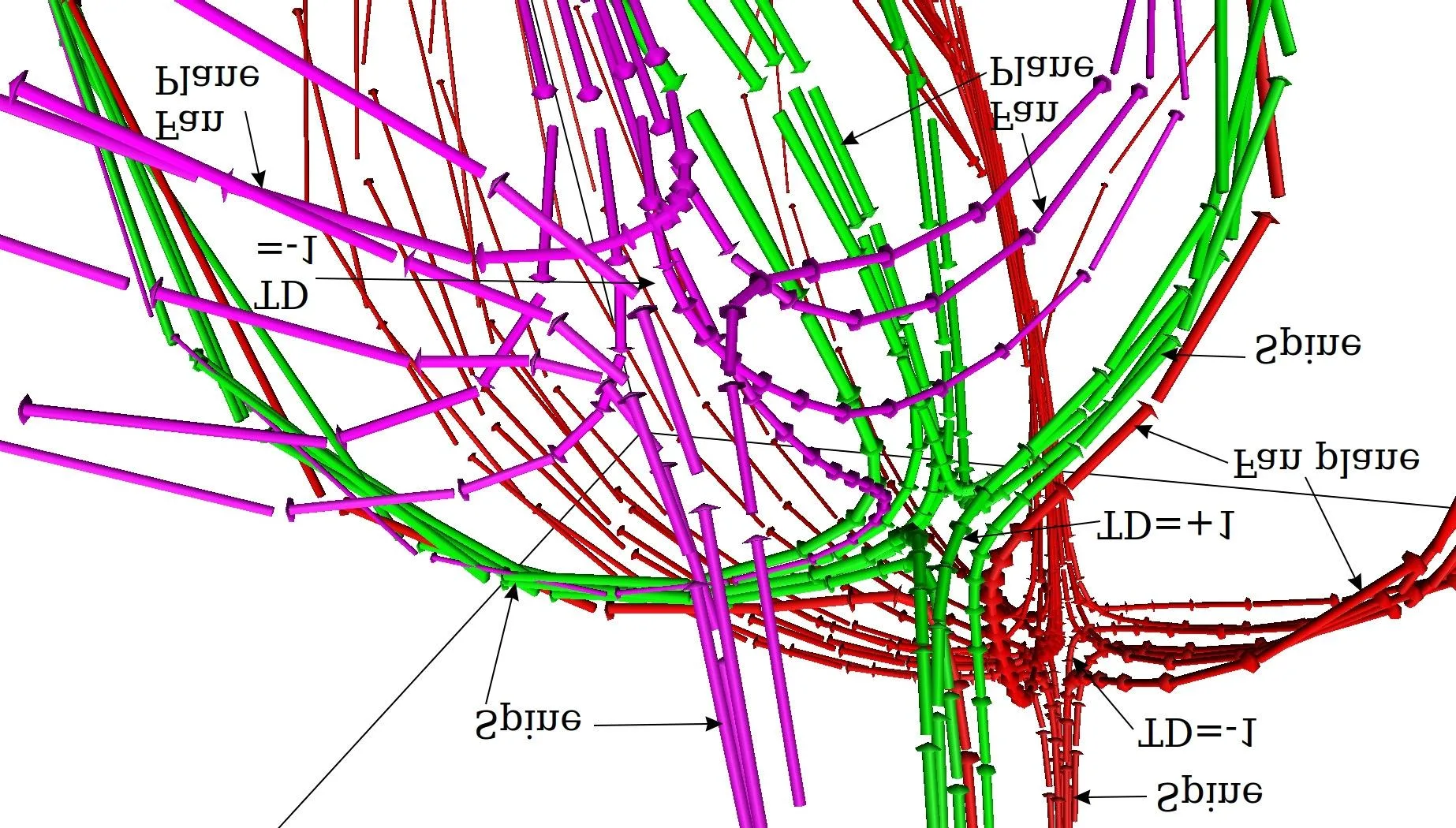
To understand what triggered this fountain, researchers built a computer model of the magnetic field in the active region of the Sun. The model revealed a special point, a three-dimensional null point where the magnetic field vanishes, and a twisted magnetic structure, a flux rope. As the flux rope began to move, magnetic field lines started to reconnect: they broke and rejoined, releasing energy.
The model showed that reconnection generated pairs of new null points, which immediately annihilated. This cascade triggered the simultaneous jet and flare. Such behavior had not been observed in detail before: it opens a new direction in the study of solar jets.
Original abstract
as written by the authors arXiv:2602.01742
Coronal jets are collimated plasma eruptions which are ubiquitous in the solar atmosphere. Believed to be triggered by magnetic reconnection, these jets can contribute to various phenomena, including coronal heating and particle acceleration. Coronal jets are a contemporary area of research with their onset mechanism meriting further attention. Importantly, a subclass of jets, the blowout jets, are particularly interesting because of their broad spire, suggesting substantial three-dimensional (3D) reconnection between open and closed field lines involving 3D null points. Consequently, here we explore the onset of a blowout jet associated with Active Region (AR) SPoCA 29093 detected by Spatial Possibilistic Clustering Algorithm (SPoCA). This AR produced a C1.1-class flare on 10 November 2022 and we investigate it using a data-constrained magnetohydrodynamic simulation initiated with a non force-free-field (NFFF) extrapolation of the photospheric magnetic field. Key elements of the extrapolated field lines are the presence of a 3D null and a magnetic flux rope (MFR) co-located with the jet activity region, the evolution of which is further traced in the simulation. The simulation suggests that magnetic reconnection is responsible for the evolution of the MFR, leading to a near-simultaneous onset of the flare and jet as observed by the AIA/SDO. In particular, the simulation shows spontaneous creation and annihilation of 3D null pairs via magnetic reconnection near the jet region. Such spontaneous null pair generation, in principle, can trigger or contribute to coronal jets; opening up a new avenue for further research.
Coronal jets can accelerate particles to high energies, contributing to the solar wind and space weather.