Relativistic jets are narrow, high-speed outflows of plasma and magnetic fields launched from the vicinity of black holes or neutron stars, traveling at speeds close to the speed of light. In active galactic nuclei, they are powered by accretion onto supermassive black holes and can extend for millions of light-years, far beyond their host galaxy. These jets are among the most energetic phenomena in the universe, emitting radiation across the entire electromagnetic spectrum and sometimes producing neutrinos and cosmic rays.
History
The concept of jets in active galaxies was established in the 1970s with radio observations, but the relativistic nature was confirmed in the 1980s with very long baseline interferometry (VLBI) showing apparent superluminal motion. The theoretical framework of magnetic launching was developed by Roger Blandford and Roman Znajek in 1977.
How it works
The jet is launched by the twisting of magnetic field lines anchored in the rotating accretion disk or the black hole's ergosphere. As matter falls inward, the magnetic field extracts rotational energy and accelerates plasma outward along the black hole's spin axis. The jet's emission is produced by synchrotron radiation from relativistic electrons spiraling in the magnetic field, and by inverse Compton scattering of low-energy photons to high energies. When the jet is pointed toward Earth, it appears as a blazar, with its emission boosted by relativistic beaming.
In practice
Relativistic jets are studied to understand black hole spin and accretion physics, and they serve as natural particle accelerators, with some of the highest-energy cosmic rays and neutrinos traced back to them.
Fun fact
The jet in the galaxy M87, imaged by the Event Horizon Telescope, appears to wobble, providing direct evidence of the black hole's spin influence on the jet direction.
Universal constant of gravitation, determining the strength of gravitational force. — gravitational constant= 6.67430e-11cubic metre per kilogram per second squared
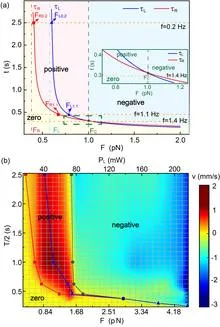
A swing that rocks on a sawtooth hill behaves strangely: without kicks, it gets stuck in the first dip, but with rhythmic pushes it can move uphill, downhill, or stay frozen in place. That is exactly what physicists saw when they placed a single dust grain in a trap with a sawtooth bottom and started pushing it alternately with laser beams.
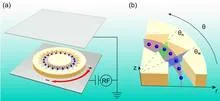
In a ring-shaped channel between two toothed rings, microspheres are suspended: some with a radius of 8 micrometers, others 14. The discharge is switched on, and the particles start moving. The small ones go one way, the large ones the other. It is like a shopping mall where escalators for people of different heights run in opposite directions.
A particle with an energy of $$10^{18}$$ eV hitting Earth's atmosphere is like a tennis ball traveling at 200 km/h slamming into a wall. Astrophysicists have debated for decades where such projectiles come from. Gamma-ray bursts, brief and powerful explosions of gamma radiation, have long been suspected as accelerators.
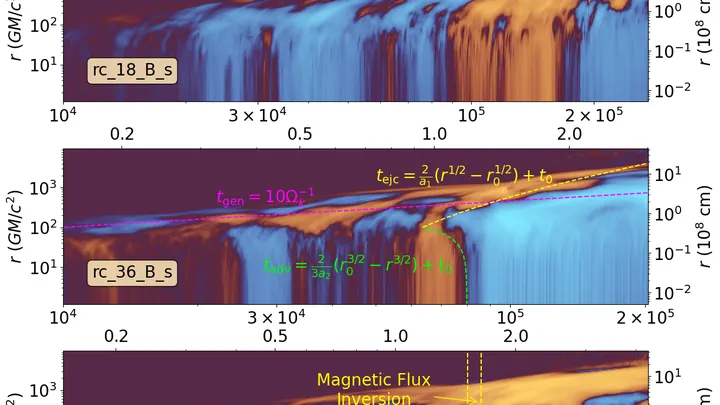
A whirlpool gulps down water, but splashes most of it back out. That's roughly how a black hole behaves when too much matter falls onto it. In a new study, astrophysicists ran 32 computer simulations to understand how a black hole's parameters — mass, spin, and "appetite"—control these cosmic fountains.
The fastest wind in the Universe travels at 0,58 times the speed of light. It covers the distance from Earth to the Moon in two seconds. This wind is not a jet stream but a broad flow of gas erupting from the center of a galaxy. Not all black holes work the same: some create such hurricanes, while others produce narrow plasma beams.
Seventy-two protoplanetary disks, swirling cocoons of cosmic dust and gas, came under the gaze of the MIRI instrument on JWST. Most of them shoot outflows into space: dense conical structures and narrow, high-speed jets. They blast like fountains. This process is not accidental.
At the center of a distant galaxy, where a supermassive black hole weighing a hundred million suns spins, space is threaded with magnetic fields. They coil into tight vortices, like a drain in a sink, but instead of water, there's plasma whipped up to near-light speeds.
The collapse of a star's core is like compressing a spring: matter falls inward, and a neutron star is born at the center. But the fall is never perfectly smooth. In the boiling outer layers, random eddies transfer angular momentum to the infalling gas, and a disk swirls around the central object.
This disk is no calm river. It pulses, strengthening and fading.
A branch falls into a whirlpool. It gets spun and broken, but sometimes a powerful fountain of water bursts from the center. Similarly, a black hole tears apart a passing star, and occasionally a blinding plasma jet, a jet, shoots into space.
Ten billion years ago, the universe was speckled with strange crimson sparks. The JWST spotted them in images at distant redshifts — compact sources blazing like entire galaxies yet no larger than a tiny central region. Astronomers nicknamed them “little red dots.” Their nature long defied explanation.
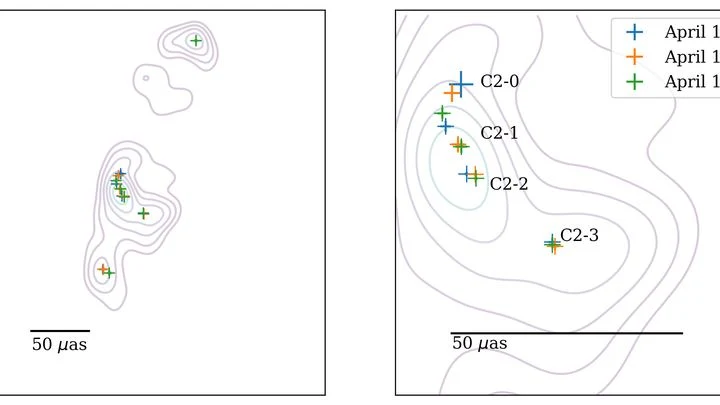
In April 2021, the antennas of the Event Horizon Telescope (EHT)—a global network of millimeter-wave radio telescopes — zeroed in on a tiny spot in the constellation Virgo.
The cosmos is full of screams we can't hear. Every time a black hole tears a star apart, a blinding flash is born, and often — a narrow relativistic jet, shooting out thousands of light-years. But if that searchlight is aimed away from Earth, we see only a faint afterglow — a radio echo arriving with a delay.
For years, silence reigned in the heart of galaxy 1ES 1927+654: the accreting gas merely whispered in X-rays, leaking slow winds. But in 2022–2025, the picture changed dramatically. Spectra taken by XMM-Newton and Swift lit up with emission lines — a narrow peak at 0.56 keV, likely from OVII oxygen, a broader feature near 1 keV, and a powerful iron band in the 6–7 keV region.
In the constellation Aquila, about 40,000 light-years away, one of the most powerful natural accelerators in the Galaxy is at work. It's the microquasar GRS 1915+105—a pair consisting of an ordinary star and a black hole.
Nearly a decade and a half ago, the Fermi gamma-ray telescope spotted mysterious "bubbles" — giant plasma blobs, as if inflated by invisible lungs, towering tens of thousands of light-years from the Galactic center.
Blazars are long-lasting beams from black holes at the centers of galaxies. Gamma-ray bursts are the briefest flashes from supernova explosions or neutron star mergers. The former act like eternal spotlights, the latter like camera flashes.
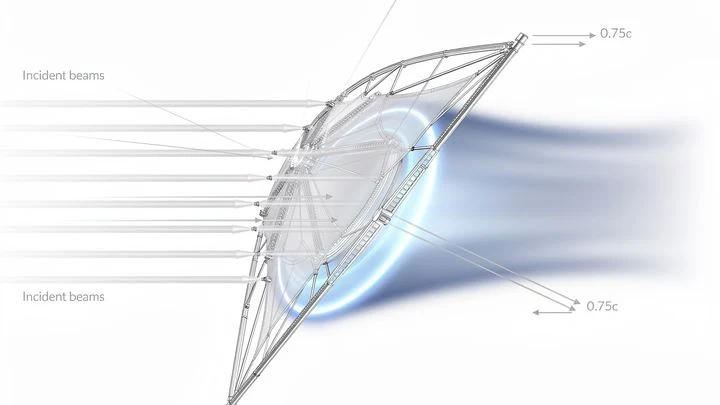
Imagine a three-faced dancer on the crest of a light wave. One face is a catcher, absorbing incoming photons. The second is a perfect mirror, throwing light back. The third is frosted glass, scattering rays in all directions. As long as speed is low, the dance is harmonious. But at near-light speeds, the choreography breaks.
This is like a surfer chasing a wave.
A powerful vacuum cleaner sucks in not only dust but also its own collection bag. That's roughly how a black hole behaves at the center of a 'red dot'—a distant galaxy where the glow comes not from the hole itself but from its dense gas shroud. This shroud is so thick it resembles a puffed-up cool star. And, like many stars, it has a magnetic field.
A massive star collapses, and a black hole is born, surrounded by a disk of incandescent plasma. For narrow jets to burst out of this disk, an ordered magnetic field is needed. But inside the star, it's tangled.
At the center of many galaxies sits a supermassive black hole. When gas falls onto it, the gas heats up and shines brighter than an entire galaxy: this is an active galactic nucleus. Sometimes a true hurricane erupts from there: a stream of ionized gas racing at tens of percent of the speed of light.
A newborn star is like a kitchen mixer: it whips up the surrounding cloud, and splatters fly in all directions. Only instead of batter, it's gas and dust. Previously, astronomers had only seen gas jets, and dust was considered too fragile: the shock wave should shatter dust grains into atoms.
Near black holes and neutron stars, plasma churns like water in a boiling kettle. But this 'kettle' has no walls — only magnetic fields that twist and tear. At the tears, thin sheets form where magnetic field lines reconnect, giving particles a kick like a surfer catching a wave.
A stream of water from a hose hitting a wall splashes sideways. Astrophysical jets behave similarly — narrow plasma flows ejected from the vicinity of black holes or young stars. When such a flow encounters resistance from surrounding gas, a shock wave forms inside it, akin to a standing wave in a fast-flowing river.
When two lead nuclei collide at tremendous speed, a cloud of scorching matter is born for an instant — denser and hotter than the center of the Sun. Through this cloud fly jets of particles: narrow, laser-like beams knocked out by the impact. The CMS detector captures their tracks and shows how the jets change as they fight through the hot 'fog'.
A garden hose blasts a powerful stream of water. If you pinch it or give it a jerk, the stream starts to writhe like a snake, and spray flies everywhere. Something similar happens with the giant plasma jets that black holes shoot out.
Not all water in a whirlpool goes down the drain: some splashes back up in narrow sprays. Gas near a black hole behaves similarly. It falls, heats up, collides with itself, and part of it is ejected back into space in two narrow jets that fly in opposite directions.
From the center of a galaxy, where a black hole lurks, narrow jets of hot gas shoot out in opposite directions. They shine across vast distances, sometimes longer than the galaxy itself.
When two protons collide at enormous speed, a narrow beam of particles (a jet, like the spray from a stone thrown into water) shoots out from the point of impact. In collisions of heavy lead nuclei, things are more complicated: a hot cloud forms inside, which interferes with the jet's straight flight.
Black holes are cosmic drains, gravitational funnels that pull in matter from their surroundings. This process, called accretion, doesn't always go smoothly: some of the infalling gas can be ejected back as narrow relativistic jets — jets.
A young star that hasn't yet ignited its thermonuclear furnace is surrounded by a rotating disk of gas and dust. To gain mass, it needs to shed excess rotation — otherwise, material won't fall onto the star but will keep orbiting. Usually, this excess is carried away by two narrow gas jets that shoot from the star's poles in opposite directions, like two fountains.
One night in 2008, something in the core of the distant galaxy J1047+5907 flared sharply in X-rays. That's how the neighborhood of a supermassive black hole sometimes behaves: a scorching cloud of gas above it suddenly blasts out a powerful stream of light. The black hole itself emits nothing, but its surroundings can light up like a neon sign.
The Sun frequently launches narrow plasma jets, coronal jets, that resemble fountains of superheated gas erupting from the star's atmosphere. One such eruption, which occurred on November 10, 2022, caught scientists' attention: it was accompanied by a C1.1-class flare and had an unusually wide cone.
At the center of galaxy NGC 4278 sits a black hole that shoots out two plasma jets, like a giant cannon firing particles into space. These jets accelerate particles to energies that no earthly accelerator could ever dream of.
Astronomers nicknamed them 'little red dots' — distant galaxies where a giant black hole hides at the center, wrapped in a thick layer of hydrogen. This packaging isn't just camouflage; it's a natural cannon. The black hole sucks in matter, but some of it is spat back out in narrow jets.
At the center of galaxy VV 340a lies a supermassive black hole — an object with gravity so strong that even light cannot escape it. It emits a relativistic jet: a narrow stream of matter accelerated to near-light speeds.
At night, invisible bullets streak across the sky — cosmic rays. These are atomic nuclei accelerated to near-light speeds. The Galaxy's magnetic fields tangle their paths, making it hard to pinpoint where they were born.
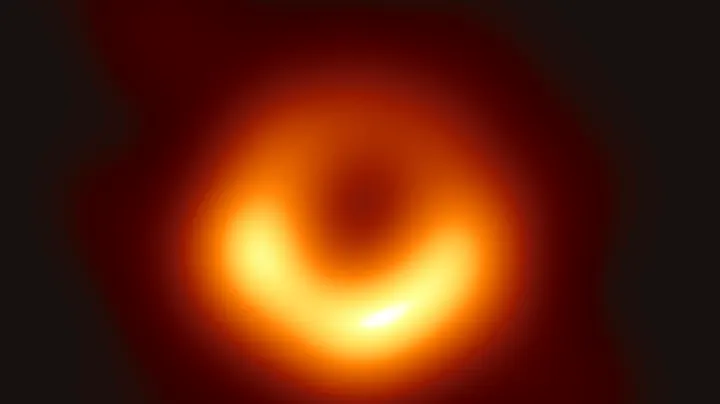
In 2019, astronomers unveiled the first-ever image of a black hole's shadow — a dark void encircled by a lopsided orange ring. This is the supermassive black hole at the heart of galaxy M87, 55 million light-years away. The ring isn't just glowing: one side is noticeably brighter than the other, like a campfire burning unevenly, with flames leaping higher on one side.
The James Webb Space Telescope spotted a luminous streak in a distant galaxy, like the wake of a speedboat, only two hundred thousand light-years long. At the head of this trail races a supermassive black hole, plowing through tenuous gas at 954 km/s. The gas gets compressed, heats up, and glows.
Gamma-ray bursts are the most powerful explosions in the Universe: a dying star collapses into a black hole, ejecting streams of energy. Often this happens after a supernova flare. But astronomers caught a strange rhythm — in the emission of 34 such bursts, clear pulsations appeared, like beats of a cosmic heart.