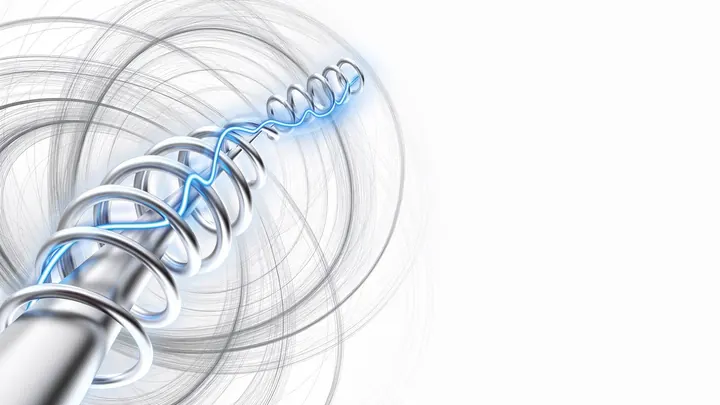
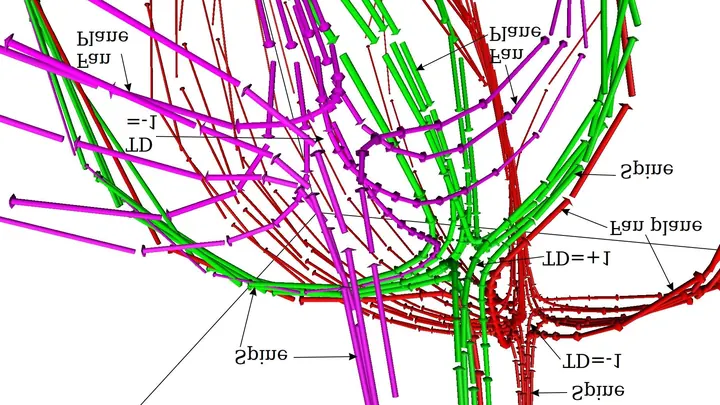
Jet magnetic signature refers to the distinctive pattern of magnetic fields revealed by the twisted or structured appearance of relativistic jets emitted from cosmic accelerators such as active galactic nuclei, microquasars, and gamma-ray bursts. These jets are collimated outflows of plasma moving at speeds close to the speed of light, and their magnetic fields play a crucial role in their formation, collimation, and acceleration. The magnetic signature can be observed through the polarization of light emitted by the jet, which reveals the orientation and structure of the magnetic field along the jet's path.
History
The study of jet magnetic fields began with early radio observations of active galaxies in the 1970s, which revealed polarized emission from jets. The concept of helical magnetic fields in jets was developed in the 1980s and has been supported by increasingly detailed observations across the electromagnetic spectrum.
How it works
The magnetic fields in jets are thought to be generated by the accretion disk around a compact object, such as a black hole, and are twisted into helical structures as the disk rotates. This helical magnetic field helps to collimate the jet, focusing the plasma into a narrow beam, and can also accelerate particles to high energies through magnetic reconnection and shock acceleration. The observed polarization patterns in jet emission, such as the degree and angle of polarization, provide a direct probe of the magnetic field geometry, allowing astronomers to map the field's structure and its evolution along the jet.
In practice
Analyzing jet magnetic signatures helps astronomers understand the physics of black hole accretion and jet launching, and it is used to interpret observations from radio telescopes like the Very Large Array and the Event Horizon Telescope.
Fun fact
The magnetic field in some jets can be so strong that it would be millions of times stronger than the Earth's magnetic field, yet it is still not enough to prevent the jet from bending over thousands of light-years.
Seventy-two protoplanetary disks, swirling cocoons of cosmic dust and gas, came under the gaze of the MIRI instrument on JWST. Most of them shoot outflows into space: dense conical structures and narrow, high-speed jets. They blast like fountains. This process is not accidental.
The cosmos is full of screams we can't hear. Every time a black hole tears a star apart, a blinding flash is born, and often — a narrow relativistic jet, shooting out thousands of light-years. But if that searchlight is aimed away from Earth, we see only a faint afterglow — a radio echo arriving with a delay.
At the center of many galaxies lurks a supermassive black hole, ejecting relativistic plasma jets over hundreds of kiloparsecs. One such is the radio galaxy ESO 137-G007 in the Norma Cluster, known as the “Corkscrew Galaxy” for its twisted jets.
A fire hose blasts into a snowdrift. The water doesn't just shove the snow aside — at the point of impact, spray, steam, and a roar are born. That's roughly how jets behave: narrow streams of matter shooting out from around a black hole at enormous speeds.
A translator works in two worlds at once: to an outside observer, they are silent and unobtrusive, but inside their mind, a flurry of activity unfolds along clear lines of meaning. Altermagnets, a recently discovered class of magnetic materials, are much the same.
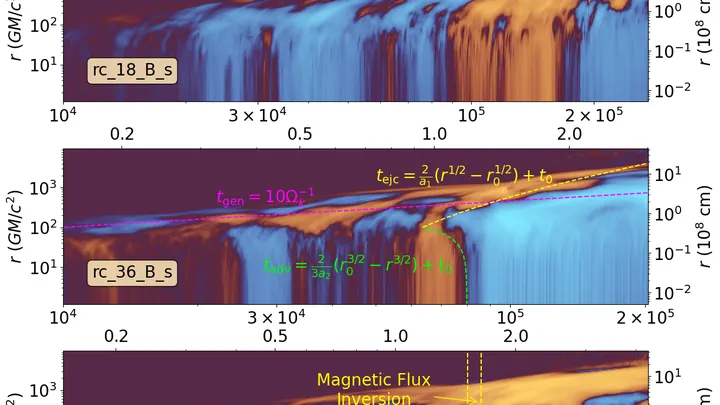
A massive star collapses, and a black hole is born, surrounded by a disk of incandescent plasma. For narrow jets to burst out of this disk, an ordered magnetic field is needed. But inside the star, it's tangled.
In 2017, detectors picked up a tremor in space — gravitational waves from the merger of two neutron stars. At the same moment, telescopes saw a flash. For the first time, one event spoke in two languages at once: light and gravity.
Einstein and Rosen imagined a bridge connecting two sheets of reality. Wheeler gave it a name — wormhole, and Thorne with Morris proved: the tunnel is traversable if you fill it with exotic matter.
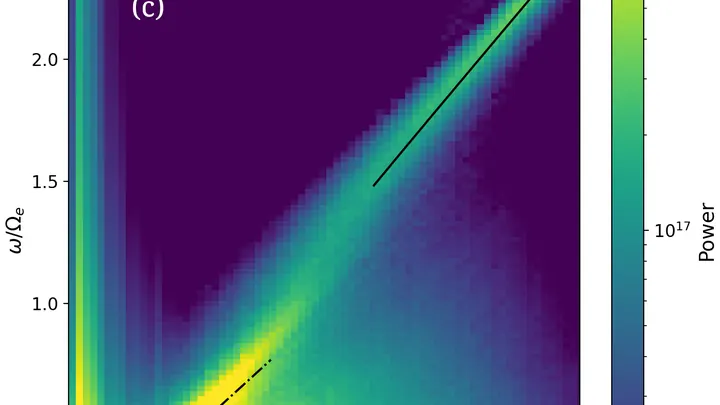
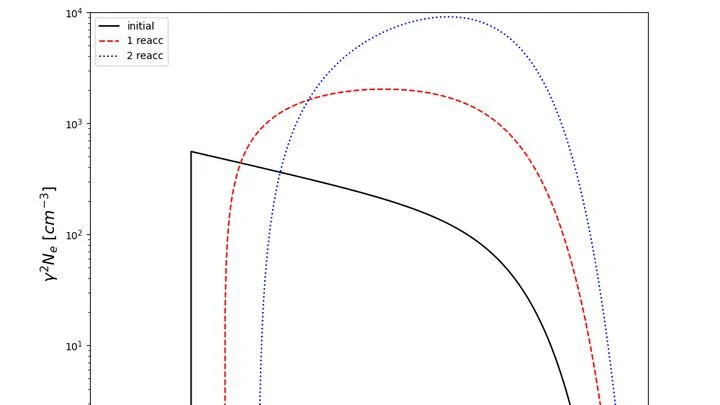
When water boils in a kettle, waves of steam ripple through the kitchen. A similar process happens in space, in plasma — gas so hot that electrons are stripped from atoms. Around black holes and neutron stars, this plasma isn't just hot: its particles zip around at nearly the speed of light.
A massive star, 40 times heavier than the Sun, dies in a fraction of a second. Its core compresses like a spring squeezed too hard, then snaps back: that's a supernova explosion. But what if the star is also spinning, like a figure skater pulling in their arms, and threaded with a magnetic field, like invisible strings?
A stream of water from a hose hitting a wall splashes sideways. Astrophysical jets behave similarly — narrow plasma flows ejected from the vicinity of black holes or young stars. When such a flow encounters resistance from surrounding gas, a shock wave forms inside it, akin to a standing wave in a fast-flowing river.
When two lead nuclei collide at tremendous speed, a cloud of scorching matter is born for an instant — denser and hotter than the center of the Sun. Through this cloud fly jets of particles: narrow, laser-like beams knocked out by the impact. The CMS detector captures their tracks and shows how the jets change as they fight through the hot 'fog'.
A garden hose blasts a powerful stream of water. If you pinch it or give it a jerk, the stream starts to writhe like a snake, and spray flies everywhere. Something similar happens with the giant plasma jets that black holes shoot out.
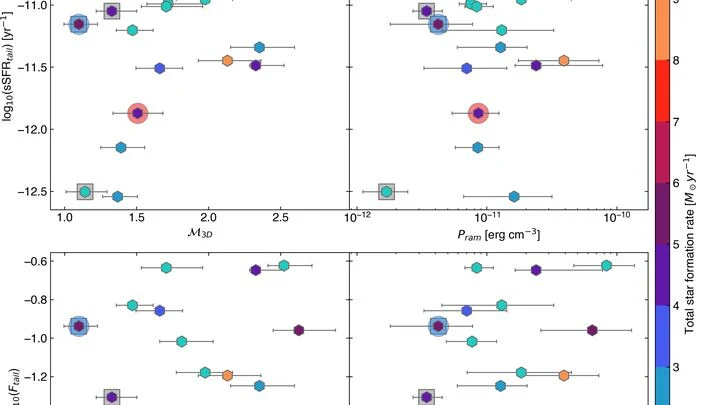
A galaxy plunges into a dense cluster like a runner into a crowd. The oncoming gas, known as the intracluster medium, strips away its own gas, stretching it into a long, glowing tail. Astronomers call these galaxies jellyfish: they have a body and flowing tentacles of stripped material. But only in a few do new stars ignite within those tentacles.
When two protons collide at enormous speed, a narrow beam of particles (a jet, like the spray from a stone thrown into water) shoots out from the point of impact. In collisions of heavy lead nuclei, things are more complicated: a hot cloud forms inside, which interferes with the jet's straight flight.
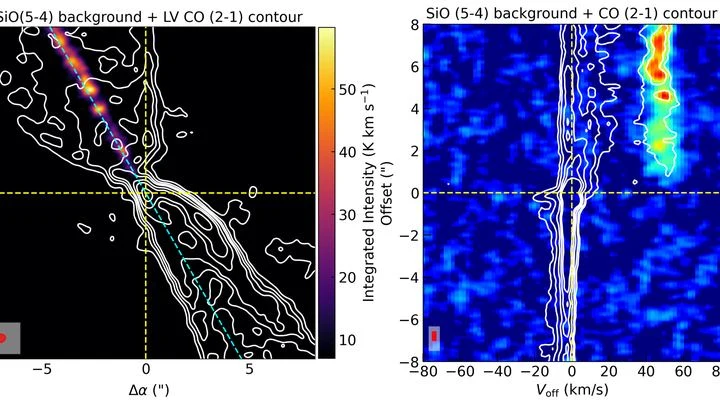
A young star that hasn't yet ignited its thermonuclear furnace is surrounded by a rotating disk of gas and dust. To gain mass, it needs to shed excess rotation — otherwise, material won't fall onto the star but will keep orbiting. Usually, this excess is carried away by two narrow gas jets that shoot from the star's poles in opposite directions, like two fountains.
A blazar is a distant galaxy with a plasma jet shooting from its center, aimed almost directly at us. Inside this jet, particles are accelerated to near-light speeds and emit powerful radiation.
The Sun frequently launches narrow plasma jets, coronal jets, that resemble fountains of superheated gas erupting from the star's atmosphere. One such eruption, which occurred on November 10, 2022, caught scientists' attention: it was accompanied by a C1.1-class flare and had an unusually wide cone.
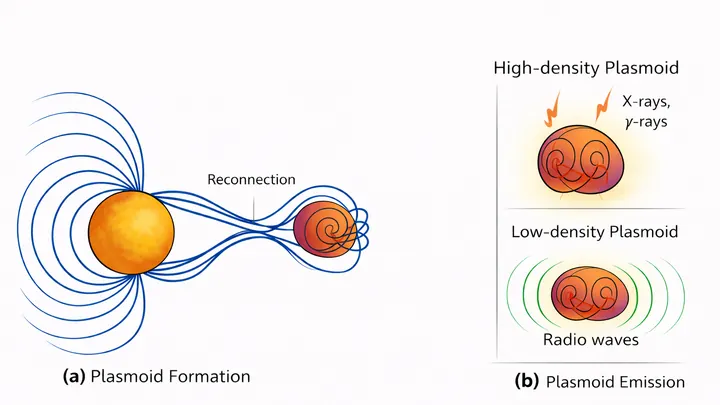
A magnetar is a neutron star with a magnetic field a quadrillion times stronger than Earth's. Sometimes it ejects a blob of plasma, like a tiny balloon with thousands of invisible springs bouncing around inside.