The Solar Knot That Unties Itself express
The Sun frequently launches narrow plasma jets, coronal jets, that resemble fountains of superheated gas erupting from the star's atmosphere. One such eruption, which occurred on November 10, 2022, caught scientists' attention: it was accompanied by a C1.1-class flare and had an unusually wide cone.
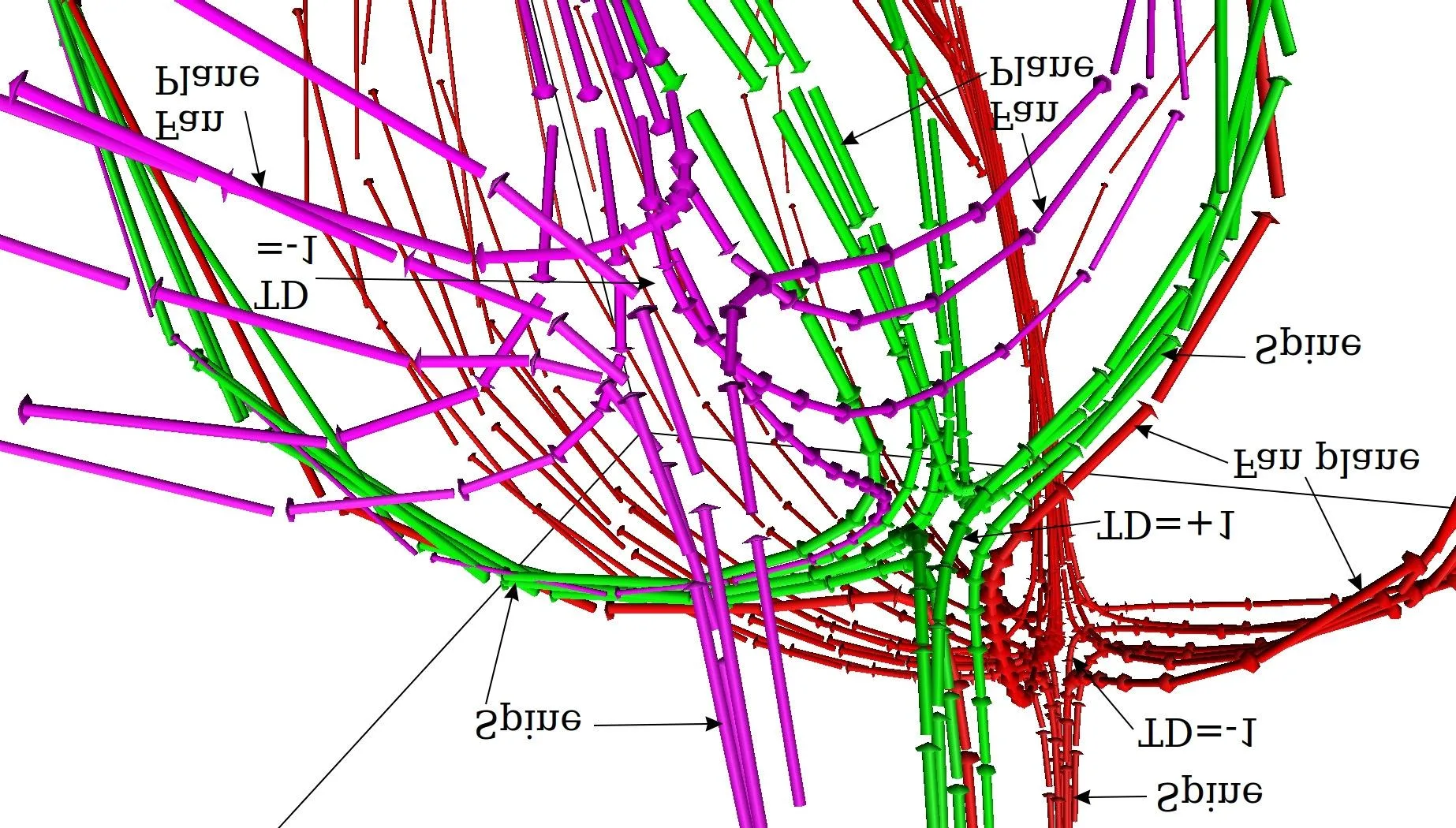
To understand what triggered this fountain, researchers built a computer model of the magnetic field in the active region of the Sun. The model revealed a special point, a three-dimensional null point where the magnetic field vanishes, and a twisted magnetic structure, a flux rope. As the flux rope began to move, magnetic field lines started to reconnect: they broke and rejoined, releasing energy.
The model showed that reconnection generated pairs of new null points, which immediately annihilated. This cascade triggered the simultaneous jet and flare. Such behavior had not been observed in detail before: it opens a new direction in the study of solar jets.
Coronal jets can accelerate particles to high energies, contributing to the solar wind and space weather.