Black hole magnetohydrodynamics (MHD) is the study of how ionized gas (plasma) and magnetic fields interact in the extreme environment around a black hole. This field is crucial for understanding how matter falls into a black hole (accretion), how some of that matter is ejected as powerful jets, and how these processes generate some of the most energetic phenomena in the universe, such as quasars and gamma-ray bursts. The presence of magnetic fields fundamentally changes the behavior of the inflowing plasma, enabling angular momentum transport, turbulence, and the launching of relativistic outflows.
History
The foundations of black hole MHD were laid in the 1970s with the work of Roger Blandford and Roman Znajek on jet formation, and the identification of the magnetorotational instability by Steven Balbus and John Hawley in 1991, which explained how accretion disks become turbulent. Since then, numerical simulations have become the primary tool for studying these systems.
How it works
The core mechanism is the magnetorotational instability (MRI), where a weakly magnetized plasma in a differentially rotating disk becomes turbulent, allowing angular momentum to be transported outward and matter to spiral inward. Near the black hole, the magnetic field lines become twisted by the rotation, and the resulting magnetic pressure can accelerate plasma along the field lines, forming collimated jets. General relativistic effects — such as frame dragging — further modify the field structure and energy extraction, potentially allowing the black hole's rotational energy to be tapped via the Blandford–Znajek process.
In practice
Black hole MHD simulations are used to interpret observations from telescopes like the Event Horizon Telescope, which imaged the shadow of M87* and Sgr A*, and to predict the polarization and variability of emission from accretion flows.
Fun fact
The magnetic field near a black hole can be so strong that it extracts energy from the black hole's rotation itself, effectively slowing the black hole down over time — a process that can power jets brighter than entire galaxies.
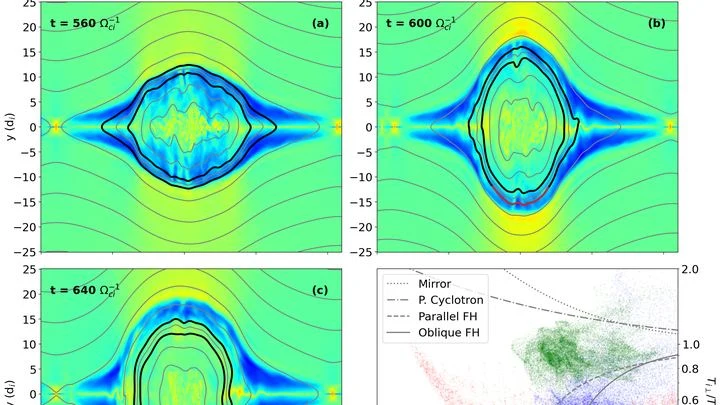
In a binary star system, a white dwarf acts like a vacuum cleaner, pulling gas from its companion star. If the dwarf has a magnetic field, the gas does not fall anywhere but flows toward the poles, like iron filings to a magnet. There it accumulates into a pile. But what keeps this pile from spreading out?
Two galaxies (our Milky Way and its satellite, the Large Magellanic Cloud) slowly circle each other. Their gravitational pull stirs the distant outskirts of the Milky Way, like a pebble thrown into a pond makes the water ripple.
Inside planets and stars, in rotating oceans of plasma, turbulent flows, Coriolis forces, and magnetic tension collide. The central question is how the energy of this chaos crystallizes into a stable magnetic framework that can last billions of years.
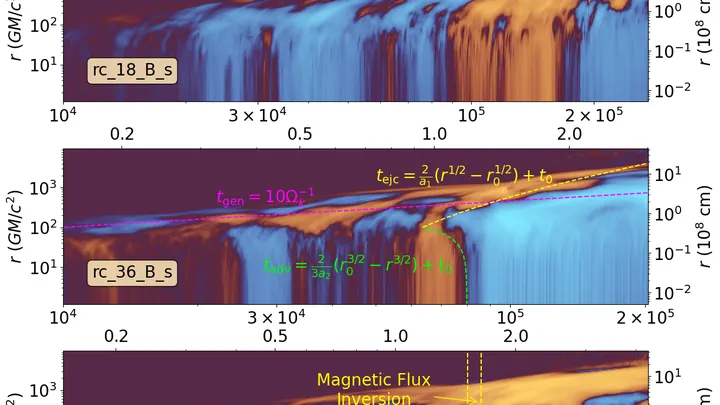
The heart of many galaxies is a supermassive black hole. It doesn't just sit at the center; it occasionally flares brightly as it swallows surrounding gas.
A thick rubber band is twisted tighter and tighter. At some point, it can't take it anymore — it snaps and whips around, releasing the stored energy. That's roughly how magnetic fields inside neutron stars — the ultra-dense remnants of exploded stars — behave.
A massive star collapses, and a black hole is born, surrounded by a disk of incandescent plasma. For narrow jets to burst out of this disk, an ordered magnetic field is needed. But inside the star, it's tangled.
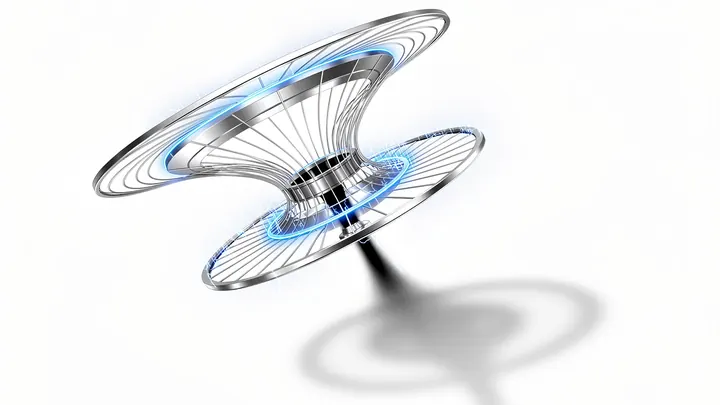
The shadows of supermassive objects at the centers of galaxies, M87 and the Milky Way, have become icons of modern astrophysics. But what if these shadows are not from absorption, but passage? The equations of Einstein allow for traversable wormholes — tunnels in the fabric of spacetime.
A juggler tosses clubs while sitting on a spinning chair. If he starts spinning the clubs all in one direction, the chair will rotate the opposite way — otherwise, the conservation of angular momentum would be violated.
Two stars orbit a common center, accreting gas from a surrounding cloud. Rotating disks of gas form around each star and around the pair as a whole. From these disks, jets shoot out like hoses. Inside the disks, gas is constantly churned — that's the magnetorotational instability at work.
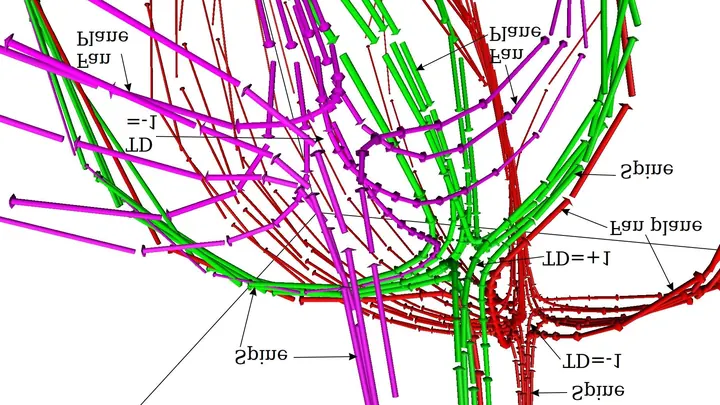
Space plasma is not a calm gas but a boiling soup of charged particles threaded with magnetic fields. These fields behave like stretched rubber bands: sometimes they snap and immediately reconnect, but in a different configuration. This process, called magnetic reconnection, releases enormous energy.
A magnetar is a neutron star with a magnetic field hundreds of millions of times stronger than Earth's. If you brought an ordinary magnet near such a field, it would instantly lose its magnetism, and atoms would stretch into thin filaments.
A powerful laser strikes a tiny target, and it instantly turns into a cloud of scorching gas — plasma. Within this cloud, magnetic fields spontaneously arise. Like invisible hands, they prevent heat from freely escaping the hot core.
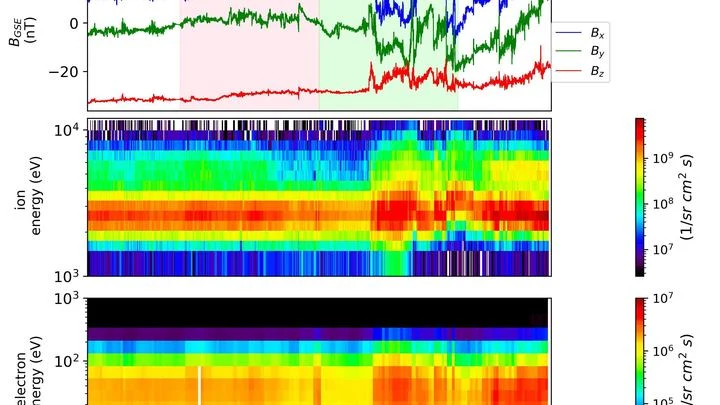
October 10, 2024. The Sun hurled a cloud of magnetized plasma toward Earth, and four spacecraft, stationed at a single point between the Sun and Earth, simultaneously recorded how that cloud churned. The distance between the outermost probes was just 80 Earth radii, about half a million kilometers.
In a jar of oily liquid float millions of tiny magnetic grains: each about the size of a bacterium. Switch on a magnet, and the grains, like obedient little soldiers, line up into long threads. But why do they form threads rather than clumps? It turns out it's not just about magnetism.
The Sun frequently launches narrow plasma jets, coronal jets, that resemble fountains of superheated gas erupting from the star's atmosphere. One such eruption, which occurred on November 10, 2022, caught scientists' attention: it was accompanied by a C1.1-class flare and had an unusually wide cone.
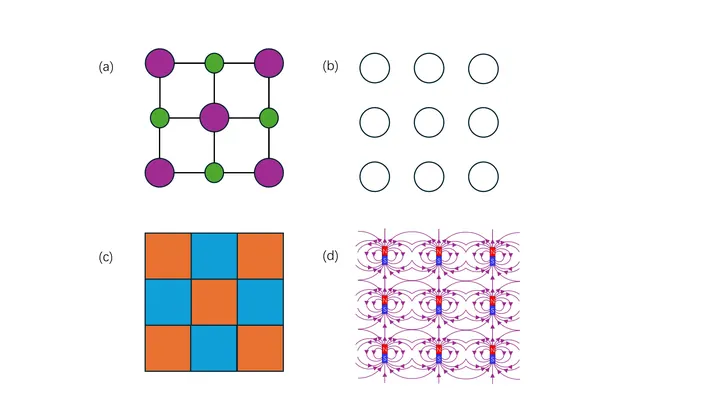
Plasma is a gas heated so intensely that electrons are stripped from atoms. Waves run through it, akin to sound in air, but they are governed by the magnetic field. When the magnetic field becomes periodic rather than uniform, like a fence with alternating slats, waves behave differently. Some frequencies simply vanish: the wave cannot propagate and is reflected back.
Around young stars, flat clouds of gas and dust swirl: these are the birthplaces of planets. For matter in such a disk to clump together, it must be constantly stirred. But what makes the gas move chaotically when it would otherwise be calm? Part of the answer lies in the fact that the gas in the disk barely conducts electricity: it is weakly ionized.