The Mystery of White Dwarfs with a Long Delay express
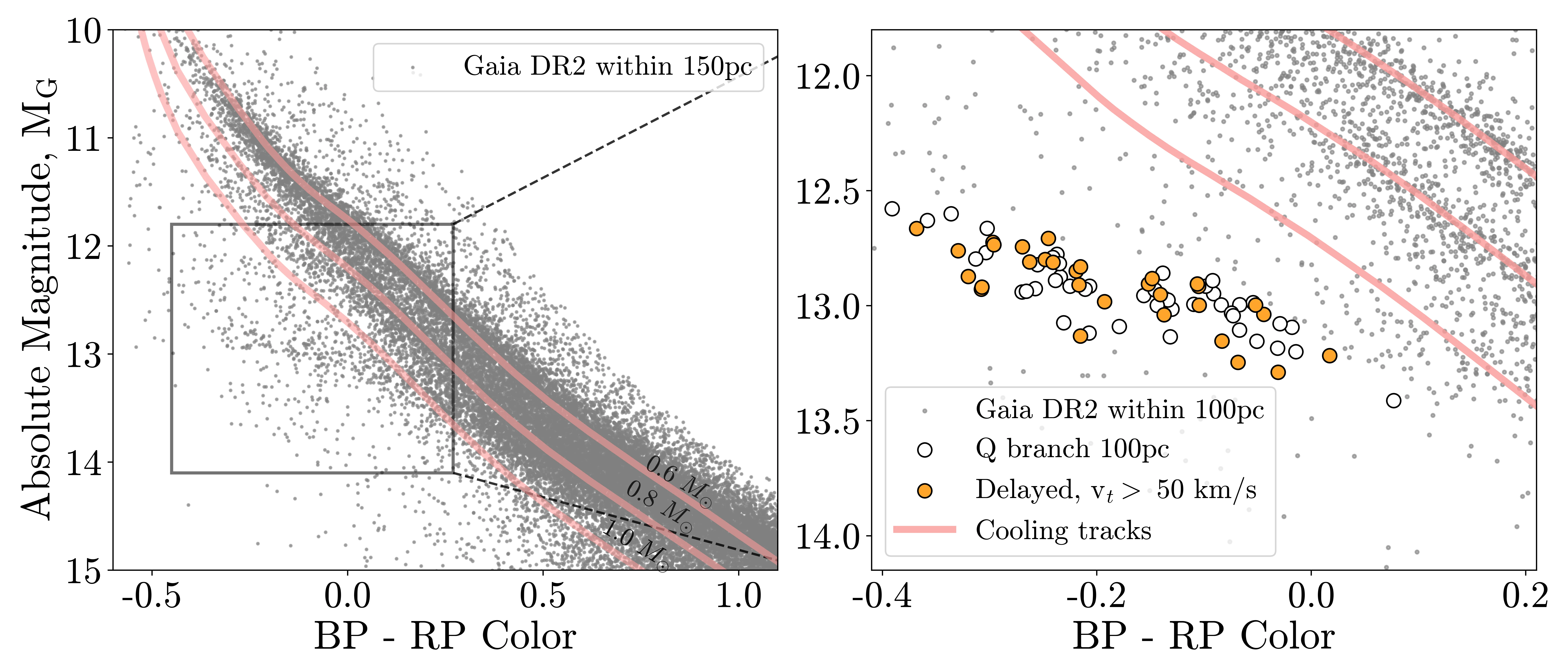
An old star like the Sun, at the end of its life, shrinks into a white dwarf — a dense sphere about the size of Earth. After that, it simply cools down, like embers in a campfire. But some white dwarfs somehow stay hot for billions of years. Astronomers studied such objects within a radius of one hundred parsecs from us and found an unexpected pattern.
It was thought that the long cooling delay is linked to the merger of two white dwarfs: the collision releases energy and produces a strong magnetic field. But the most "delayed" dwarfs show no magnetism and rotate slowly. It seems that the signs of merging are erased over the cooling time, or these stars were born differently.
In addition, two dwarfs with hydrogen atmospheres showed brightness pulsations. One of them is hotter than expected for such pulsations. This pushes the boundaries of the zone where white dwarfs can "shiver."
Original abstract
as written by the authors arXiv:2602.02670
A population of anomalous ultra-massive white dwarfs discovered with Gaia, often referred to as the Q branch, show high (multi-Gyr) cooling delays produced by exotic physical mechanisms. They are believed to be the products of stellar mergers, but the exact origin and formation channel remain unclear. We obtained a spectroscopically complete, volume-limited sample of the Q branch region within 100 pc, and found significant differences in atmospheric composition and rotation rates as a function of tangential velocity. In particular, we discover that stellar remnants with the longest cooling delays do not show strong magnetism nor detectable short-period rotational variability, as opposed to what is generally believed for double-degenerate mergers. This indicates that either these white dwarfs arise from a formation channel with no strong magnetism induced, or that the magnetism produced from the merger dissipates over the cooling delay timescales. Our follow-up photometry has also discovered pulsations in the second and third hydrogen-dominated DAQ white dwarfs, one hotter than 15,500 K, possibly extending the boundaries of the DAV instability strip for white dwarfs with thin hydrogen layers.
A white dwarf is so dense that a teaspoon of its material would weigh as much as several elephants.