A magneticwhite dwarf is a stellar remnant—the dense core left after a Sun-like star exhausts its nuclear fuel—that possesses an exceptionally strong magnetic field, often thousands to millions of times stronger than that of the Sun. These fields profoundly affect the star's structure, cooling rate, and the appearance of its spectrum, as the magnetic field splits spectral lines (Zeeman effect) and can even distort the star's shape.
History
The first magneticwhite dwarf was discovered in 1970 by James Kemp and collaborators, who observed circular polarization in the star Grw+70°8247. Since then, surveys have found hundreds, with the recent discovery of 32 new ones (as referenced in the title) expanding the known population.
How it works
The magnetic field is thought to be a fossil remnant from earlier evolutionary stages, possibly amplified by differential rotation or convection during the star's collapse. The field interacts with the charged particles in the star's atmosphere, altering energy transport and creating distinct polarization patterns in the emitted light. In some cases, the field can also influence the accretion of matter from a companion star, funneling it toward the magnetic poles.
In practice
Magneticwhite dwarfs serve as natural laboratories for studying extreme matter under intense magnetic fields, and they are important for understanding stellar evolution and the physics of accretion in binary systems.
Fun fact
Some magneticwhite dwarfs have fields so strong that they can slow down the infalling matter from a companion star, creating a 'propeller' effect that ejects material instead of letting it accumulate.
In a binary star system, a white dwarf acts like a vacuum cleaner, pulling gas from its companion star. If the dwarf has a magnetic field, the gas does not fall anywhere but flows toward the poles, like iron filings to a magnet. There it accumulates into a pile. But what keeps this pile from spreading out?
In a close binary system, one star can spend years transferring its material to its companion, like a person gradually giving away everything they own. When the source runs dry, a dense core remains, wrapped in a cloud of its own leftovers.
A star blinks every 38 seconds. This is no random twinkle: inside the white dwarf WD 0158−160, steady oscillations run like the beats of an invisible metronome. From the rhythm of those beats and the star's precise distance, astronomers have computed its mass and temperature — without ever looking at its spectrum.
A white dwarf is the former core of a star like the Sun, squeezed down to the size of Earth. A teaspoon of its material would weigh several tons. A neutron star is an even denser remnant: a city the size of Manhattan, but with more mass than the Sun.
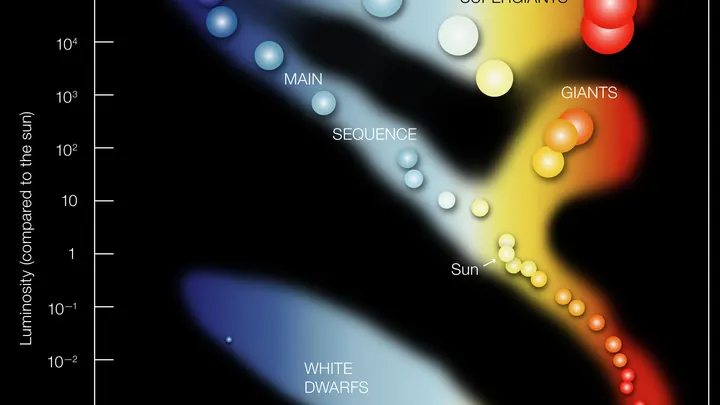
A white dwarf is the cooling core of a Sun-like star. Its fate hinges on mass: there's a strict Chandrasekhar limit (about 1.4 solar masses) beyond which the star collapses further.
A star wrapped in an invisible blanket warms up more than it should. That's exactly how ten red dwarfs look, which astronomers from the Hephaistos project have been monitoring. These stars lie within 300 parsecs (about 1000 light-years) of us and emit far more infrared energy than their modest sizes can explain.
A star's radius drops by a thousand kilometers. Not because its mass increased, but because its own magnetic field squeezed the crust like an invisible corset.
10¹⁵ Gauss — that's the magnetic field found on some white dwarfs. It is billions of times stronger than what a compass shows on Earth. A white dwarf is not a star in the usual sense, but a cooled core the size of a planet. Inside, gravity opposes the pressure of degenerate electrons.
A supernova explosion blasts off the outer layers of a dying star. What remains is the core — a neutron star, packed into a sphere the size of a city. The existence of such stars was predicted back in 1934 by Fritz Zwicky.
Two hundred and eighty-nine days: that's how long one rotation of the white dwarf white dwarf WD 1532+129 takes. This is not just a record: on its surface, near the magnetic poles, scars of iron and other metals appear — silent testimony to planets it has devoured.
Radio astronomy began with the mysterious noise caught by the antenna of Karl Jansky and the rhythmic pulses that Jocelyn Bell Burnell playfully called 'little green men'.
A lighthouse at sea doesn't just rotate: its lamp itself dims and brightens on its own. Magnetic white dwarfs, the ultra-dense remnants of stars like our Sun, behave in much the same way. Their powerful magnetic fields can convert light into axions — hypothetical particles that could explain the Universe's hidden mass.
In 2024, the Hephaestus project sifted through millions of stars and flagged a few dozen suspicious ones: they shone brighter in the mid-infrared than a normal red dwarf should. Two of these candidates, labeled D and E, looked especially tantalizing, as if an invisible heater were working next to the star.
A teaspoon of neutron star matter weighs as much as a mountain. But this mountain may have an invisible twin.
Deep inside a neutron star, ordinary matter is compressed to unimaginable densities. There, protons and neutrons can dissolve into a quark soup.
Two dead suns circle in an eternal dance. Their orbit is a perfect metronome, keeping time with the accuracy of atomic clocks. But even dead stars can tremble.
Light passes through a crumpled film — and comes out slightly altered. In much the same way, gravitational waves born in the early universe feel the lumpy distribution of galaxies and dark matter.
Two burned-out stars, each about the size of Earth but heavier than the Sun, spiral ever closer until one crashes into the other. The impact triggers a thermonuclear explosion, giving birth to a type Ia supernova. Such flashes serve as cosmic beacons for measuring distances across the universe. Yet the details of their origin remain hotly debated.
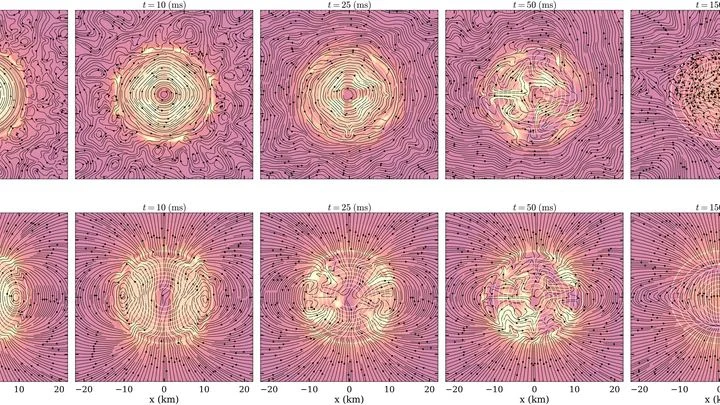
A neutron star is a sphere the size of a city but with the mass of an entire Sun. Its magnetic field can tear atoms apart from thousands of kilometers away. Yet until now, it was a mystery how this field is arranged inside: whether it is twisted into tight ropes or more like neat lines radiating from the poles.
A galaxy is like a cosmic highway where stars, like cars, race along circular orbits. Their speed is set by the invisible "cargo" of mass enclosed within the orbit: the more massive the central region, the faster the stars at the periphery.
A distant city seen through a fogged-up window: bright lights blur, details are lost. That's roughly how astronomers see gas with magnesium ions (magnesium) in our galaxy — the strongest spectral lines "peg the needle," preventing us from knowing how much material is really there.
Around small, cool, but extremely restless red dwarfs, planets the size of Earth often orbit. Such a star is like a temperamental stove that intermittently erupts flares: powerful streams of light and particles batter the planet's atmosphere, as if someone splashed fire into a simmering soup pot.
Every 15 hours, in a constellation 57 light-years away, a miniature solar eclipse takes place. A tiny white dwarf — a star the size of Earth but heavier than the Sun — ducks behind the disk of a red dwarf. For astronomers, this is not just a pretty coincidence but a way to peek into the pair's past.
A white dwarf is what remains of a star like the Sun after it sheds its outer layers. What's left is a hot core the size of Earth but with a mass close to that of the Sun. A teaspoon of this material would weigh as much as a truck. Some of these stars have extremely strong magnetic fields — a billion times stronger than Earth's.
The white dwarf WDJ165335.21-100116.33 is the cooled core of a star, about the size of Earth but with the mass of the Sun. On its surface, there is an unusual hot spot that appears and disappears. Astronomers long puzzled over why the star's brightness changes every 80 hours.
Some stars end their lives as white dwarfs — dense remnants the size of a planet. A small fraction of these objects have very strong magnetic fields, millions of times more powerful than a refrigerator magnet. Such stars are called magnetic white dwarfs.
When a star like the Sun ages, it swells and sheds its outer layers. What remains is a small, dense white dwarf — the former core. Around it, planetary debris can remain: rocks, dust, even whole asteroids. They orbit like a carousel that's been taken apart, but the pieces are still spinning.
Astronomers watched the white dwarf WD 1054-226 for six years.
If you build a giant blanket around a star, you get a Dyson sphere. It absorbs all the radiation and glows in invisible heat rays. No such sphere has been seen yet, but astronomers know: to find it, look for this thermal glow.
A red giant in the constellation Cygnus has swelled so much that its outer layers are spilling onto a small but heavy neighbor — a white dwarf. The gas swirls around the dwarf like water down a bathtub drain, falling onto it. But in CH Cygni, this flow is not calm: every 682.5 seconds, the X-ray emission flares and fades.
An aging star sheds its outer layers, leaving behind a dense, hot core the size of Earth — a white dwarf. If remnants of planets, asteroids, or comets orbit nearby, they heat up and begin to glow in the infrared. That extra light is like a warm spot on a cold floor.
In the dense core of the globular cluster NGC 6397, where stars jostle like commuters at rush hour, astronomers have spotted a peculiar pair. One star is a white dwarf with a surface temperature of 16,000 K, the scorched remnant of a star that has been cooling for billions of years, and circling it is an unseen companion.
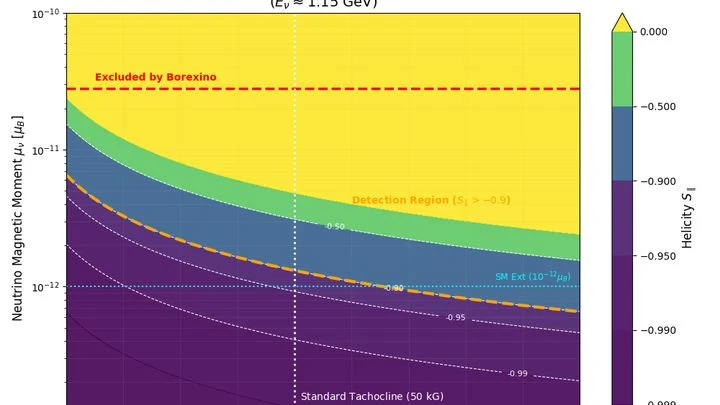
The Sun doesn't just shine: it continuously emits streams of tiny particles, neutrinos. They are born in thermonuclear reactions in the core and pass through the star almost unhindered. But inside the Sun, there are magnetic fields that can influence these particles, like invisible corridors that slightly bend their path.
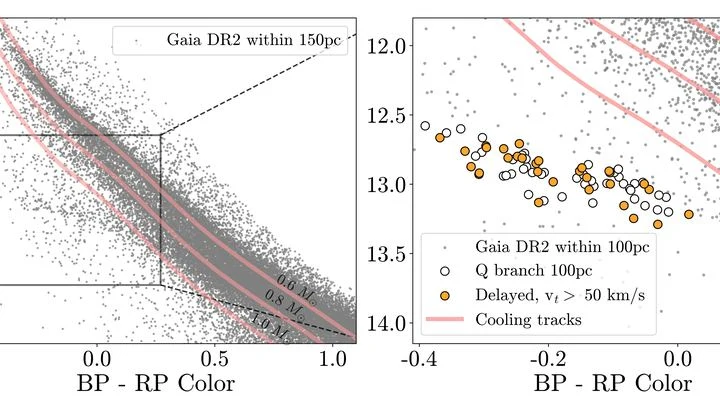
An old star like the Sun, at the end of its life, shrinks into a white dwarf — a dense sphere about the size of Earth. After that, it simply cools down, like embers in a campfire. But some white dwarfs somehow stay hot for billions of years. Astronomers studied such objects within a radius of one hundred parsecs from us and found an unexpected pattern.
Our Sun emits streams of neutrinos — particles that barely interact with matter. Passing through the dense solar material, they change their type — scientists call this 'flavor.' It's like a voice that changes as it moves through a crowd: the thicker the crowd, the more it gets distorted.