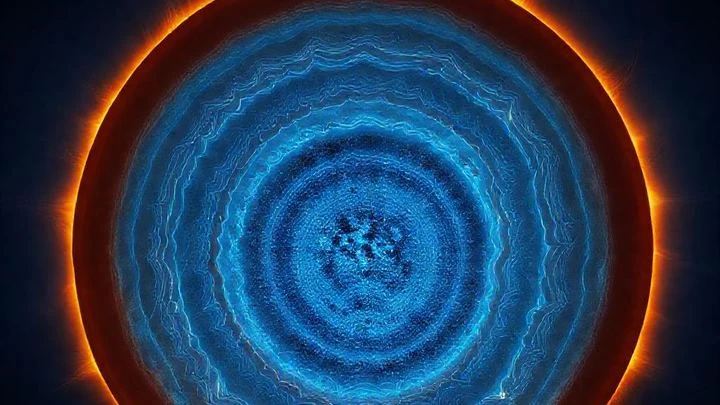
The cosmic dawn, the period when the first stars and galaxies formed, left behind subtle magnetic imprints in the intergalactic medium. These magnetic fields, though extremely weak, are relics of the complex processes that unfolded during the epoch of reionization, when ultraviolet light from the first stars ionized the neutral hydrogen that filled the universe. Studying these magnetic signatures offers a unique window into the conditions of the early universe and the nature of dark matter.
History
The concept of primordial magnetic fields dates back to the 1960s, but the specific idea of detecting magnetic signatures from the cosmic dawn gained traction in the 2000s with the development of sensitive radio telescopes like LOFAR and the Square Kilometre Array (SKA).
How it works
During recombination, when the universe cooled enough for electrons and protons to form neutral hydrogen, tiny fluctuations in density and temperature were imprinted on the cosmic microwave background. Later, during reionization, the movement of charged particles in the ionized gas generated magnetic fields through the Biermann battery effect and other plasma instabilities. These fields can be detected through their effects on the polarization of the cosmic microwave background and through the Faraday rotation of radio waves from distant sources.
In practice
These magnetic signatures are used to constrain models of the early universe, including the timing of reionization and the properties of the first galaxies. They also provide a way to probe the interaction between dark matter and ordinary matter in the early cosmos.
Fun fact
The magnetic fields generated during the cosmic dawn are so weak that they are billions of times weaker than Earth's magnetic field, yet they can be detected through their cumulative effect on the polarization of light over billions of light-years.
In the first moments after the Big Bang, the universe expanded at an incredible rate — a phase known as inflation. Even the vacuum was restless back then: quantum jitters shook the fields like wind rustling through a wheat field.
In 1960, the Tatel radio telescope spent weeks listening to emptiness around Tau Ceti and Epsilon Eridani. Project Ozma was searching for technosignatures — traces of another mind at work.
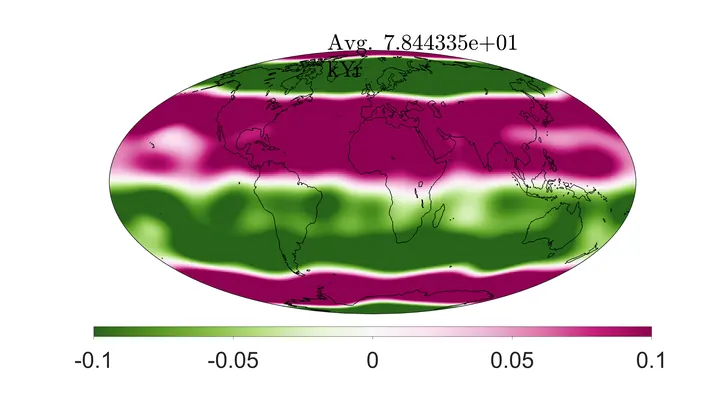
Earth's magnetic field is like an invisible shield that protects us from cosmic radiation. But if you look closely at its long-term averaged pattern, you'll notice that this shield isn't perfectly smooth: it has its own "seams" and "patches." New research using computer simulations of the geodynamo shows that…
The galaxy NGC 1277 is like an old book that no one has opened for billions of years. It formed quickly at the dawn of the Universe and has barely changed since — no collisions with neighbors, no new layers added.
The universe is filled with invisible dark matter. Just as a drop of water, as it evaporates, leaves behind a tiny salt crystal, so too can a black hole evaporate, leaving behind a minuscule stable remnant.
In the first moments after the Big Bang, the universe was a boiling cauldron. But then, according to a new hypothesis, it suddenly cooled dramatically — far more than previously thought. In this icy world, dark matter particles, like tiny pendulums, froze and did not begin their oscillations.
Right after the Big Bang, space rippled with gravitational waves, like those from a thrown stone. These tremors in the very fabric of the cosmos, predicted by Alan Guth, stretched across the entire universe. The ripples slightly compressed primordial matter in some places and thinned it out in others.
A pond with ripples spreading from a fallen stone. So it is on cosmic scales: a sudden burst of energy in the dark sector, an invisible substance that emits no light, creates ripples in the fabric of space. These ripples alter the path of light particles traveling to us from the very birth of the cosmos.
The authors of the new study built a mathematical framework to describe these distortions.
Axions are hypothetical elementary particles introduced in 1977 by Roberto Peccei and Helen Quinn to resolve the so-called strong CP problem in the Standard Model of particle physics.
A vast, dark cloud of gas stretched across the young universe. Inside it, like invisible fingers, magnetic field lines left over from the very birth of the cosmos threaded through. These fields act on charged particles, pushing them together, like a gentle breeze gathering fallen leaves into piles.
There is something wildly generous about a garden where the first flowers don't just bloom but immediately scatter their seeds far beyond the fence. Something similar was happening in the young universe.
An old chest of family heirlooms opens, and inside lie jewels that were thought to be as old as great-grandmother. But suddenly it turns out: the gold was remelted, the stones were recut, and this happened much later than thought. A similar story happened to the oldest particles in meteorites — calcium-aluminum inclusions, or CAIs.
When the first stars ignited, their ultraviolet light began stripping electrons from hydrogen atoms. The universe transformed from a neutral fog into transparent plasma. This process, cosmic reionization, proceeded unevenly: slowly at first, like a fire catching in damp wood, then faster as the flames spread through dry tinder.
After the Big Bang, the Universe was filled with cold gas — mostly neutral hydrogen and helium. It enveloped the cosmos like a morning fog, impenetrable to light. The Dark Ages began.
When the first galaxies ignited, their radiation, like a searchlight beam, started knocking electrons out of atoms.
In the first moments after the Big Bang, the universe was not empty and quiet but filled with hot plasma, particles, and magnetic fields. Among the particles, there may have been axions — light, nearly elusive dark matter candidates.
About 380,000 years after the Big Bang, the universe cooled enough for electrons and protons to finally combine into neutral hydrogen. Although this event is called recombination, it was actually their first meeting — the heat had kept them from sticking together until then.
In the first instants after the big bang, the universe was a quantum vacuum where pairs of particles and antiparticles, virtual "guests" from physical nothingness, spontaneously appeared and almost immediately annihilated.
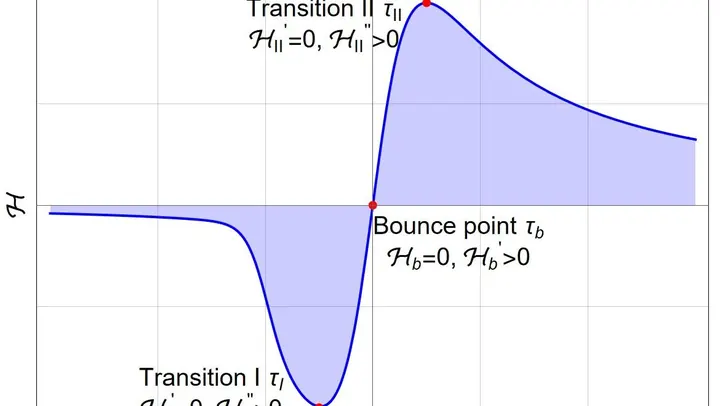
The standard cosmological model describes the birth of the universe as an explosion from a singularity — a point of infinite density and spacetime curvature.
The white dwarf WDJ165335.21-100116.33 is the cooled core of a star, about the size of Earth but with the mass of the Sun. On its surface, there is an unusual hot spot that appears and disappears. Astronomers long puzzled over why the star's brightness changes every 80 hours.
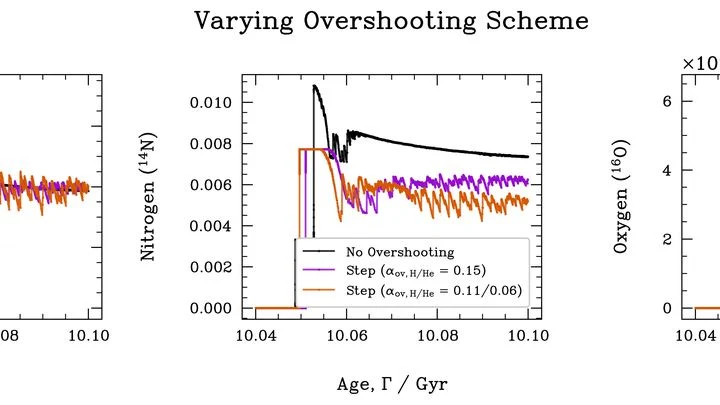
The first stars ignited from clouds that contained nothing but hydrogen and helium. Heavy elements (carbon, oxygen, iron) came later, forged inside stars. But among those pioneers, there could have been lightweight stars, with masses just below that of the Sun.
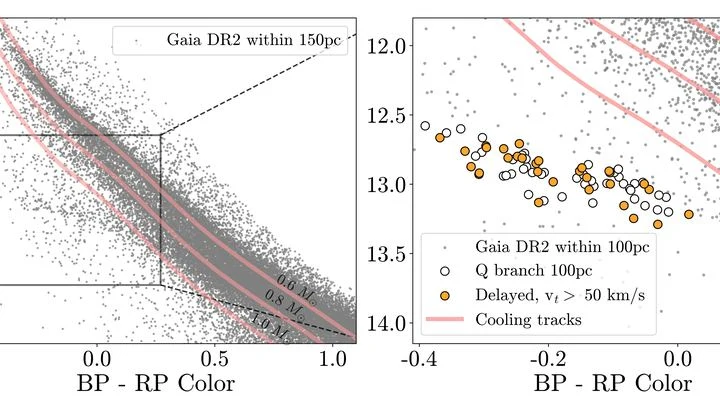
An old star like the Sun, at the end of its life, shrinks into a white dwarf — a dense sphere about the size of Earth. After that, it simply cools down, like embers in a campfire. But some white dwarfs somehow stay hot for billions of years. Astronomers studied such objects within a radius of one hundred parsecs from us and found an unexpected pattern.
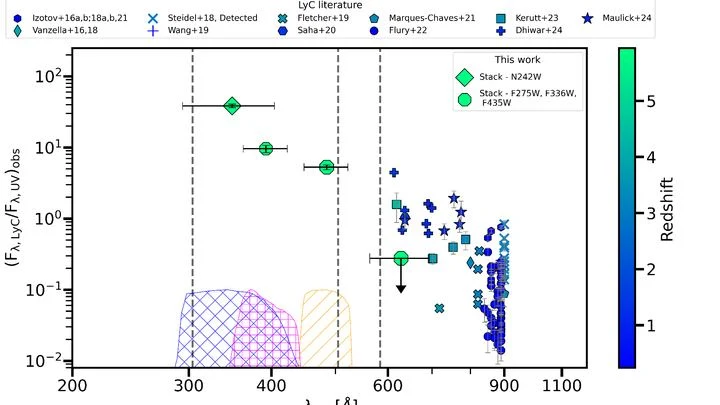
By analyzing color indices — the ratio of brightness in different spectral bands in images from the James Webb Space Telescope, astronomers have identified galaxies whose light cuts off sharply in the ultraviolet.
The Sun’s gravity creates an invisible goblet, in which dark matter of a special kind — ultralight — doesn’t splash around chaotically, but occupies strict energy steps, like transparent layers of liquid. So around the Sun, a natural spectroscope emerges, sorting the invisible substance into levels, just like electrons in an atom.
Without the invisible framework of dark matter, galaxies would fly apart. Astronomer Vera Rubin proved back in the 1970s that stars rotate as if held by an unseen mass. But new research shows it's not just passive ballast.