Roughness That Decides a Flight's Fate express
A blunt cylinder flying at six times the speed of sound isn't the most elegant object, but it's the star of a new simulation. The surface of such a vehicle is never perfectly smooth: during atmospheric entry, the heat shield ablates, leaving bumps and pits. How these imperfections turn a calm flow into wild turbulence has only been glimpsed in isolated experiments and has resisted precise modeling. Now, for the first time, scientists have run a detailed numerical experiment, covering the cylinder with rows of artificial sand grains, like sandpaper.
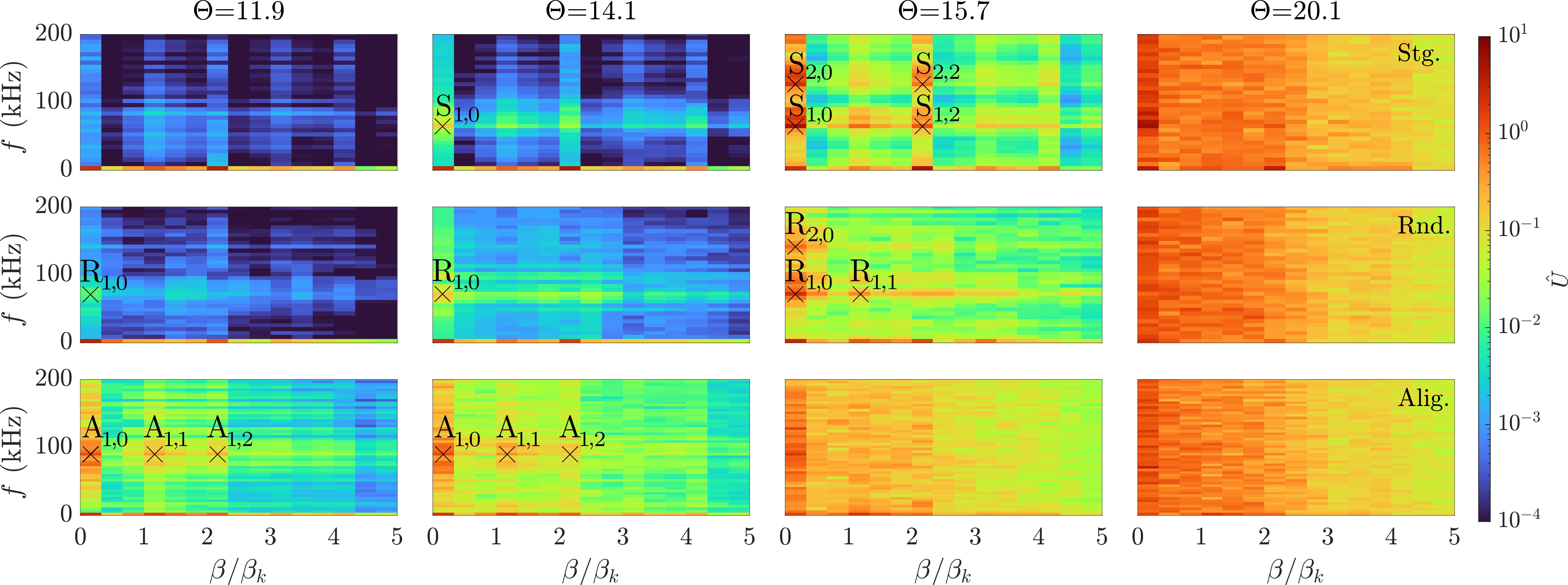
It turns out that the pattern of roughness decides the flight's fate. When the grains sat in neat rows, the transition to turbulence began with wavy streaks — the flow rocked itself like a flag in the wind. But when the rows were staggered or scattered randomly, waves like ocean swell woke up first, rolling over the bumps and growing stronger. Both mechanisms eventually spawned hairpin vortices, and the flow collapsed into chaos.
For engineers, this means: by changing the layout of roughness on a heat shield, you can delay or hasten the moment of transition to turbulence. And that determines how much the vehicle heats up during atmospheric entry. Perhaps one day, spacecraft surfaces will be deliberately made not perfectly smooth but with a clever pattern that keeps the flow calm for as long as possible.
Original abstract
as written by the authors arXiv:2602.03617
Surface roughness significantly impacts transition to turbulence, especially over high-speed, blunt geometries where surface ablation is necessary to mitigate heat loads during atmospheric entry. Inspired by sand-grain roughness experiments performed by Hollis (2017), we perform the first direct numerical simulation (DNS) of a blunt cylinder in Mach 6 cross-flow with roughness elements distributed along the entire surface. Such simulations aimed to uncover the precise means by which laminar-turbulent transition occurs given the limited measurements attainable from experiments and non-existent high-fidelity simulations. Element heights were held fixed at approximately 35% boundary layer thickness, while the relative phasing between streamwise rows was varied. All configurations exhibited convective instabilities driving the transition process, with the mode type being set by the roughness configuration. A fundamental sinuous streak mode dominated the aligned roughness element case, whereas both the staggered and randomly phased cases saw 2D T-S waves dominating. These instability waves, when grown to sufficient amplitude, triggered the steady streaks seeded by the underlying roughness pattern to begin forming hairpin vortices and breakdown occurred soon thereafter. The roughness arrangement was found to dramatically influence the degree to which the waves were destabilised, as well as the strength of the underlying steady streaks, thereby combining to dictate the position along the surface where LTT occurred. Finally, exogeneous forcing was not required for the T-S dominated cases as the acoustics generated by the turbulence in the subsonic flow excited T-S waves on the other side - a feedback mechanism hitherto unknown.
The height of the roughness in the simulation was only about a third of the boundary layer thickness, like bumps a fraction of a millimeter high on a golf ball. It's these tiny details that decide whether the flow becomes turbulent.
In the movie The Martian, the Hermes spacecraft's heat shield looks perfectly smooth, but in reality, after atmospheric entry, its surface would be covered with thousands of imperfections, and those very bumps could control the transition to turbulence.