Invisible Lenses Made of Grass express
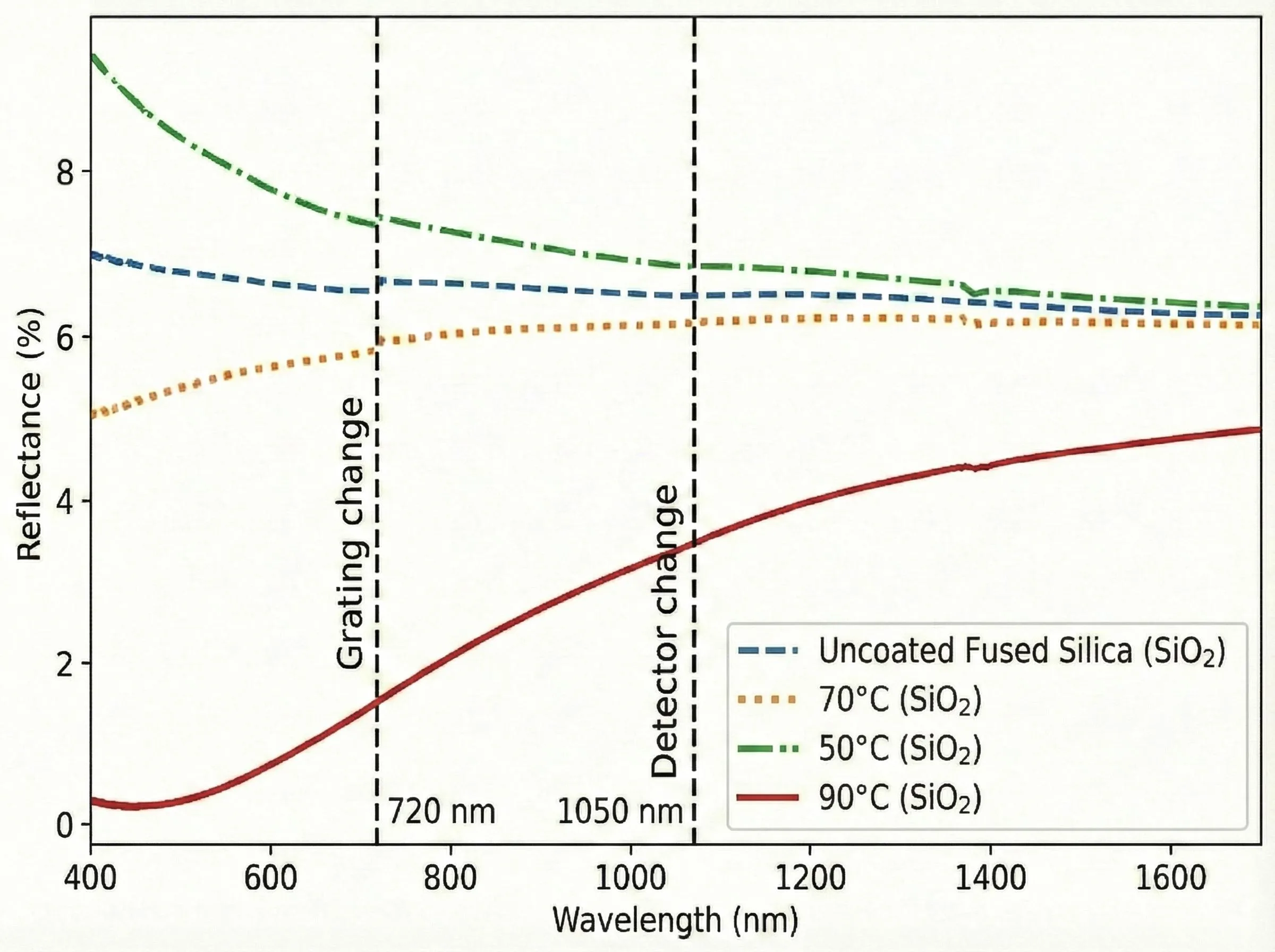
When light hits a transparent plate, some of it bounces off the surface. For astronomers, that means losing precious photons from distant stars. New 3D-printed microlenses made from IPX Clear resin transmit visible and near-infrared light, but at the air boundary they lose about 8%.
The solution came from nature. A layer of aluminum oxide is grown on the glass, forming tiny blades of grass. Light passing through this 'lawn' encounters not a sharp boundary but a smooth transition from air to material. Reflection is suppressed, and transmission rises from 92% to 99%.
The authors applied this coating for the first time to printed microlenses made from IPX Clear resin. After treatment, the lenses reflect only 0.3% of light in the 400–850 nm range. This means telescopes with such lenses can collect more light from faint objects.
So far, the coating has been tested only over part of the resin's working range (up to 1700 nm), but the first results are promising. Future plans include adding a protective layer of silicon dioxide to shield the blades from moisture and temperature swings.
Original abstract
as written by the authors arXiv:2602.03752
Two-photon polymerization (2PP) enables fabrication of high-precision micro-optics with complex freeform geometries, opening a new parameter space for custom astronomical optics. Among available resins, the newly developed IPX Clear is particularly well suited for visible applications, offering high transmission across the visible-near-IR, low surface roughness, and excellent shape fidelity. However, Fresnel reflections at the air-polymer interface introduce significant optical losses, which are detrimental in low-signal astronomy. Previous studies show grass-like alumina coatings on glass and fused silica can raise average transmission from 91.9% to approximately 99% over 400-900 nm. Here we explore the feasibility of Atomic Layer Deposition (ALD) to apply such coatings to IPX-Clear micro-optics over 400-1700 nm. Grass-like alumina anti-reflective (AR) coatings can approximate the ideal index condition by creating a gradual refractive-index transition from air to bulk IPX Clear, suppressing surface reflections. While grass-like coatings are established on bulk optics and conformal ALD films have been applied to 2PP micro-optics, we demonstrate - for the first time - alumina grass on 2PP microlenses made with the new IPX-Clear resin. We discuss key challenges and process steps, and observe that alumina-grass-coated microlenses lose only approximately 0.3% of photons to reflection in the 400-850 nm range. Future work will test performance across the full 400-1700 nm band and explore improved environmental resilience, e.g., a SiO2 overcoat. Combined with the high optical transparency of IPX Clear, these coatings enable custom-designed, highly efficient microlenses for astronomical applications.
The 'grass' layer of aluminum oxide is so thin that its thickness is a thousand times smaller than the diameter of a human hair, yet it boosts light transmission by nearly 7%.
In Arthur C. Clarke's novel Rendezvous with Rama, the alien spacecraft has perfectly black surfaces that absorb all light — here the task is the opposite: to make surfaces that don't reflect light but transmit it.