Chromium and Terbium: How to Make Magnets Obey Current express
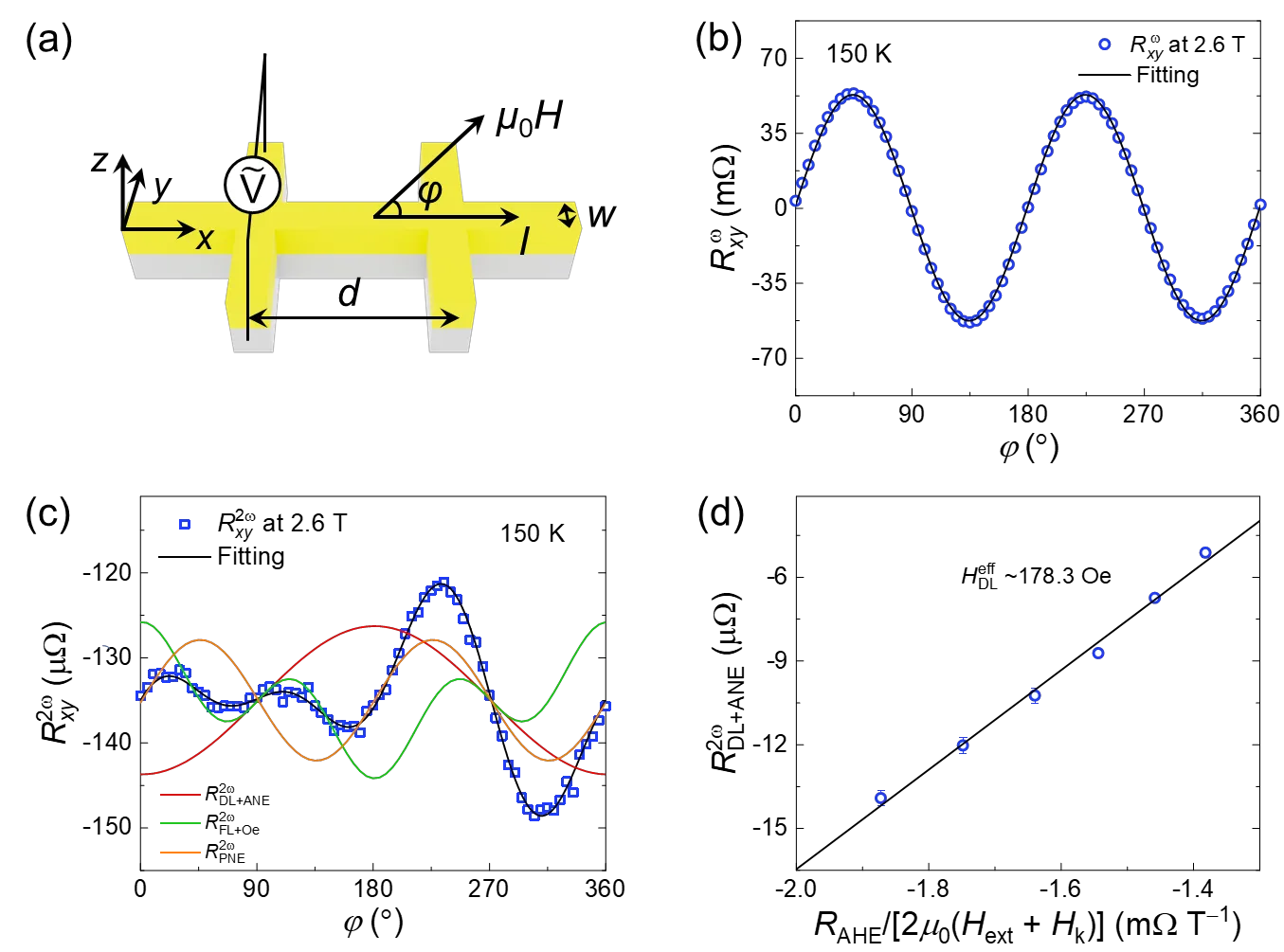
A magnetic material can be compared to a crowd of tiny compasses. In an ordinary magnet, all the needles point in the same direction, and turning them all at once is no easy feat. Physicists have found a way to do this with an electric current. When current passes through a thin layer of chromium, it creates a flow of orbital moments, as if each electron, in addition to its charge, also carried a tiny rotation around the atom.
In the new experiment, a chromium layer was placed on a terbium layer — a rare-earth metal whose orbital moments are not frozen, unlike those in most magnets. When current was sent through the chromium, it generated a flow of orbital moments, and this flow transferred into terbium almost without loss. There, it began to rotate the magnetization, as if an invisible hand had taken hold of the compass needles. The efficiency of this rotation turned out to be 3.66 times higher than in conventional chromium pairs with other ferromagnets.
Previously, it was thought that chromium transfers moment poorly because in most magnets the orbital moments are "frozen"—hard to move. Terbium turned out to be an exception: its orbital moments are mobile, and the chromium flow found fertile ground. The authors named this effect orbit-orbit torque — moment from orbit to orbit. This is the first time that orbital currents directly control the orbital magnetization of a material. Such an approach could form the basis of new electronics where information is carried not by charge but by orbital moments.
Original abstract
as written by the authors arXiv:2602.04151
We study the current-induced torques in bilayers composed of a light 3d metal, chromium, and a rare-earth ferromagnet with finite orbital moments, terbium, utilizing second-harmonic Hall-response measurements. The dampinglike torque efficiency of chromium is found to be positive and reaches ~3.66 in this system, in sharp contrast to the negative and subtle dampinglike torque efficiency in general Cr/ferromagnet heterostructures with quenched orbital moment. We suggest that the orbital currents generated by the orbital Hall effect in Cr can be injected into Tb with negligible loss at the interface and then efficiently interact with the orbital moments. We term such an exotic effect as the orbit-orbit torque (OOT). Our work implies that orbital currents could be harnessed to manipulate the orbital magnetization of materials, which would advance the development of orbitronics.
Terbium is used in phosphors: it glows green in screens and fluorescent lamps.
In Robert Ibatullin's novel "The Rose and the Worm," orbital effects are used to control the magnetic fields of ships.