Rare earth metals are a group of 17 metallic elements in the periodic table, including the 15 lanthanides plus scandium and yttrium. Despite the name, they are not particularly rare in the Earth's crust — cerium, for example, is more abundant than copper. They are, however, difficult to extract in pure form because they occur together in ores and have very similar chemical properties, which makes separation laborious and environmentally challenging.
History
The first rare earth, yttrium, was identified in 1794 by Finnish chemist Johan Gadolin, who isolated an oxide from a mineral found in Ytterby, Sweden. The term 'rare earth' was coined in the early 19th century because the oxides were scarce and difficult to reduce to metals.
How it works
The similar behavior of rare earths stems from their electron configuration: the 4f orbitals, which are being filled across the lanthanide series, are deeply buried beneath the 5s and 5p shells. This shielding means the outer electrons dominate chemical bonding, so all rare earths tend to form trivalent ions with comparable ionic radii. Their magnetic and optical properties, however, arise precisely from those inner 4f electrons, which give sharp spectral lines and strong magnetic moments that are largely unaffected by the surrounding crystal lattice.
In practice
Rare earths are essential in modern technology: neodymium magnets power electric vehicle motors and wind turbines, europium and terbium provide the red and green phosphors in displays and LED lighting, and erbium-doped fibers amplify signals in optical communication networks.
Fun fact
A single modern smartphone contains about eight different rare earth elements, used in its screen, speakers, vibration motor, and camera lenses.
Forty light-years away lives a star that went unnoticed for a long time: TRAPPIST-1 emits two thousand times less light than the Sun. But it turned out to have seven Earth-sized planets, three of which orbit in the zone where water could remain liquid. Yet little was known about the star itself, about its chemical kitchen.
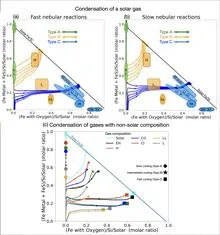
Three cabinets full of rocks. In one, metallic grains and the gray mineral enstatite; in the second, the same grains but with rusty streaks; in the third, layered clays swollen with water. All three sets were pulled from meteorites that fell to Earth: chondrites. They were born in the same gas-and-dust disk around the young Sun, yet somehow turned out so different.
An extra electron in a molecule is like a passenger barely hanging onto the step of a departing train. Such a 'passenger' turns the particle into an anion — a negative ion. Studying it is tough: the bond is weak, the electron cloud is diffuse, and any jolt can knock the electron off.
Two hundred and eighty-nine days: that's how long one rotation of the white dwarf white dwarf WD 1532+129 takes. This is not just a record: on its surface, near the magnetic poles, scars of iron and other metals appear — silent testimony to planets it has devoured.
In 1946, proposed a method that revolutionized archaeology: determining age by the decay of radiocarbon. The clock ticks: every 5730 years, half of the atoms vanish. But why so slowly? For a light nucleus, this is an anomaly — typical lifetimes are millions of times shorter. The mystery held for seven decades.
A star's age is the key to the galaxy's history. But prying that key from nature is no simple task: unlike a tree, a star doesn't grow annual rings. Yet, its atmosphere holds a chemical code — the ratio of elements that slowly shifted as generations of stars died and new ones were born.
Dark matter — the invisible architect of the universe, holding galaxies from flying apart. Thanks to the pioneering work of Fritz Zwicky and Vera Rubin we know: ordinary matter in the cosmos is just a negligible impurity. But what lies behind this dark matter?
Deep beneath our feet, in the scorching mantle, iron leads a double life. It can be divalent or trivalent, like a coin that lands heads or tails. Which side dominates determines how much oxygen stays in the planet's rocky shell and how much sinks into the core.
The story began almost a century ago, when Edwin Hubble showed that galaxies are receding, and Fritz Zwicky and Vera Rubin later realized: to explain their motions, invisible mass is needed — dark matter.
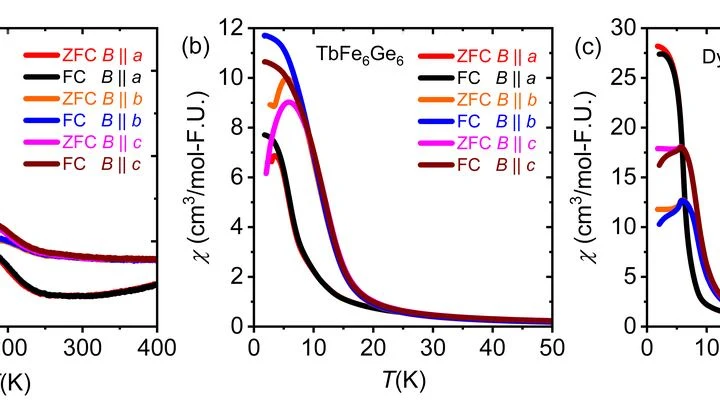
The magnetic field increases, but the magnetization stays put. It's like a scale where you add weight, yet the needle doesn't move until enough has accumulated to jump to the next mark. That's exactly how rare-earth tetraboride crystals behave, and physicists have been puzzled for decades.
In dark, cold clouds of interstellar gas, astronomers have for several years been spotting aromatic molecules — compounds built around a benzene ring (a hexagon of carbon atoms), like the benzene we know. One such substance, benzonitrile (benzene with a cyano group attached), had only been found in very calm and cold places, like the Taurus cloud.
The Red Planet is surrounded by the rubble of failed worlds — rocky boulders stuffed with metal. Shipping a kilogram of steel from Earth to Mars costs as much as several cars. It's far cheaper to pick up space junk right in orbit.
In the open cluster Trumpler 5, where hundreds of stars move together, one star behaves like a teenager among elders. It pulsates — expanding and contracting, changing brightness every few hours.
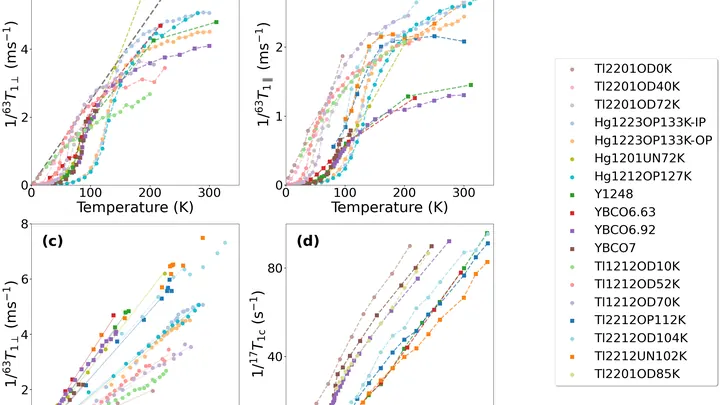
Inside copper-based superconductors, materials that carry current without loss at unexpectedly high temperatures, there is a hidden phase. It behaves like an ordinary metal, but it's invisible in standard measurements.
Deep beneath our feet, within the planet's bulk, radioactive elements are slowly decaying. This process spawns tiny particles — geoneutrinos. They pass through the crust, mantle, and core, barely interacting with anything.
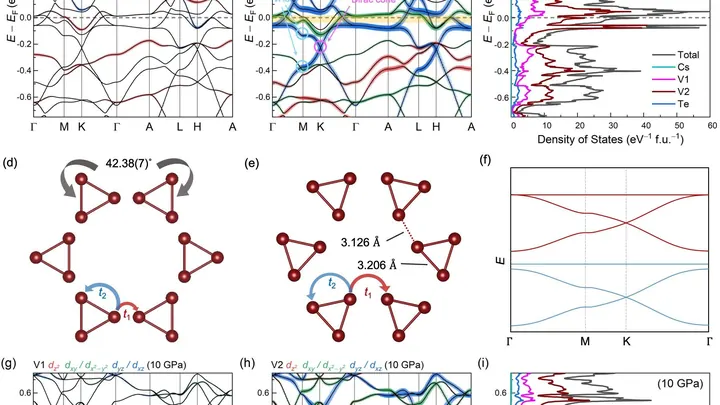
A woven basket made of willow twigs holds its shape thanks to the interweaving. A similar pattern, triangles linked into a flat network, has been found in a new crystal with the formula Cs₃V₉Te₁₃. Here, vanadium atoms form two sets of triangles that pierce each other like threads in fabric.
This pattern is not just pretty: it forces electrons to move along special "flat" energy pathways.
When a baker kneads dough, the grains of flour can tell you which mill they came from. It's the same with Earth: the composition of iron in its depths preserves a memory of where the pieces that assembled the planet were born.
In its youth, Earth resembled a beehive: it grew by sticking together from countless rocky chunks. When the main construction was over, a late swarm of meteorites rained down on the young planet — the so-called late veneer. These impacts, scientists thought, brought platinum, gold, and other rare metals to Earth's upper layers.
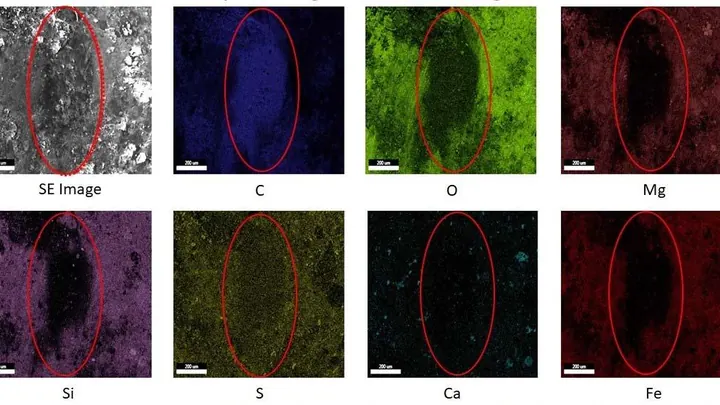
In 2017, a stone fell from the sky in the Indian village of Mukhundpura. It was a rare carbonaceous meteorite — a chunk of ancient cosmic material that preserves traces of the birth of the solar system. Locals quickly gathered the fragments, and they ended up in a laboratory.
On the outskirts of the Milky Way, tiny stellar systems hide, so faint that even powerful telescopes barely spot them. Until recently, astronomers knew almost nothing about these objects, dubbed ultra-faint compact satellites.
Sometimes a fiery streak crosses the night sky. It's a piece of rock from space burning up in the air, and the color of the flash can tell you what elements it contained. Astronomers pointed sensitive cameras at such flashes and, among 180 images, found two rocks that stand out from the majority of shooting stars.
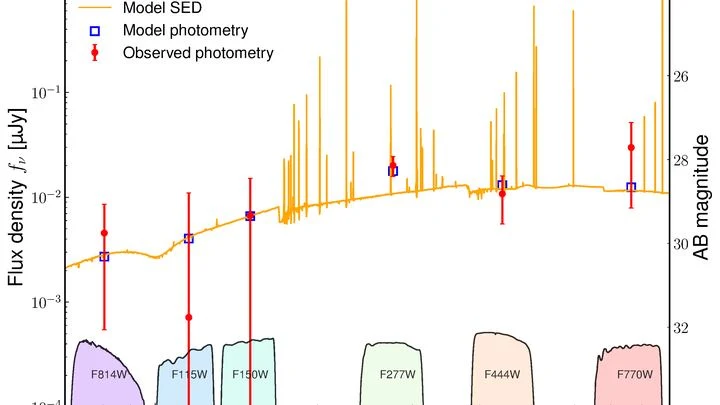
In the deep cosmos, more than 12 billion light-years away, the James Webb Space Telescope has spotted a galaxy that looks like a visitor from the dawn of creation. Its light has been traveling to us since the universe was only about two billion years old — a time when galaxies were growing especially vigorously, a period astronomers call the cosmic noon.
A piece of chromium exposed to air gets covered in invisible armor, an oxide film, within a minute. That film protects the metal from rust, but for a battery it's a disaster: the film blocks chromium ions, so no current flows.
Scientists mixed five metals — chromium, bismuth, copper, tin, and nickel.
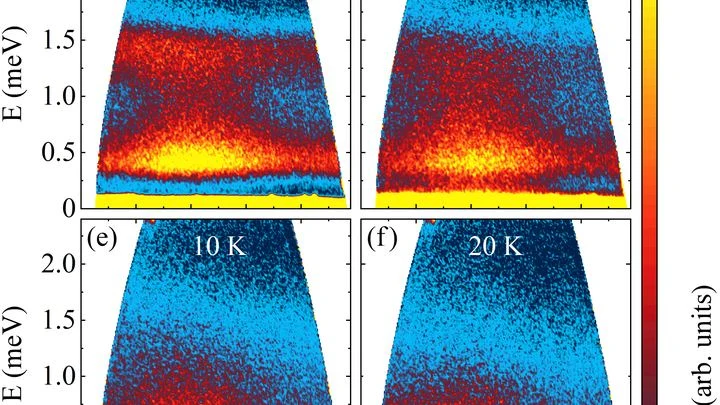
The tiny magnetic arrows inside a crystal of terbium-iridium oxide behave strangely: instead of lying along their preferred axis, they stand across it. This state fully forms when cooled to 1.5 Kelvin — colder than outer space.
Researchers probed the crystal with neutrons and observed how these flipped arrows oscillate and exchange energy.
The second interstellar guest, comet 3I/ATLAS, shines unusually due to rusting metal grains in its icy core. As it gets closer to the Sun, it behaves like an old tin can tossed into a fire: the heat melts the ice, water seeps into the metal, and vigorous corrosion begins.
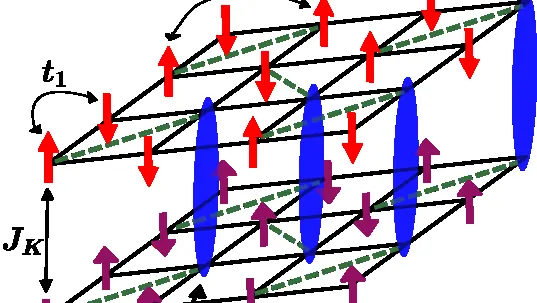
Imagine a stack of pancakes where each pancake is magnetized, but the magnetization directions in adjacent pancakes are opposite. That's exactly how this new magnetic material is arranged: in each atomic layer, all magnetic moments — the atom's 'arrows'—point in one direction, while the next layer is magnetized in the opposite direction.
In the stream of charged particles flying toward us from the depths of the Galaxy, iron turned out to be the odd one out. The ATIC-2 instrument, lifted on a balloon over Antarctica, compared how the fraction of nuclei from sulfur to chromium relative to iron changes with energy.