The idea was first clearly described by Hermann Oberth in his 1923 book, although hints also appeared in Tsiolkovsky's work. The law works due to the nonlinear dependence of kinetic energy on speed. Imagine you push a cart. If it is barely moving, your push adds almost no energy to it — most of the energy turns into heat in your shoes. If the cart is racing, you push off the ground, transferringmomentum while remaining nearly in place, and almost all the work turns into its acceleration. In space, the planet's gravitational field plays the role of the ground, and the rocket exhaust provides the 'push.' The faster the rocket relative to the planet, the greater the percentage of fuel energy converted into motion.
History
Hermann Oberth, one of the pioneers of astronautics, formulated the effect in 1923 in his work 'The Rocket into Interplanetary Space.' He showed that it is most advantageous to fire the engine at the moment of maximum speed relative to the center of attraction, which later became a standard technique in celestial mechanics. Oberth's ideas were developed by Konstantin Tsiolkovsky and Robert Goddard, but the clear energetic justification was given by Oberth. Later, in the space age, the effect began to be actively used for maneuvers near giant planets, especially in the Voyager and Cassini programs.
How it works
The Oberth effect is fundamental to Hohmann transfers and poweredgravity assists. For example, to leave low Earth orbit and head to the Moon, it is advantageous to fire an impulse at perigee. The reverse situation: braking to enter orbit around another planet is most efficient at the pericenter of the approach hyperbola. Limits of applicability: the effect is noticeable when the exhaust velocity is comparable to the current orbital velocity, and it is negligible for low-speed vehicles like atmospheric drones.
In practice
Orbital maneuvers of spacecraft: firing the engine at pericenter (the point closest to the planet) yields the maximum energy gain, saving fuel when reaching high orbits and interplanetary transfers.
Fun fact
Oberth first proposed using an 'orbital refueling system' — refueling at high speed, which could allow reaching high velocities without enormous single-use rockets.
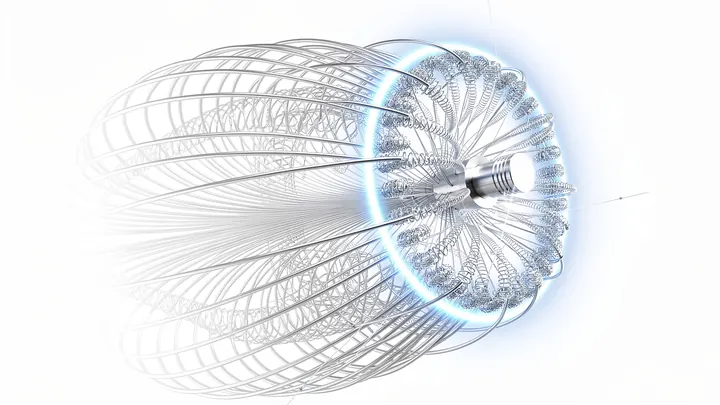
A stellarator fusion reactor resembles an intricately twisted magnetic cocoon. Its job is to confine superheated plasma so that hydrogen nuclei fuse and release energy. But the cocoon's three-dimensional shape creates gaps: some particles escape, especially the fastest ones, which carry most of the heat.
A camera flash that fires in a thousandth of a second doesn't heat the subject — unlike a regular flash that lasts a full second. A similar trick has been found in radiotherapy: when a radiation dose is delivered in milliseconds instead of minutes, healthy tissues suffer less. This is called the FLASH effect.
The enigma of fast radio bursts (FRBs) is not just a question of 'what exploded?' It’s a drama of energy transfer under extreme conditions, where the slightest stumble leads to collapse.
Perth residents know: when the daytime heat becomes unbearable, relief arrives from the ocean — a fresh breeze affectionately called the Freo Doctor. The same wind, only on a global scale, decides the fate of cosmic visitors plunging into the atmosphere. A meteorite fall is a two-act spectacle.
A juggler tosses clubs while sitting on a spinning chair. If he starts spinning the clubs all in one direction, the chair will rotate the opposite way — otherwise, the conservation of angular momentum would be violated.
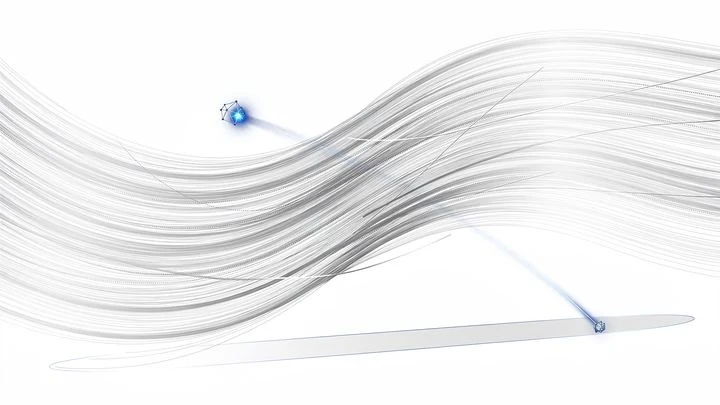
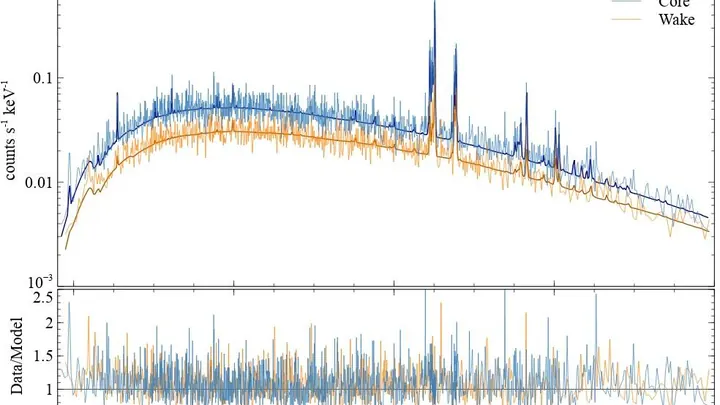
At the heart of the Ophiuchus galaxy cluster floats a bubble of hot plasma the size of several galaxies. It rises like a giant hot-air balloon in the atmosphere, leaving a wake behind it — a region where gas is set in motion.
In quantum batteries, charging can be accelerated by shuffling the steps in time, like a deck of cards. Instead of a smooth energy climb, you get abrupt efficiency explosions, like microscopic supernovae inside atoms.
Somewhere above our heads, every second, a proton accelerated to energies millions of times greater than those at the Large Hadron Collider slams into the atmosphere. It strikes an air molecule, and a cascade is born — a wide atmospheric shower of thousands of particles.
A magnetic material can be compared to a crowd of tiny compasses. In an ordinary magnet, all the needles point in the same direction, and turning them all at once is no easy feat. Physicists have found a way to do this with an electric current.
Spinning a sling, we whirl a stone. Its speed builds, and if released at the lowest point, it flies farthest. In space, the gravity of the Sun acts as the strap: the probe dives as close to the star as possible, and at the moment of maximum speed, a brief engine thrust, like a yank of the hand, gives it a huge boost.
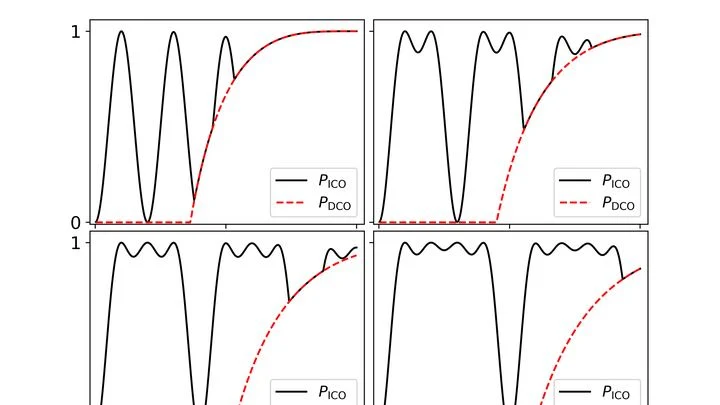
A quantum system, like a person in a noisy room, gradually loses the thread of conversation: its state dissipates into the surroundings. But sometimes, as if suddenly recalling an important thought, it can recover part of the lost information. Physicists call this phenomenon non-Markovian dynamics: the environment's memory of the system's past allows information to flow back.
According to the laws of the microworld, an electron obeying the Dirac equation trembles even at complete rest. This is Zitterbewegung — an oscillation with an amplitude of trillionths of a millimeter, like a spinning top on an invisible axis.
A heat engine is like a sailboat: to move forward, it needs a difference. Usually that means a temperature difference between hot and cold reservoirs. But what if the reservoir itself starts moving? The wind that fills the sails is created not only by a pressure difference but also by the motion of air masses.