Chromium, with atomic number 24, is a hard, corrosion-resistant metal. In cosmic-ray physics, chromium nuclei serve as probes of galactic propagation processes. Measurements of chromium and other heavy nuclei in cosmic rays help scientists understand how these high-energy particles are accelerated and how they travel through the interstellar medium. Anomalies in the abundance of chromium relative to iron, for instance, can reveal details about the sources of cosmic rays, such as supernova remnants.
History
Chromium was discovered in 1797 by Louis Nicolas Vauquelin. Its role in cosmic-ray studies emerged with the advent of satellite-based detectors in the late 20th century.
How it works
Cosmic-ray nuclei are detected by space-based instruments that measure their charge and energy. Chromium nuclei are primarily produced as secondary particles when heavier nuclei, like iron, collide with interstellar gas. By comparing the ratios of secondary to primary nuclei (e.g., chromium to iron), researchers can infer the amount of material cosmic rays have traversed, providing insights into their propagation paths and the structure of the galaxy.
In practice
Chromium is widely used in stainless steel and chrome plating, while its cosmic-ray properties are used in astrophysical research to model galactic cosmic-ray transport.
Fun fact
Chromium gets its name from the Greek word 'chroma' meaning color, because its compounds come in a vivid array of colors.
The atomic nucleus is not a bag of marbles but an ordered structure where protons and neutrons fill shells, much like electrons in an atom. When a shell is filled, the nucleus becomes especially stable, and the number of particles is called magic. For calcium with 20 protons, the classic magic neutron numbers are 20 and 28.
An extra electron in a molecule is like a passenger barely hanging onto the step of a departing train. Such a 'passenger' turns the particle into an anion — a negative ion. Studying it is tough: the bond is weak, the electron cloud is diffuse, and any jolt can knock the electron off.
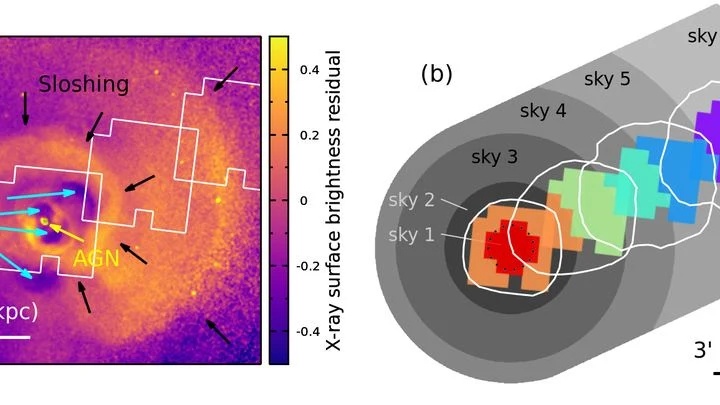
The Perseus galaxy cluster is a giant metropolis of thousands of star islands, bathed in an invisible ocean of scorching gas. Like urban smog, this gas preserves traces of all the chemical factories that have operated in galaxies for billions of years: supernova explosions that scatter freshly forged atoms across the surroundings.
The most precise modern clocks count time by the oscillations of electrons in atoms. But their rhythm can be thrown off, like a mechanical watch's spring gets jolted by shaking. Physicists found a more reliable pendulum: the atomic nucleus.
In the dense gaseous cocoon around a young massive star, streams of matter collide as if in a giant chemical flask. One stream moves relative to us at about 11 kilometers per second, the other at about 5. The telescope at Onsala (Sweden) caught their radio voices and resolved them into hundreds of spectral lines — molecular fingerprints.
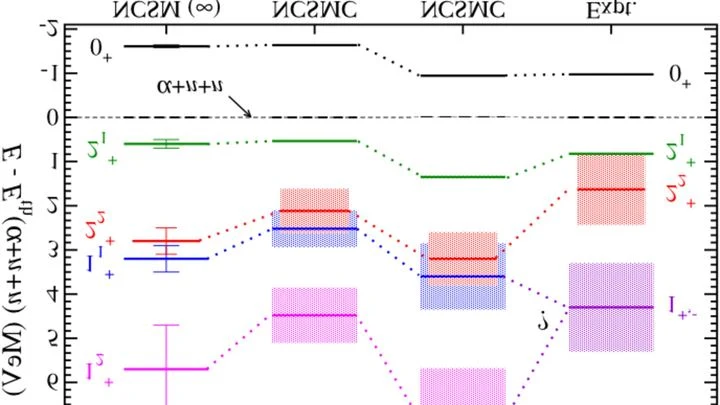
An ordinary atomic nucleus is like a tight ball: protons and neutrons are packed closely together. But some light nuclei, such as helium-6, are different. Two neutrons seem to step aside and form a dilute cloud around the nucleus — called a halo.
Every molecule is like a set of building blocks: the same pieces can be assembled in different ways. Two assemblies with the same atoms but different geometry are called isomers. If one can be turned into the other by a simple rotation around a bond, they are conformers, like a bent arm versus a straight one.
A piece of chromium exposed to air gets covered in invisible armor, an oxide film, within a minute. That film protects the metal from rust, but for a battery it's a disaster: the film blocks chromium ions, so no current flows.
Scientists mixed five metals — chromium, bismuth, copper, tin, and nickel.
Conventional atomic clocks are essentially optical counters: they rely on spectroscopy — a method for measuring the frequency of radiation with high precision as electrons jump between energy levels.
Cosmic rays are atomic nuclei accelerated to near-light speeds. They arrive at Earth from all directions, and their composition tells us what's happening in the far reaches of the Galaxy.
Like long-distance runners, atomic nuclei, from light helium to heavy iron, race toward us across the Galaxy. At the finish line, in a detector on a high-altitude balloon, we see that heavy nuclei arrive a bit more exhausted than light ones. The difference is small, but it repeats from flight to flight.
High above Earth, a satellite flies, and inside it is an instrument the size of a small wardrobe. It catches particles that have been racing through the galaxy for billions of years and finally slam into the detector. Such particles are called cosmic rays, and they bring news of distant stellar explosions.
In the stream of charged particles flying toward us from the depths of the Galaxy, iron turned out to be the odd one out. The ATIC-2 instrument, lifted on a balloon over Antarctica, compared how the fraction of nuclei from sulfur to chromium relative to iron changes with energy.
In the stream of cosmic rays, particles flying toward us from the depths of the Galaxy, titanium is rare. Its nuclei are almost indistinguishable from iron: both are heavy, and both leave similar tracks in detectors.