Thorium is a naturally occurring, slightly radioactive actinide metal, found in trace amounts in soil, rocks, and water. It is more abundant than uranium in the Earth's crust and is a significant contributor to natural background radiation, though its radioactivity is relatively weak. Thorium isotopes, particularly thorium-232, have long half-lives and decay through a chain that eventually produces stable lead.
History
Thorium was discovered in 1828 by the Swedish chemist Jöns Jacob Berzelius, who named it after Thor, the Norse god of thunder.
How it works
Thorium-232, the most common isotope, undergoes alpha decay with a half-life of about 14 billion years. Its decay chain includes several intermediate radioactive isotopes, some of which emit beta and gamma radiation. Because thorium is an alpha emitter, it poses a health risk primarily if ingested or inhaled, as alpha particles are easily stopped by skin but can damage internal tissues.
In practice
Thorium is used in gas mantles for portable lighting, as an alloying element in magnesium for high-temperature applications, and is being researched as a potential fuel for nuclear reactors.
Fun fact
Thorium is so abundant that the energy potentially available from thorium in the Earth's crust exceeds that of all fossil fuels and uranium combined.
Forty light-years away lives a star that went unnoticed for a long time: TRAPPIST-1 emits two thousand times less light than the Sun. But it turned out to have seven Earth-sized planets, three of which orbit in the zone where water could remain liquid. Yet little was known about the star itself, about its chemical kitchen.
The pendulum in these clocks doesn't swing from a spring or a weight, but from a tiny kick inside the atomic nucleus. Ordinary atomic clocks keep time by the oscillations of electrons, but here the pendulum is the nucleus itself — a dense ball of protons and neutrons.
An extra electron in a molecule is like a passenger barely hanging onto the step of a departing train. Such a 'passenger' turns the particle into an anion — a negative ion. Studying it is tough: the bond is weak, the electron cloud is diffuse, and any jolt can knock the electron off.
The river splits in two. One branch is wide and fast, with water flowing smoothly, but as temperature rises, the flow slows: eddies and waves appear. The second branch is narrow, with rapids, where water leaps from rock to rock. This flow, on the contrary, becomes more lively with warming.
The most precise modern clocks count time by the oscillations of electrons in atoms. But their rhythm can be thrown off, like a mechanical watch's spring gets jolted by shaking. Physicists found a more reliable pendulum: the atomic nucleus.
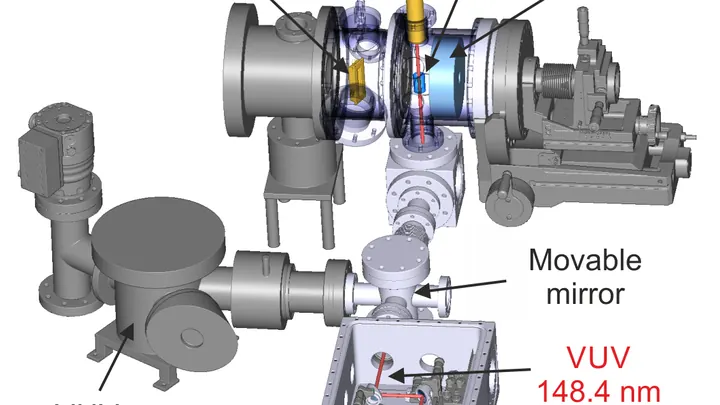
A laser beam as faint as a whisper of light has stirred a thorium-229 nucleus into a higher energy state. Most nuclei demand a blast of energy, but thorium-229 has such a tiny energy gap that even this gentle nudge works.
Deep beneath our feet, within the planet's bulk, radioactive elements are slowly decaying. This process spawns tiny particles — geoneutrinos. They pass through the crust, mantle, and core, barely interacting with anything.
An atomic nucleus usually follows its own rules: its decay doesn't care about temperature, pressure, or molecular neighbors. But the uranium-235m isotope is a striking exception. This nucleus sits in an excited state, like a tightly coiled spring, and sooner or later it releases the extra energy.
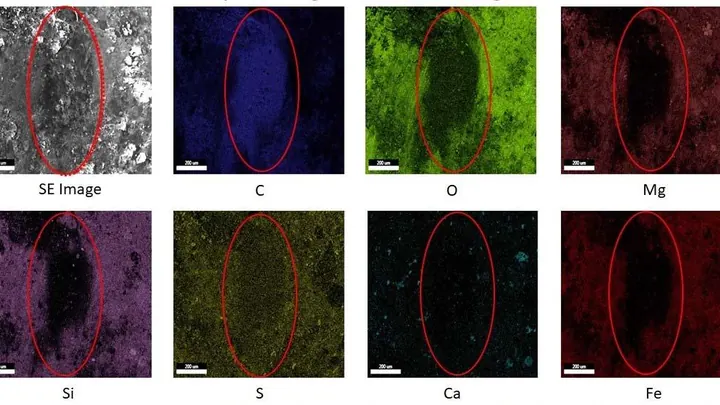
In 2017, a stone fell from the sky in the Indian village of Mukhundpura. It was a rare carbonaceous meteorite — a chunk of ancient cosmic material that preserves traces of the birth of the solar system. Locals quickly gathered the fragments, and they ended up in a laboratory.
A multitude of atoms can act like a synchronized orchestra: if each emits light in unison with the rest, the flash becomes many times brighter. This is superradiance — a phenomenon well studied in the lab, but almost never sought in space. Now astrophysicists suspect that such collective 'notes' also play out in interstellar space.
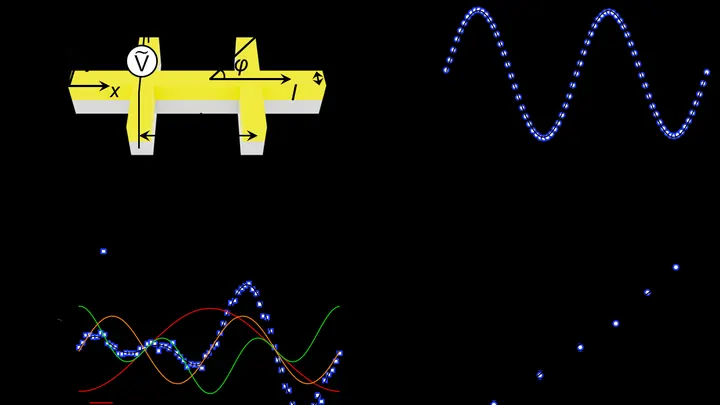
A magnetic material can be compared to a crowd of tiny compasses. In an ordinary magnet, all the needles point in the same direction, and turning them all at once is no easy feat. Physicists have found a way to do this with an electric current.
A piece of chromium exposed to air gets covered in invisible armor, an oxide film, within a minute. That film protects the metal from rust, but for a battery it's a disaster: the film blocks chromium ions, so no current flows.
Scientists mixed five metals — chromium, bismuth, copper, tin, and nickel.
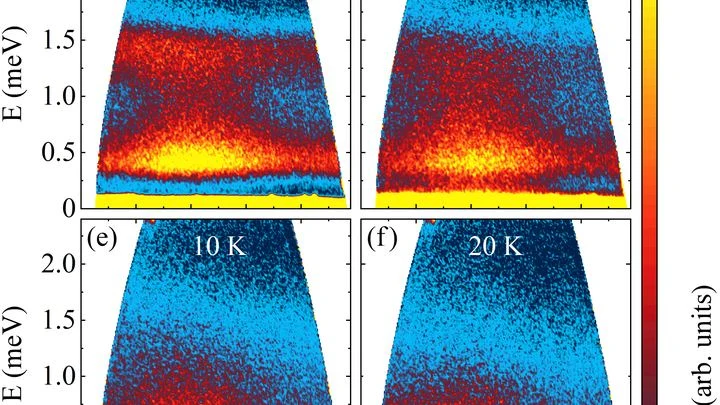
The tiny magnetic arrows inside a crystal of terbium-iridium oxide behave strangely: instead of lying along their preferred axis, they stand across it. This state fully forms when cooled to 1.5 Kelvin — colder than outer space.
Researchers probed the crystal with neutrons and observed how these flipped arrows oscillate and exchange energy.
The second interstellar guest, comet 3I/ATLAS, shines unusually due to rusting metal grains in its icy core. As it gets closer to the Sun, it behaves like an old tin can tossed into a fire: the heat melts the ice, water seeps into the metal, and vigorous corrosion begins.
Conventional atomic clocks are essentially optical counters: they rely on spectroscopy — a method for measuring the frequency of radiation with high precision as electrons jump between energy levels.
In the stream of charged particles flying toward us from the depths of the Galaxy, iron turned out to be the odd one out. The ATIC-2 instrument, lifted on a balloon over Antarctica, compared how the fraction of nuclei from sulfur to chromium relative to iron changes with energy.