Ancient Explosion Left a Bubble in Space express
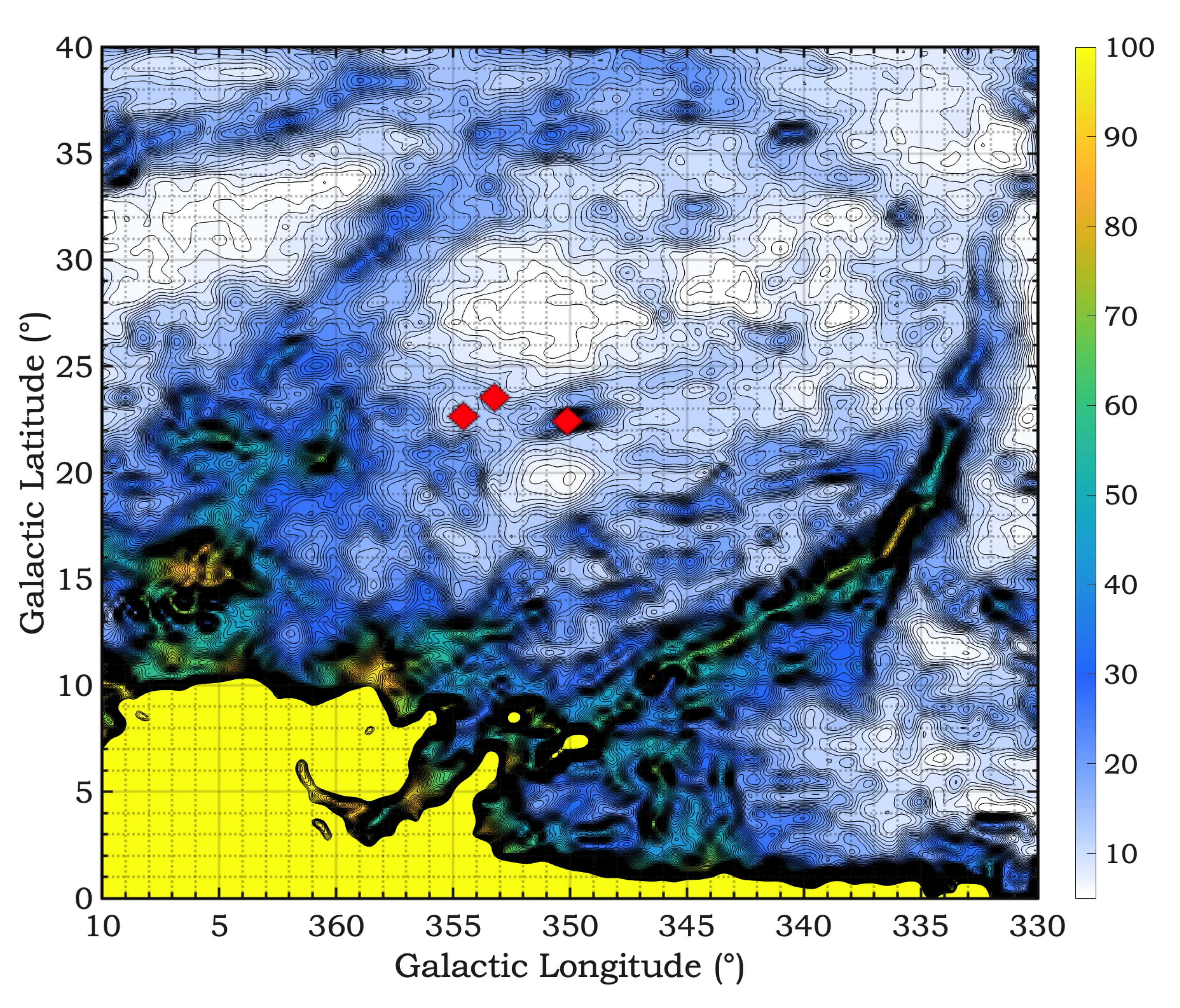
In radio sky data, like on old photographic film, two bright gas streaks have emerged. They move at different speeds but hang near the same dim star. The star and the streaks turned out to be inside a huge empty bubble in the interstellar gas. This bubble is like a blown soap bubble left over from an ancient supernova explosion.
The gas streaks are most likely remnants of a planetary nebula — the shell shed by a dying star. Usually such shells quickly dissipate into the surrounding gas. Here they survived because they expanded into the nearly empty space of the bubble. Over 300,000 years, the gas cooled, became neutral, and began emitting radio waves at a wavelength of 21 centimeters.
So an ancient explosion inadvertently preserved for us the traces of another, more modest stellar death. The bubble acted as a museum display case: without it, the gas would have long since mixed with the interstellar medium.
Original abstract
as written by the authors arXiv:2602.08756
Two mysterious unresolved HI structures at velocities of +12 and -6 km/s were discovered in high resolution 21-cm survey data in the direction of a faint white dwarf star. Examination of the HI morphology in this area of sky shows that the star and HI features exists in a large cavity in interstellar HI surrounding the Upper Sco-Cen OB2 Association. The cavity may have been created by an ancient supernova. It is hypothesized that the pair of HI features and filamentary HI structure found in its immediate vicinity may be the remnants of a planetary nebula some 3 x 10^5 years old that have cooled to the point that the gas is neutral and emitting the 21-cm spectral line. This remnant has maintained the morphological characteristics of the original planetary nebula because it expanded into a volume of space relatively devoid of interstellar gas that would otherwise have absorbed any traces of the original nebula.
Radio waves at a wavelength of 21 centimeters are emitted by neutral hydrogen — the most abundant element in the universe. It is through this radiation that astronomers see cold gas invisible to ordinary telescopes.