Supernova remnant formation refers to the structures and processes that result after a massive star explodes as a supernova. The explosion ejects stellar material at speeds up to 10% of the speed of light, creating a shock wave that sweeps up interstellar gas and dust, forming a glowing shell of hot plasma. Over thousands of years, this remnant expands, cools, and enriches the surrounding medium with heavy elements synthesized in the star's core and during the explosion.
History
The concept of supernova remnants was established in the 1930s–1940s, with Walter Baade and Fritz Zwicky first linking supernovae to neutron stars in 1934. The first identified remnant was the Crab Nebula, associated with the 1054 supernova observed by Chinese astronomers.
How it works
The supernova explosion releases an enormous amount of energy (~10^44 joules), driving a blast wave into the interstellar medium. The ejecta and swept-up gas form a forward shock and a reverse shock, creating a hot, X-ray-emitting bubble. As the remnant expands, it cools, and the shock compresses surrounding molecular clouds, triggering new star formation. The heavy elements (e.g., iron, silicon, oxygen) are dispersed, becoming the building blocks for future stars and planets.
In practice
Supernova remnants are used as cosmic laboratories to study particle acceleration (cosmic rays), nucleosynthesis, and the dynamics of shock waves in astrophysical plasmas. They also serve as distance indicators and probes of the interstellar medium.
Fun fact
The iron in your blood was forged in a supernova explosion billions of years ago, as supernovae are the primary source of iron in the universe.
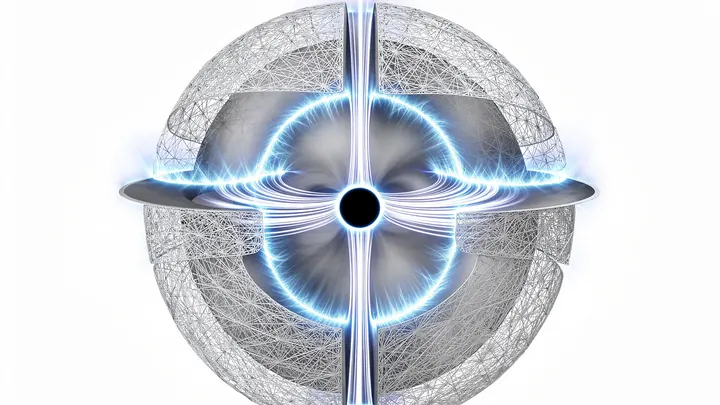
The collapse of a star's core is like compressing a spring: matter falls inward, and a neutron star is born at the center. But the fall is never perfectly smooth. In the boiling outer layers, random eddies transfer angular momentum to the infalling gas, and a disk swirls around the central object.
This disk is no calm river. It pulses, strengthening and fading.
When two neutron stars, the ultra-dense cores of dead stars, collide, a kilonova is born: an explosion a thousand times brighter than a typical nova. This is the universe's true smelting works. In the scorching cloud racing outward at near-light speeds, a furious flux of neutrons transmutes atomic nuclei into gold, platinum, osmium.
When JWST peered into the young universe at redshifts of 6–10, it revealed a scattering of mysterious 'little red dots' (LRDs). These objects combined features of galaxies and active nuclei, but their spectra refused to fit into familiar patterns.
Two neutron stars, ultra-dense remnants of massive stars, merge into one, and the space around them shudders: a gravitational wave is born, a ripple in the very fabric of spacetime. Almost simultaneously, a narrow stream of matter, the jet, erupts from the scene.
The birth of planets resembles the workings of a cosmic forge. Rocky blocks collide and fuse together. A powerful impact strikes a spark — material heats to white-hot and glows like cooling metal. Computer simulations show: the flash is visible from days to years, peaking at a tenth of the sun's light.
A clap of the hands compresses the air, and it flies outward — the simplest shock. In space, exploding stars play the role of hands: their shock waves sharply compress gas and trigger chaotic mixing — turbulence.
A supernova is the final explosion of a massive star, scattering its material over light-years. Inside the expanding shell, a neutron star remains, and the shell itself continues to plow through interstellar gas for thousands of years.
Stars tens of times heavier than our Sun don't die as thought before. Computer models show that their core often doesn't ignite a supernova, but quickly collapses into a black hole. Imagine a soufflé: the center suddenly sinks, and almost all the batter falls into the funnel, with just a few drops splashing out.
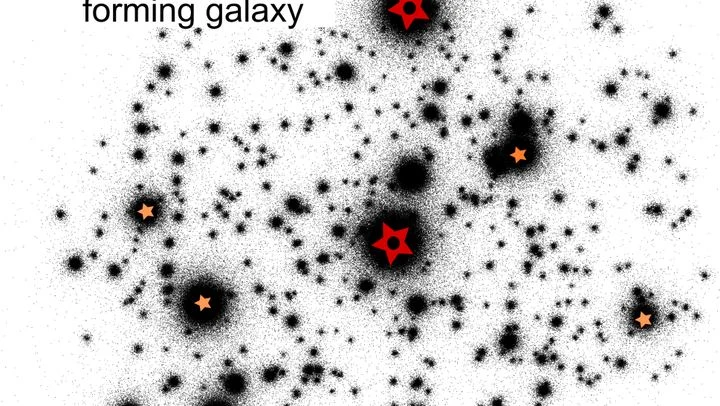
In the early Universe, star clusters were so dense that they gave birth to giants the size of the Solar System. If such a giant had taken the place of the Sun, its edge would have reached as far as Jupiter. These stars sometimes swallowed small black holes. The black hole would sink into the core and begin to grow, turning the star into a ghostly glow — a quasi-star.
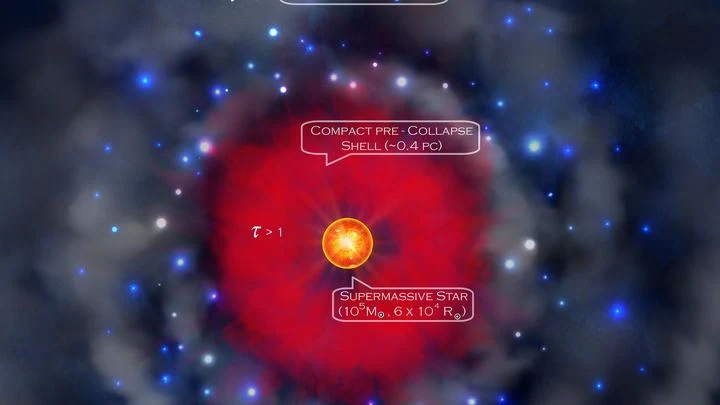
A star weighing a hundred thousand Suns lives bright and brief. Its finale is a rapid collapse into a black hole. But just before the end, it manages to wrap itself in a dense gas cocoon.
When a massive star explodes as a supernova, its outer layers are blasted into space at thousands of kilometers per second. A shock wave forms — a giant invisible bulldozer that sweeps up interstellar gas and dust. In this maelstrom, particles can be accelerated to energies comparable to that of a flying tennis ball compressed into a single proton.
A gamma-ray burst is a brief but extremely powerful flash of light, born from the merger of neutron stars or the collapse of a massive star. Inside such a flash, plasma flows race at enormous speeds and collide with each other.
Deep inside a massive star, before it explodes, layers sit on top of each other like the layers of an onion. Sometimes two adjacent layers, the carbon and oxygen layers, mix together. It's like how layers of broth and vegetables in a pot of soup blend when you stir them with a spoon.
When a massive star dies, its core collapses into a neutron star, and the outer layers are blown off in an explosion. At that moment, an unimaginably dense cloud of neutrinos is born — particles that barely interact with matter but actively 'talk' to each other. There are so many of them that together they behave like a fluid, with waves rippling across it.
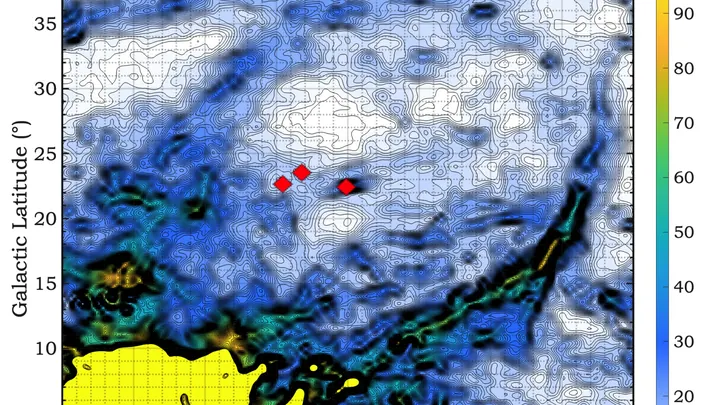
When a massive star explodes, it hurls giant clouds of gas into space. These clouds, known as supernova remnants, can stretch across hundreds of trillions of kilometers. Two such clouds — G107.7-5.1 and G150.3+4.5—were recently studied by astronomers using a telescope in Turkey.
In radio sky data, like on old photographic film, two bright gas streaks have emerged. They move at different speeds but hang near the same dim star. The star and the streaks turned out to be inside a huge empty bubble in the interstellar gas. This bubble is like a blown soap bubble left over from an ancient supernova explosion.
On December 31, 2023, the Sun unleashed a flare of the highest class — one that releases the energy of billions of atomic bombs in just a few minutes. Along with it, a huge prominence, a cloud of superheated gas, tore away from the surface and shot outward at nearly 3000 kilometers per second.
When a massive star explodes as a supernova, its material slams into the surrounding shell of cosmic dust and gas, like an invisible fur coat. The impact spawns myriads of neutrinos, ghostly particles that zip through planets without swerving.
In 2014, astronomers spotted a massive yellow star in the Andromeda galaxy. By 2022, it had vanished without a trace — without the usual blinding explosion of a supernova. It was as if someone simply switched off the light.
After the Big Bang, the universe was hot and dense. In clumps of dark matter, invisible stuff felt only through gravity, its particles, colliding, annihilated, giving birth to powerful radiation. This hidden heat, like an invisible furnace, warmed gas clouds from within.
North of the microquasar SS 433, an arc has emerged in the soft X-ray band. Faint and diffuse, yet stubbornly tracing contours already familiar from radio observations. Astronomers studied its spectrum and saw gas heated to eleven million kelvin. Gas that could not have been heated by the jets or the accretion disk wind.