Star formation regions are cosmic structures—filaments, clouds, and clusters—where new stars are born. These regions are typically composed of cold gas and dust, which collapse under gravity to form protostars. Observations show that star formation is not uniform but concentrated in dense filaments that thread through galaxies, often triggered by shock waves from supernovae or collisions between clouds.
History
The concept of star formation regions dates back to the early 20th century with the identification of dark nebulae as sites of star birth. Modern understanding emerged with radio and infrared observations in the 1960s–80s, revealing the cold, dusty nature of these regions.
How it works
The process begins when a giant molecular cloud becomes gravitationally unstable, fragmenting into cores that collapse. As a core contracts, it heats up and eventually ignites nuclear fusion. The surrounding gas and dust form accretion disks, which can later spawn planets. Feedback from young stars—winds, radiation, and outflows—disperses the remaining material, regulating further star formation.
In practice
Understanding star formation is key to modeling galaxy evolution, predicting the chemical enrichment of the universe, and studying the conditions that lead to planetary systems like our own.
Fun fact
The James Webb Space Telescope recently detected some of the earliest star-forming regions, showing that stars were being born less than a billion years after the Big Bang.
A river drawn on a map is always a single line. But stand on the bank, and you will see that within the channel there are faster currents, eddies, and branches that merge and split. The cosmic web is like that river, but made of dark matter, and until recently astronomers drew it as a single line.
The explosion of a massive star is not just a flash: it's a blow to the surrounding gas. But until now, no one had looked at how the gas itself moves at the sites of such explosions. Now astronomers have gathered data on 33 nearby supernovae and for the first time measured the turbulence of the cold molecular gas around them.
In the furnace of star formation, the heat reaches 900 degrees Celsius, like a glowing blast furnace. It is in this hellish heat that cosmic crystals are born. Astronomers have for the first time caught the moment when crystalline dust appears right during an accretion flare (when the star gobbles up surrounding gas) at the very young star EC 53, still cocooned in dense gas.
A stone falls into still water, and smooth rings spread across the surface. If the stone doesn't just fall but also spins, tiny whirlpools, vortices, appear on the surface. Light can do the same, only instead of water, it's space and time themselves.
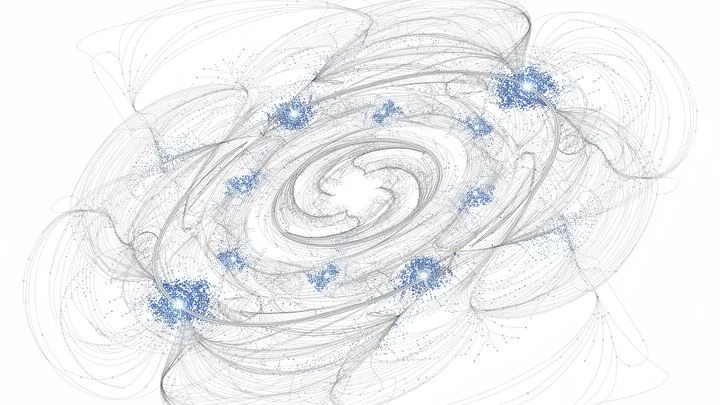
The cosmos resembles silk fabric with threads of the dark web showing through. We only glimpse tiny swatches of the real tapestry — through telescopes, in actual galaxy catalogs. To separate the fundamental signal from astrophysical noise in the cosmic pattern, statistical analysis demands thousands of plausible sketches — synthetic sky maps.
In the early universe, just a few hundred million years after the Big Bang, astronomers see strange objects — little red dots. They are compact, red, and in their spectra, broad Balmer lines scream the presence of supermassive black holes. But how did the hole manage to accumulate millions of solar masses in such a short time?
In 2016, astronomers saw something incredible: a distant star, named Icarus, flared up for several weeks, crossing the abyss of space. Gravitational lensing, an effect predicted by Einstein, had kicked in: a massive object bends spacetime and focuses light like a giant magnifying glass.
The Orion Nebula is a showcase of astrophysics, a laboratory for studying star formation right in our backyard. For over a century, its light has been split into spectra, and each forbidden line whispers its own version of how many electrons per cubic centimeter.
The cosmic spectacle unfolds on the stage of Galaxy галактики Centaurus A. In the lead role: a supermassive сверхмассивная чёрная дыра with a powerful jet that pierces space for hundreds of thousands of light-years.
In the young Universe, about ten billion years ago, galaxies resembled endless fields after a thunderstorm: everywhere, giant — thousands of light-years across — clumps of star formation were boiling up, where young stars were born with unbridled energy. Today, these patches are an almost vanished species: in nearby galaxies, raucous hotbeds are rare.
Look at an equilateral triangle — the probability simplex for three assets. Each interior point is a portfolio: non-negative shares summing to one. The triangle's center, the barycenter, corresponds to an equal-weight allocation (1/3, 1/3, 1/3). It seems that by moving toward this point, you lower risk and avoid dangerous edges.
Imagine a forest planted in a single day. At first glance, all trees look alike, but their cross sections tell different stories: some grew on clean soil, others on the ashes of ancient fires.
The hot broth of the early universe cooled unevenly. At some point, bubbles of a new phase began to pop within it, like steam bubbles in boiling water. But these bubbles weren't made of steam; they were made of a new state of matter in which particles of the dark sector clumped into larger lumps. That's how dark matter could have been born.
The James Webb Space Telescope peered into the era when the expansion of the Universe stretched the light of distant objects into the red, and found a scattering of strange sources — 'little red dots'. Their spectra broke the usual patterns: they are blue in the ultraviolet, but deep red in the optical, as if seen through a cherry veil.
When the James Webb Space Telescope turned its gaze deep into time, astronomers expected to see familiar galaxies. Instead, the images were dotted with a scattering of bright, incredibly compact red dots.
The James Webb space telescope peered into an era when the Universe was less than a billion years old and discovered hundreds of strange objects there. Tiny yet dazzlingly bright, they glowed a deep red — like burning coals scattered across the black velvet of space.
A bonfire that no one sees, but everyone feels the warmth: that's how astronomers found a flare in a distant galaxy. Not by its light, but by the infrared radiation of heated dust. The galaxy SDSS J010320.39+140152.5 caught attention when its center suddenly blazed in the infrared, as if someone had thrown logs onto an invisible fire.
In the heart of the Eagle Nebula, about 7000 light-years away, three giant pillars of gas and dust rise — the Pillars of Creation. Their shape is familiar to many from Hubble Space Telescope images. Now, Webb's infrared camera has allowed us to peer inside these dense cocoons where stars are born.
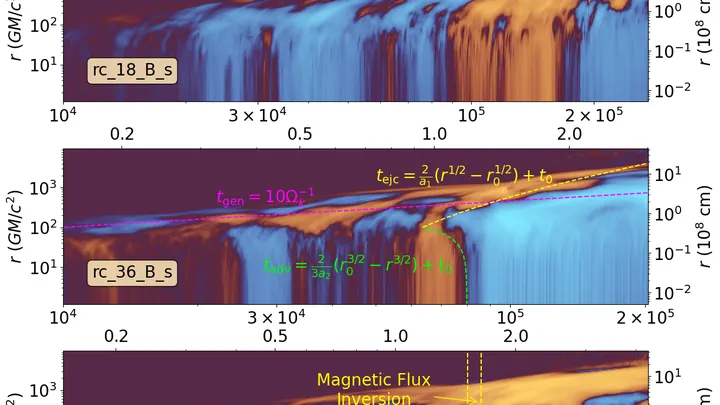
A massive star collapses, and a black hole is born, surrounded by a disk of incandescent plasma. For narrow jets to burst out of this disk, an ordered magnetic field is needed. But inside the star, it's tangled.
The universe keeps a tally of every newborn star. Over 13.8 billion years, galaxies have ignited so many stars that their 'census' can reveal the nature of the cosmos itself, just as tree rings reveal past climates.
At the edge of the Milky Way, there are stars that move against the general flow, like cars driving in the wrong lane. Previously, it was thought that all of them were remnants of one dwarf galaxy that our Galaxy tore apart and swallowed. But new research shows that there were several such 'oncoming' galaxies.
A newborn star is like a kitchen mixer: it whips up the surrounding cloud, and splatters fly in all directions. Only instead of batter, it's gas and dust. Previously, astronomers had only seen gas jets, and dust was considered too fragile: the shock wave should shatter dust grains into atoms.
In a large gas cloud where stars are born, the magnetic field lines are roughly aligned in one direction, like the fibers in a piece of felt. But look inside, into the dense clumps that will eventually become stars, and the picture changes: there the lines are twisted every which way, like a ball of yarn after a kitten has played with it.
In cold clouds of interstellar gas, long, dense filaments stretch out. Inside them, like overcrowded incubators, future stars are maturing. For a long time, it was thought that within such filaments, everything was governed by gravity: matter smoothly flows toward the centers, where density increases and eventually a star ignites.
Interstellar space is not empty: it is filled with tenuous gas, which is warm in some places and cold in others. The boundaries between such regions resemble the walls between soap bubbles.
The James Webb Space Telescope has spotted tiny, unnaturally bright red objects in the early universe. Their light outshines by a hundredfold what you’d expect from ordinary galaxies of that era.
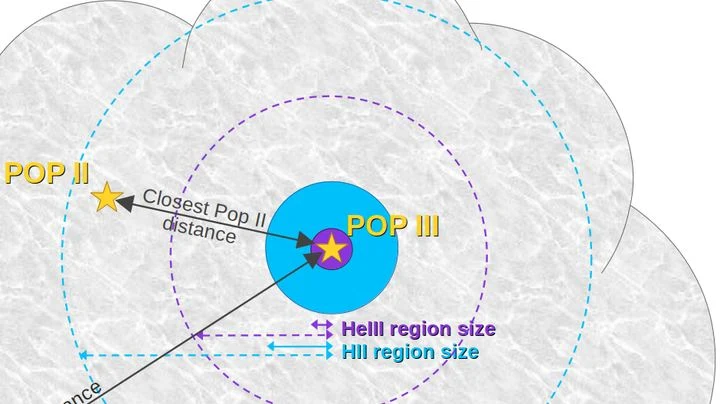
Immediately after the Big Bang, an idea championed by Georges Lemaître, the cosmos was a dark broth of hydrogen and helium. Then the first stars ignited — enormous, dazzlingly bright and hot, like sparks from a cosmic bonfire.
In the cold gas clouds where giant stars are born, everything is churning with motion. Gas compresses, swirls, and fragments into clumps — the future stars. For a long time, it was thought that the magnetic field brought order here: like invisible threads, it stretched clumps perpendicular to itself. But new observations showed the opposite.
When a massive star runs out of fuel, its core collapses and a shock wave races outward. But even before the star tears apart, particles that barely interact with ordinary matter may be born in its depths. If they decay into light, that energy leaks into the dense gas around the star.
This gas, like a blanket, wraps the star.
The Universe looks like a giant spiderweb: galaxies aren't scattered randomly but are gathered into knots and along filaments. Inside the filaments, there's plenty of gas, and that's where new stars most often flare up. But how has this changed over time? Scientists compared data from a computer model with real observations of thousands of galaxies.
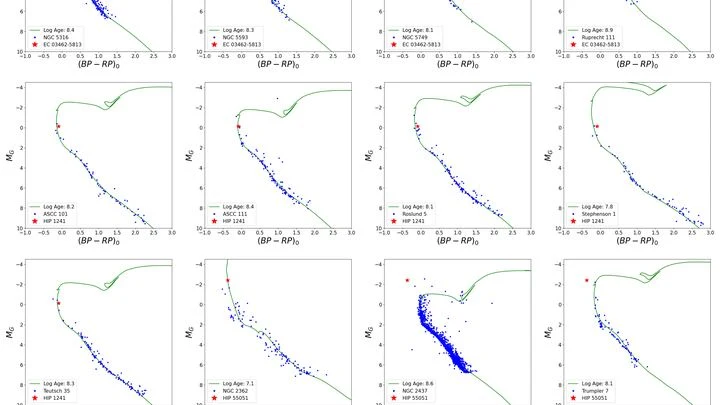
Blue giant stars are usually born in tight stellar nurseries — open clusters within the thin disk of our Galaxy. But sometimes such stars are found high above the disk, as if thrown out of their home. How did they get there?
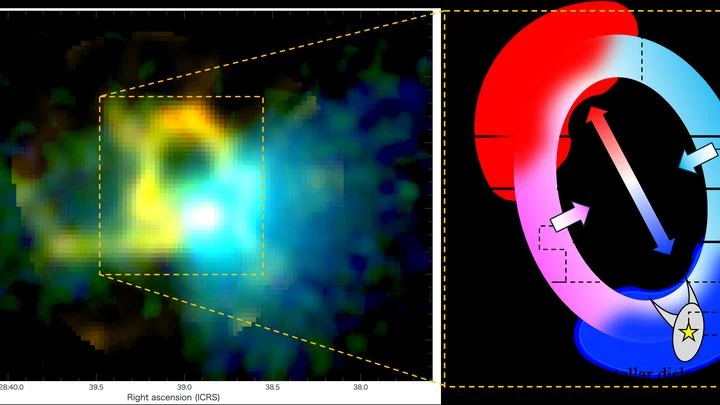
In a cold, dark cloud of gas where a star is just beginning to form, the ALMA telescope has spotted an unusual ring. It is made of gas that is warmer and denser than its surroundings. Such details were previously hidden because the gas at the cloud's center is opaque to ordinary observations.
Inside cold clouds of gas and dust where new stars ignite, astronomers have spotted unexpectedly delicate structures. The ALMA telescope, working in the millimeter range, has revealed more than 323 ultra-thin dust filaments within 121 massive clumps.
A young star that hasn't yet ignited its thermonuclear furnace is surrounded by a rotating disk of gas and dust. To gain mass, it needs to shed excess rotation — otherwise, material won't fall onto the star but will keep orbiting. Usually, this excess is carried away by two narrow gas jets that shoot from the star's poles in opposite directions, like two fountains.
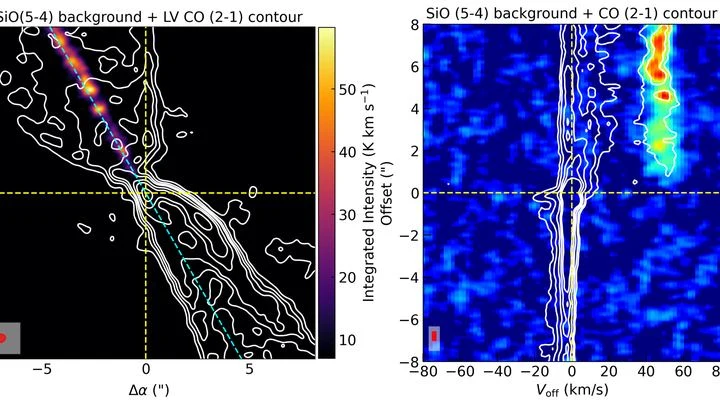
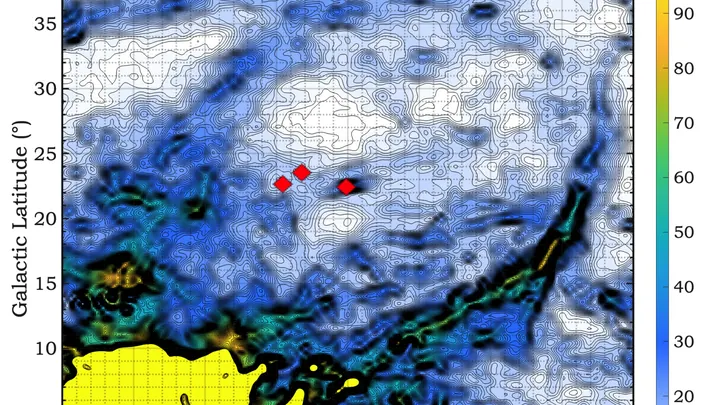
In radio sky data, like on old photographic film, two bright gas streaks have emerged. They move at different speeds but hang near the same dim star. The star and the streaks turned out to be inside a huge empty bubble in the interstellar gas. This bubble is like a blown soap bubble left over from an ancient supernova explosion.
A radio telescope has caught signals from three galaxies that existed when the universe was less than a billion years old. Their radio glow is so powerful that each seems to be birthing a thousand suns per year in a short span. For comparison, our Milky Way produces only a couple of stars per year.
Gas clouds in the Milky Way give birth to stars, and the heaviest among them are true giants. Previously, it was thought that such a star ignites almost instantly, like a light bulb. But new research shows that a star grows gradually, like a snowball rolling down a mountain: the longer it rolls, the bigger it gets.
The authors compared two catalogs: bright gas clouds around young stars and the stars themselves.
A galaxy cluster is like a busy intersection where galaxy-cars race through a headwind of hot gas. This wind, called ram pressure, strips galaxies of their cold gas — the fuel for star formation. Astronomers from the SAMI survey traced how this happens in hundreds of galaxies across eight nearby clusters.
In the Antennae Galaxies, which are crashing into each other, giant gas clouds collided at a speed of 50 kilometers per second. It's like two trains hurtling toward each other — the impact compressed the gas, and it ignited with new stars.
In the dark cloud G318.049+00.086, where no star has yet formed, dust and gas have arranged themselves into four long filaments. They converge into a dense central hub, like four rivers emptying into a lake. Gas flows along these filaments toward the center: the flow speed reaches 10–20 kilometers per second per parsec of length.