Intermediate-mass black holes (IMBHs) are the missing link between stellar-mass black holes, which form from collapsing stars and weigh a few to tens of solar masses, and supermassive black holes, which anchor galaxy centers and can reach billions of solar masses. IMBHs are thought to range from about 100 to 100,000 solar masses. Their existence is strongly implied by observations of ultraluminous X-ray sources and by the gravitational wave events that suggest mergers involving objects in this range, yet they have been notoriously difficult to pin down unambiguously.
History
The concept was proposed in the 1980s as a natural evolutionary step between stellar and supermassive black holes, but definitive evidence has remained elusive. The first strong candidate, HLX-1, was identified in 2009 in the galaxy ESO 243-49.
How it works
IMBHs are expected to form through hierarchical merging of smaller black holes or through the collapse of massive, low-metallicity stars in dense stellar clusters. They would grow by accreting gas and by merging with other black holes and neutron stars. Detection relies on indirect signatures: tidal disruption events, where an IMBH shreds a passing star, producing a bright flare; gravitational lensing, where its gravity bends light from background objects; and dynamical measurements, where its gravitational influence on nearby stars or gas reveals its mass.
In practice
IMBHs are key to understanding how supermassive black holes grew in the early universe, and they serve as laboratories for testing gravitational dynamics in extreme regimes.
Fun fact
The tidal disruption event AT2018cqh, observed in 2018, provided one of the best candidates for an IMBH, with a mass estimated around 50,000 solar masses.
A little monster hides in a dwarf galaxy, and its neighbor feeds it. The satellite galaxy is slowly merging with a massive companion, and gas from the outer regions falls toward the center, where a black hole sits. By cosmic standards, it is not large: only 800 to 5000 solar masses, but its appetite is ferocious.
Light from a distant galaxy reaches us through its own dust. This dust is not a smooth haze but ragged clouds, like wisps of cotton. Old models treated it as a uniform mist, and then the galaxy didn't add up energetically: too much light disappeared in the ultraviolet and too little came back in the infrared.
Astronomers did what a cook does when they dice a potato instead of tossing it in whole.
A black hole with a mass of 35,000 Suns drifts through a galaxy's gas like a barge through fog. Its gravity rakes the material ahead of it, leaving a dense trail behind — a wake of gas. Some of that gas gets pulled into the black hole, and it grows.
An accountant tallies up all the factories, warehouses, and shops, but the balance doesn't add up — half the inventory seems to have evaporated. That's roughly how astronomers have spent decades searching for ordinary matter in the present-day Universe.
In a distant galaxy about 290 million light-years away, the object HLX-1 lies hidden. It once flared brighter than hundreds of billions of suns, but now it has quieted down. From 2018 to 2022, the Hubble, Chandra, and Swift space telescopes tracked its fading.
Two galaxies (our Milky Way and its satellite, the Large Magellanic Cloud) slowly circle each other. Their gravitational pull stirs the distant outskirts of the Milky Way, like a pebble thrown into a pond makes the water ripple.
At the center of most galaxies lurk supermassive black holes — the overlords of gravity. Since 2019, thanks to interferometry with very long baselines, we’ve glimpsed their shadows: dark silhouettes set against a blazing gas backdrop. But what exactly is painting that shadow?
In the centers of distant galaxies, X-ray 'beacons' sometimes light up. They don't flash randomly but on a strict schedule: every few hours or days. These bursts are called quasi-periodic eruptions (repeating at nearly regular intervals).
Light from a distant blazar, an active galactic nucleus whose jet points our way, travels for billions of years. Along the way, it triggers cascades of charged particles that the intergalactic magnetic field deflects sideways. This creates a blurred gamma-ray glow around the blazar: a secondary halo.
LIGO and Virgo detectors catch ripples in spacetime, but some signals force us to rewrite the scripts of stellar death. GW190814 — the merger of a black hole of 23 solar masses with a compact object of 2.6 solar masses — is a discordant chord in the symphony of standard models.
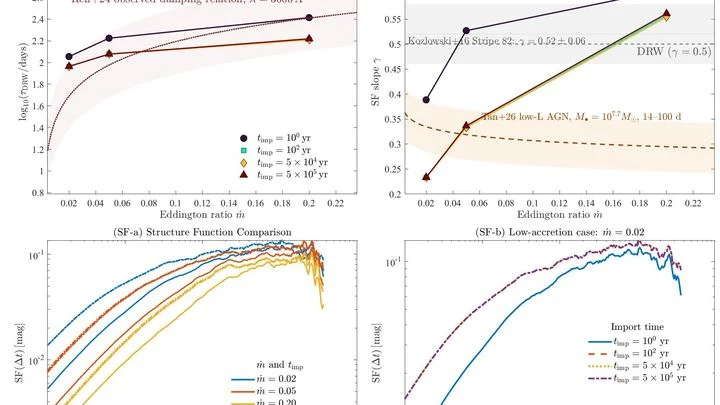
At the heart of nearly every large galaxy shines an active nucleus — a supermassive black hole surrounded by a flat, rotating disk of incandescent gas. The disk itself flickers, but astrophysicists suspect that within it lurks a whole swarm of small, stellar-mass black holes.
When a piano falls into an abyss, we think about the abyss. We don't think about the piano's cover. In much the same way, astrophysicists have for decades studied extreme close encounters between small bodies and massive black holes. They focused on the black hole itself and what orbits it. But what the 'bullet'—the small object heading toward doom — is wearing, almost no one asked.
Picture a tightrope walker balancing over an abyss. Every step changes the rope's tension, and the slightest shift in center of gravity can prove fatal. That's roughly what the dance of an ordinary sun-like star around a black hole of ten solar masses looks like when the orbit is highly elongated.
A magnifying glass focuses sunlight into a bright point. If the glass has a tiny flaw, the spot of light becomes distorted. Gravitational lensing works in a similar way: a massive galaxy bends light rays from a more distant source, creating an enlarged and sometimes distorted image.
Black holes come in two types: tiny ones — the remnants of supernova explosions, and giants in the cores of galaxies. But where are the intermediate ones, with hundreds and thousands of solar masses? The answer may lie in star swarms, where black holes collide like balls on a billiard table and, merging, bulk up.
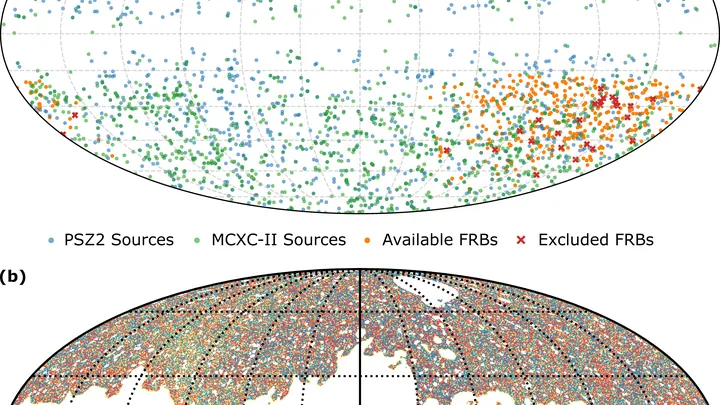
Black holes come in lightweights, born from dying stars, and supermassive ones at galactic cores. The missing intermediate link had been hiding. Fast radio bursts, cosmic signals lasting milliseconds but carrying the energy of days of sunlight, helped crack the case. Think of these bursts as cries from the depths of the universe.
The universe is full of invisible substance that governs the movement of galaxies. In the 1970s, astronomer Vera Rubin showed: without dark matter, stars on the outskirts would have long since flown apart. But what it's made of remains unknown.
In the crowded center of the galaxy, two stars orbit so close together that one strips the outer layers off the other, like wind blowing off a coat. What remains is a hot helium core, a star without a hydrogen envelope.
Two heavy spheres circle not in a neat circle but in a highly flattened oval — now approaching, now flying apart. That's roughly how pairs of black holes on elongated orbits behave. Unlike calm pairs that gradually spiral together and merge, these dancers retain a memory of their turbulent youth: of being kicked out of star clusters or made to whirl by close neighbors.
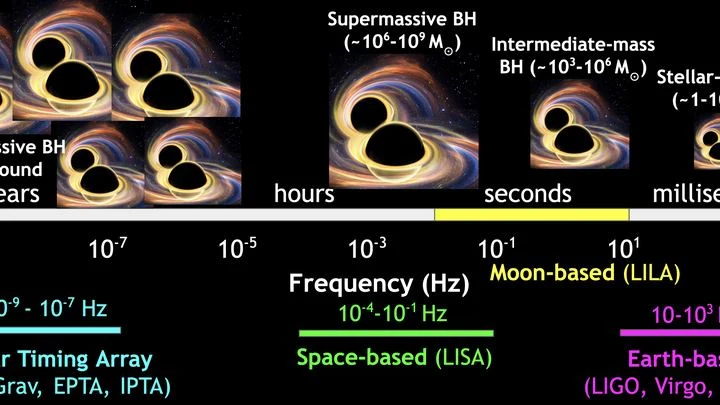
Gravitational waves are ripples in the fabric of space, like circles on water from a thrown stone. On Earth, they are drowned out by traffic, tides, and earthquakes, like a storm beating on a lake, making it impossible to notice faint splashes. The LILA project moves the detector to the Moon, where windless silence reigns.
An orchestra of millions of instruments plays a single note, but each enters at its own moment and with its own volume. That's how the stochastic gravitational wave background sounds — a hum from black hole mergers that are individually indistinguishable.
Astrophysicists have conducted a census of invisible objects that betray their presence only through the trembling of space. They studied the fresh catalog GWTC-4 — a list of dozens of black hole mergers recorded by the gravitational wave detectors LIGO, Virgo, and KAGRA.
Recently, astronomers spotted three interstellar comets coming from deep space. One of them, 3I/ATLAS, turned out to be unexpectedly large: its nucleus is several kilometers across.
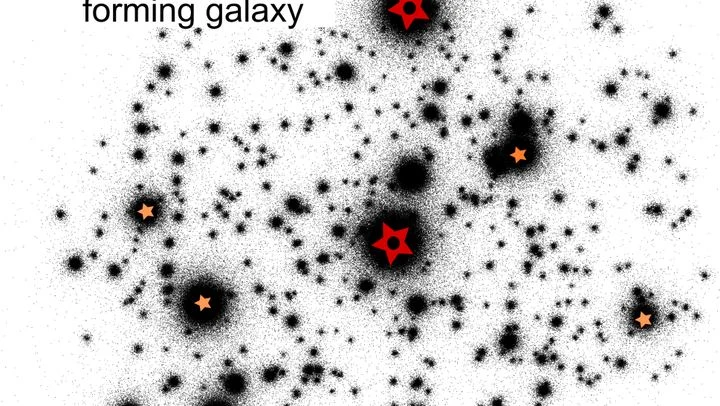
In the early Universe, star clusters were so dense that they gave birth to giants the size of the Solar System. If such a giant had taken the place of the Sun, its edge would have reached as far as Jupiter. These stars sometimes swallowed small black holes. The black hole would sink into the core and begin to grow, turning the star into a ghostly glow — a quasi-star.
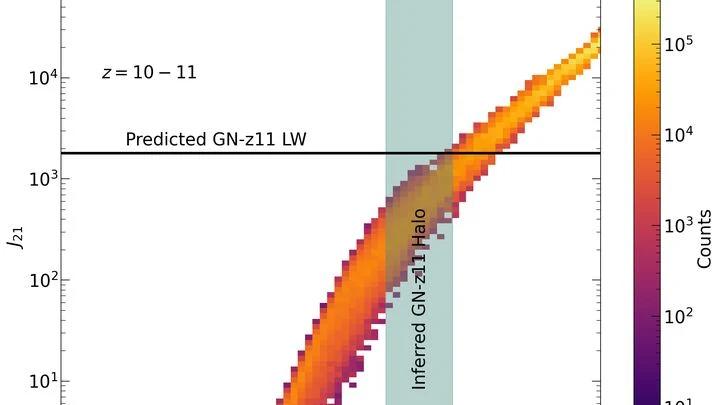
A bonfire built of pure alcohol burns hot and gives off almost no smoke. That's roughly how the first stars shone: they contained no heavy elements, only hydrogen and helium left over from the Big Bang. The James Webb Space Telescope may have caught one such "bonfire" in the galaxy GN-z11.
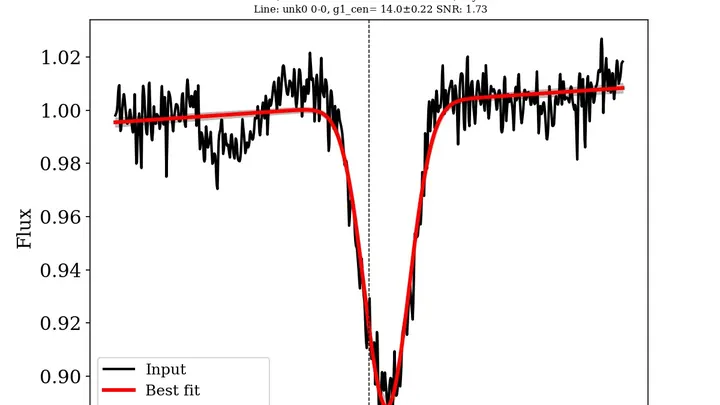
Lithium is like a thermometer dipped into a star's interior. This light element is destroyed at temperatures around 2.5 million degrees, so its abundance on the surface tells us how deeply the star's material has been mixed.
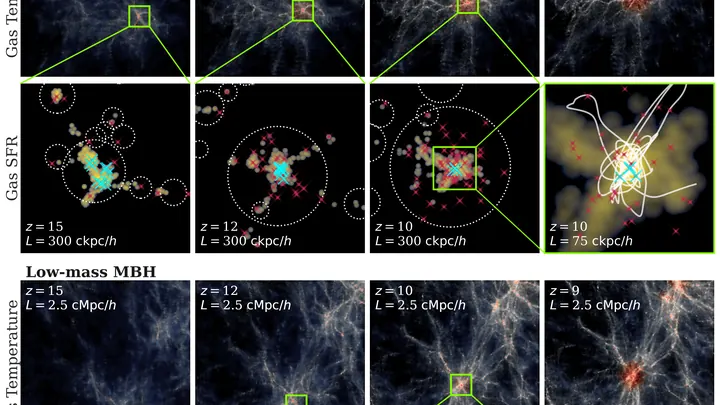
The James Webb telescope discovered black holes — so named by John Wheeler, and Karl Schwarzschild described them as a light trap — which, just 500 million years after the Big Bang, already weighed more than a million Suns.
For nearly a century, astronomers have been searching for dark matter — an invisible scaffold that keeps galaxies from flying apart. Fritz Zwicky first proposed it, and Vera Rubin proved its existence by showing that stars on the outskirts of galaxies move too fast.
In galaxy clusters, invisible dark matter serves as the framework holding star systems together. Its shape is betrayed by a faint glow — stars ripped from galaxies by tidal forces. This stellar 'broth' fills the cluster like a liquid taking the shape of its container: it envelops the clumps of dark matter, creating a precise cast of their outlines.
Around certain close binary stars, where a white dwarf siphons matter from its companion, astronomers have seen a glowing arc. They took it for a shock wave — the place where a fast stellar wind slams into interstellar gas. But new observations show: there's more than one arc.
The gravitational waves detectors LIGO and Virgo picked up a deep rumble — the aftermath of two invisible objects merging. Their combined mass turned out to be less than the Sun's. Stellar evolution doesn't produce such lightweight black holes: a dying star doesn't collapse into such a tiny finale.
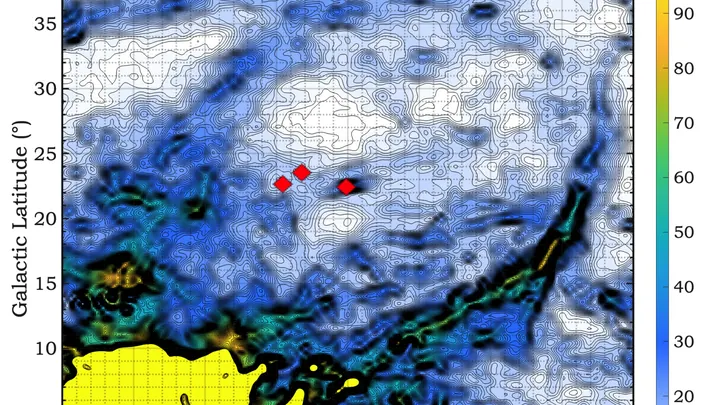
In radio sky data, like on old photographic film, two bright gas streaks have emerged. They move at different speeds but hang near the same dim star. The star and the streaks turned out to be inside a huge empty bubble in the interstellar gas. This bubble is like a blown soap bubble left over from an ancient supernova explosion.
Gas clouds in the Milky Way give birth to stars, and the heaviest among them are true giants. Previously, it was thought that such a star ignites almost instantly, like a light bulb. But new research shows that a star grows gradually, like a snowball rolling down a mountain: the longer it rolls, the bigger it gets.
The authors compared two catalogs: bright gas clouds around young stars and the stars themselves.
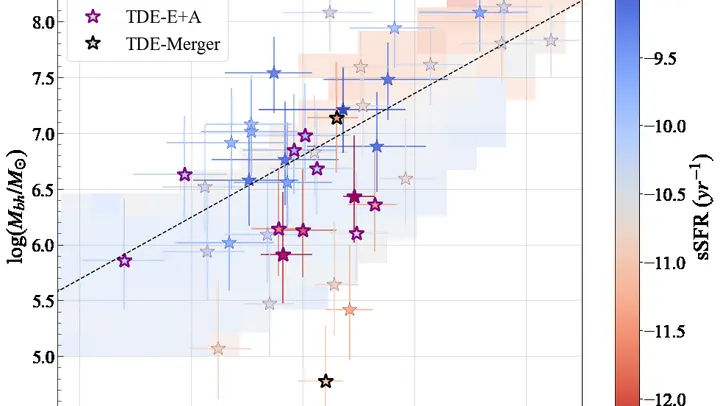
You can't see a black hole until a star wanders too close. Then tidal forces stretch the star like a cook rolling out dough, and some of the material falls into the hole, flaring up as a final goodbye. Such events, called tidal disruptions, are a rare chance to weigh a black hole that would otherwise remain invisible.
At the center of our Galaxy lies a dense forest of dust and gas. Starlight barely penetrates this thicket, like a flashlight in fog. But it is precisely there, in this dense cloud, that new stars are born.
Scientists decided to look into this fog. They took light from 15 bright stars that shine through cold clouds.
The universe is expanding, and the rate of that expansion is a hot topic in cosmology. Nearly a century ago, Edwin Hubble discovered that galaxies are flying apart, but modern measurements of the Hubble constant, which characterizes the expansion rate, give conflicting values.
In the 2010s, astronomers noticed something remarkable: supermassive black holes at the centers of galaxies, despite vast differences in size and brightness, fall onto a single straight line when you plot their millimeter emission against X-ray emission and mass.
When a star wanders too close to a black hole, an object with gravity so intense that not even light can escape, tidal forces shred it like dough caught in a mixer's beaters. This event, known as a tidal disruption event (TDE), unleashes a powerful flare of radiation.
Type Ia supernovae are the 'standard candles' of cosmology: their peak luminosity is nearly identical, allowing distances to be determined from apparent brightness — the fainter the object, the farther away it is.
Particles of dark matter can behave like molasses: in one model they don't interfere with each other; in another, they gently jostle, creating viscosity. This determines how quickly giant black holes at the centers of galaxies fall into each other and merge.