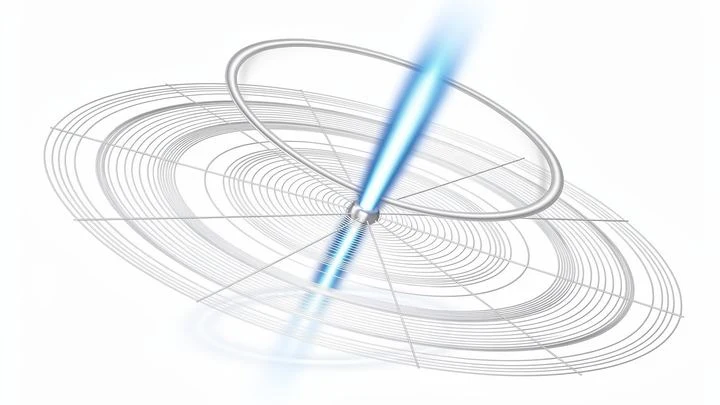
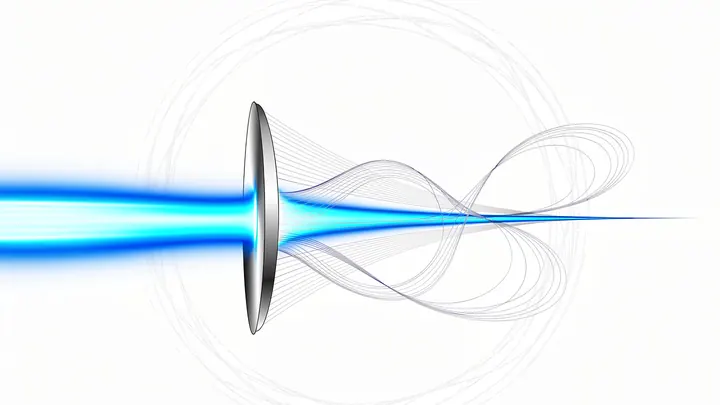
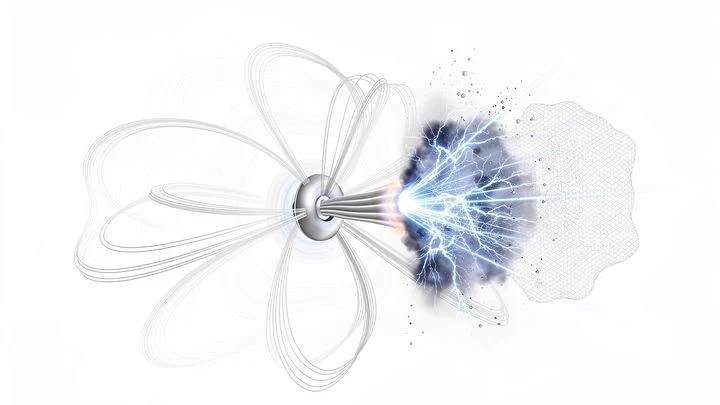
A pulsar windnebula is a glowing cloud of gas and radiation formed when the relativistic wind of particles streaming from a rapidly rotating, highly magnetized neutron star (a pulsar) collides with the surrounding interstellar medium or the remnants of the supernova that created the pulsar. The wind, moving at nearly the speed of light, is slowed down at a shock front, where particles are accelerated to extreme energies, producing synchrotron radiation across the electromagnetic spectrum, from radio to X-rays and gamma rays. These nebulae are cosmic laboratories for studying particle acceleration and magnetohydrodynamics.
History
The first pulsar windnebula identified was the Crab Nebula, which was recognized as such in the late 1960s after the discovery of the pulsar at its center. The theoretical framework for how pulsar winds create these nebulae was developed in the 1970s and 1980s by researchers like Kennel and Coroniti.
How it works
The pulsar's rotation and magnetic field generate a strong electric field that strips charged particles from the neutron star's surface and accelerates them outward. This wind carries energy and magnetic flux. When the wind encounters the surrounding material, it forms a termination shock. At this shock, the kinetic energy of the wind is converted into thermal energy and particle acceleration, often via mechanisms like Fermi acceleration. The accelerated electrons and positrons spiral in the magnetic field, emitting synchrotron radiation, which makes the nebula visible. The structure of the nebula, including jets and tori, reflects the pulsar's spin axis and the geometry of the wind.
In practice
Pulsar windnebulae serve as natural particle accelerators, and studying them helps astrophysicists understand cosmic ray origins and the physics of extreme magnetic fields and relativistic shocks, which can inform models of other high-energy phenomena.
Fun fact
The Crab Nebula's pulsar wind nebula is so energetic that it emits pulses of radiation across the entire electromagnetic spectrum, and its central pulsar rotates about 30 times per second.
Water in a tank spins at nearly four revolutions per second, and, as if by magic, a column the size of a dinner table emerges. The vortex lives for dozens of rotations, even though everything around it churns and trembles. Where does such stability come from?
The secret is that the vortex is not isolated.
In 1054, a star flared up in the constellation Taurus. The light of its death was so bright that it was visible in daylight for nearly a month, and Chinese astronomers recorded it in their chronicles. Today, the Crab Nebula is spreading over that spot, and its claws are clouds of gas still being whipped up by the dead star at its center.
The night sky is full of rings and bubbles, but in the radio band they look different. In data from the Australian radio telescope ASKAP, a structure has surfaced that resembles two soap bubbles blown from the same straw.
The night sky in neutrino light resembles a canvas worked on by two hands. One holds a broad, soft brush: these are supernova remnants, the shells left behind after stellar explosions. The other grips a fine, hard pen — microquasars, binary systems where a black hole twists matter into narrow jets.
Pulsar PSR J1740+1000 is a city-sized star spinning faster than a kitchen blender. After a supernova explosion, it left behind a dense core that accelerates particles to near-light speeds. These particles fly into space, and previously it was thought they scatter in all directions, like splashes from a stone thrown into water.
When a star many times heavier than the Sun dies, it collapses and explodes as a supernova. This is not just a flash of light — the entire process, from core collapse to the ejection of the outer layers, makes space itself tremble. These ripples are called gravitational waves.
In 1054, earthly observers recorded a 'guest star' flaring in the constellation Taurus — so bright it rivaled the Sun. Today, its remnant, the Crab Nebula, serves as a cosmic laboratory, and it has now sprung a new surprise.
In the first seconds after the Big Bang, the Universe left us not only light but also something far more elusive — the relic neutrino background. This echo of creation permeates every cubic centimeter, yet we barely notice it.
LIGO and Virgo detectors catch ripples in spacetime, but some signals force us to rewrite the scripts of stellar death. GW190814 — the merger of a black hole of 23 solar masses with a compact object of 2.6 solar masses — is a discordant chord in the symphony of standard models.
A pot of porridge boiling over a high flame: bubbles carry grains from the bottom to the surface. A similar mechanism works on a neutron star. As it accumulates hydrogen and helium from a companion star, it occasionally triggers a powerful nuclear explosion — an X-ray burst.
A massive star doesn’t simply fade away — it blows up as a supernova, leaving behind an expanding remnant and a wildly spinning neutron star — a pulsar. In this cosmic storm, astonishing patterns emerge, and the 'Nimbus'–'Thunder' system is a dazzling illustration.
A tightly twisted phone cord snaps and scatters sparks. Magnetic fields on the Sun behave the same way: they twist, break, and reconnect, powering flares. For the first time, astronomers have witnessed this process directly. One loop was twisted by 540 degrees — one full turn and then half again. That’s three times more than previously thought possible.
A vast city lights new streetlamps every night. But then a hurricane sweeps in, rips all the fuel from the warehouses, and the lamps go out one by one. Something similar has been spotted by astronomers in a galaxy whose light has traveled 12.5 billion years to reach us.
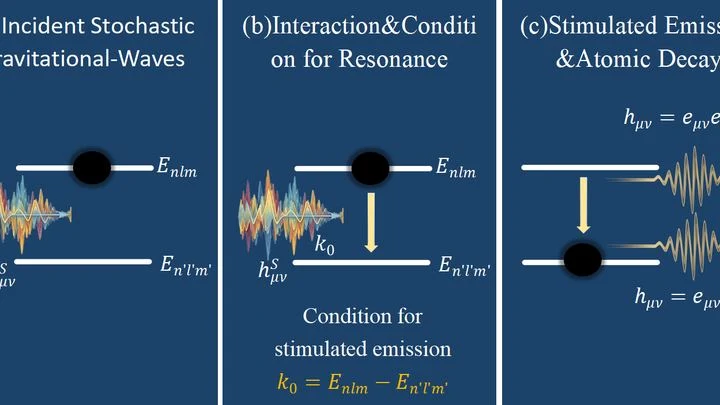
If a black hole spins quickly, it can hold a cloud of ultralight particles around it, so light that their mass almost vanishes. They arrange themselves in layers, like electrons in an atom, only here gravity does the job instead of electric forces. This structure stores energy, like a coiled spring.
When a massive star dies, its core collapses, and a supernova explosion occurs. The cataclysm births streams of particles — like ripples from a thrown stone. The first to arrive are swift neutrinos, which pierce the Earth, hardly interacting. Then, hours later, ghost particles with a tiny charge appear.
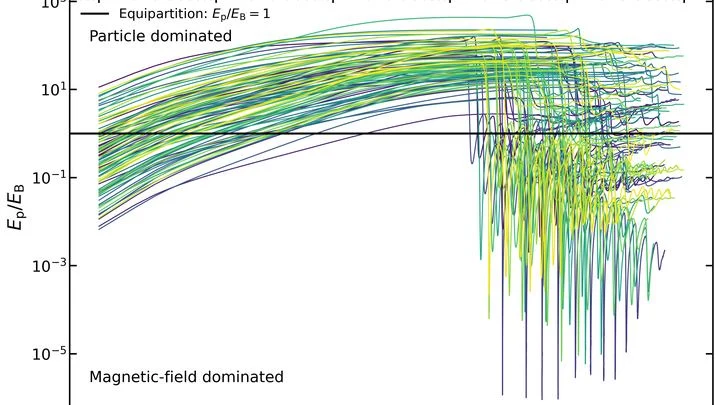
Blacksmith's bellows fan the fire by forcefully pushing out air. In space, the shock wave from a supernova, a concept introduced by Fritz Zwicky, acts like such bellows: it catches up with a giant bubble of charged particles and magnetic fields formed around a spinning neutron star…
Gravitational waves — the cosmic tremors from distant cataclysms — are so faint that detecting them is like trying to hear a whisper in a hurricane. But a black hole can amplify that whisper many times over.
At the heart of the Galaxy, about 7 kiloparsecs away, lies a true natural particle accelerator. This is a rapidly spinning neutron star — the pulsar PSR J1849-0001, left behind by a supernova explosion.
In April 2021, in a galaxy 35 megaparsecs away, supernova SN 2021foa erupted. It immediately puzzled astronomers: its spectrum feverishly switched between hydrogen and helium lines — as if the star, in agony, was frantically shedding its outer layers.
Space is full of invisible sprinters — particles racing nearly at the speed of light. They are caught in the solar wind, near neutron stars, and even in the intergalactic void between galaxies. But what accelerates them where there are no shock waves or magnetic reconnections?
In an orchestra, each musician plays their own part, but at a certain moment all instruments pause on a single note. Cosmic rays behave somewhat like this — particles flying toward us from distant stars.
Two neutron stars whirl in their final dance. If their spin aligns with their orbital motion, the partners merge neatly, launching a narrow jet of superheated matter. If they spin in opposite directions, the dance breaks apart, scattering a thick shroud of debris.
Imagine a spinning top the size of a city, weighing more than the Sun and making hundreds of revolutions per second. That's a neutron star — the remnant of an exploded star. Occasionally, its rotation suddenly speeds up, as if something inside has switched. Astronomers call these jumps glitches and suspect that invisible vortices in the star's superfluid interior are to blame.
Two burned-out stars, each about the size of Earth but heavier than the Sun, spiral ever closer until one crashes into the other. The impact triggers a thermonuclear explosion, giving birth to a type Ia supernova. Such flashes serve as cosmic beacons for measuring distances across the universe. Yet the details of their origin remain hotly debated.
Inside a neutron star, matter is compressed so intensely that atomic nuclei fuse into long strands and flat sheets. Astrophysicists call these structures nuclear pasta. At their surface, the density of matter plummets to nearly zero, like diving out of thick jelly into thin air.
It's this sharp transition that creates the unusual effect.
Two neutron stars (the remnants of dead stars, compressed to the size of a city but weighing as much as the Sun) spiral around each other and eventually collide. At that moment, something between a black hole and a super-powered magnet is born: a field billions of times stronger than that of the most powerful MRI machine.
A clap of the hands compresses the air, and it flies outward — the simplest shock. In space, exploding stars play the role of hands: their shock waves sharply compress gas and trigger chaotic mixing — turbulence.
A swing swings higher and higher if you push it in rhythm. A similar mechanism kicks in when a dead star orbits a massive black hole shrouded in a cloud of ultralight particles. These particles are candidates for dark matter — the invisible substance that keeps galaxies from flying apart.
Every second, invisible projectiles from the depths of space pierce through us. These are cosmic rays — atomic nuclei accelerated to speeds nearly indistinguishable from the speed of light. Their energy is hundreds of millions of times greater than what our most powerful accelerators can achieve. Where does this monstrous force come from?
A giant cauldron of simmering soup stretches across millions of light-years. This is the atmosphere of the Perseus galaxy cluster — a cloud of scorching gas held together by gravity. Until recently, astronomers thought that in the center of this cauldron, the gas was calmly cooling, ready to condense into new stars.
Be stars are rapidly rotating luminaries with bright gas disks. Usually, a companion star spins them up: mass flowing from the neighbor whirls the star like a bullet in a rifled barrel. But there are also lone Be stars without a partner: their origin long remained a mystery.
New research shows that solitaries can be born from a supernova explosion.
A neutron star is a spinning top with the mass of the Sun, crushed to the size of a city. It's born in the fire of a supernova and usually only slows its spin. But sometimes, for no apparent reason, it suddenly speeds up — such a jerk is called a glitch.
When a heavy atomic nucleus splits, it doesn't break into even halves. First, two fragments form that look like pears pressed together at their narrow ends. Then the junction begins to smooth out, like two droplets merging and the surface quickly leveling.
In that brief moment, the surface moves inward, and particles inside the nucleus can bounce off it, like a ball off an oncoming wall.
The center of our galaxy is a crowded kitchen where several dishes are simmering at once, and their steam blends into a single cloud. X-rays from the exploded star's remnant, from the stellar wind around the supermassive black hole, and from hot gas between stars all overlap.
Superbubbles are cosmic giants, akin to soap bubbles, but instead of soap film, they contain rarefied interstellar gas, and they're inflated not by a breath but by a series of supernova explosions. In computer simulations, they behave like living things: they grow, cool, and move. But until now, we couldn't precisely trace their boundaries.
When a massive star dies, its core collapses into a neutron star, and the outer layers are blown off in an explosion. At that moment, an unimaginably dense cloud of neutrinos is born — particles that barely interact with matter but actively 'talk' to each other. There are so many of them that together they behave like a fluid, with waves rippling across it.
Deep in the constellation Aquila lies a nebula that looks like an expanding bubble. It is inflated by a tiny star the size of a city — a pulsar that makes several rotations per second and loses rotational energy. Usually, such bubbles shine exactly as brightly as their pulsar is powerful.
A cosmic neon sign lit up in an incredibly distant galaxy: almost all its light comes from hot gas, and the stars are lost in this glow. The James Webb telescope recorded that the gas, a mix of hydrogen and helium, is so heated that it glows on its own.
In the Norma cluster, the nearest rich galaxy cluster to us, astronomers have spotted a shock wave. It arose when one cluster plowed into another, like the bow wave of a ship cutting through water. This wave compressed and heated the gas between the galaxies.
Two galaxies sit right behind the wave front.