Thermal Map of Galaxy Clusters express
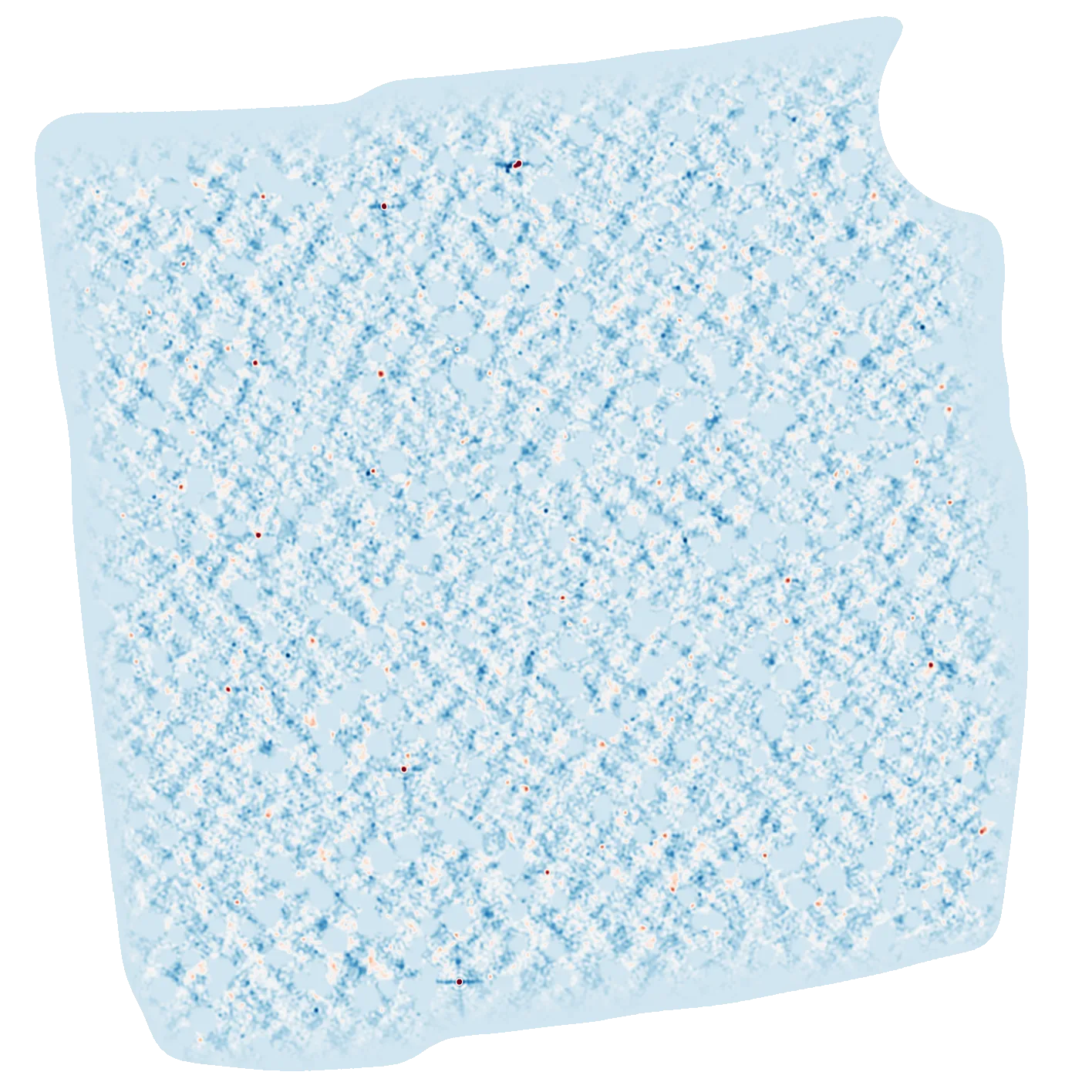
In the frozen desert of Antarctica, the SPT-3G telescope peers deep into the universe. Its target is the ancient microwave radiation left over from the Big Bang. But on its way to us, this radiation passes through giant galaxy clusters filled with scorching gas. The gas slightly warms the photons, and barely visible spots appear on the sky map.
This effect is called the Sunyaev-Zeldovich effect, after the two physicists who predicted it. It works like X-rays, but without X-rays: the hotter the gas, the stronger the distortion. By studying these spots, astronomers learn where clusters are located and how matter is distributed within them. In the new work, they gathered data from several years of observations at 95, 150, and 220 GHz, and also added images from the Herschel space observatory at 600 and 857 GHz. All of this was combined into a single map — the deepest ever created.
The main challenge is separating the desired signal from interference. The most insidious "noise" comes from the cosmic infrared background: light from distant dusty galaxies that also enters the telescope. To remove it, they built two versions of the map: one with maximum sensitivity, the other with the background suppressed. The comparison showed that on the scales of interest, the background is tens of times weaker than the signal. Moreover, the difference between the maps allowed them to measure, for the first time, how the Sunyaev-Zeldovich effect and the infrared background correlate. It turned out that on large scales the correlation is positive — meaning that where there is lots of hot gas, there are also many dusty galaxies. On small scales, the correlation disappears.
This result is not just a technical achievement. It provides new constraints on models describing how galaxies eject matter and energy into their surroundings. Such "feedback" processes are key to understanding the evolution of galaxies and clusters. So the map built in the icy desert helps us see how the entire universe works.
The Sunyaev-Zeldovich effect allows us to see galaxy clusters at vast distances because its brightness does not depend on distance — unlike ordinary light, which fades.
In Carl Sagan's novel "Contact," radio telescopes pick up a signal from a galaxy cluster — maps like this help locate such regions.