C. Feng

11 articles · 30 co-authors · latest: 2026-08-21
492 citations · h-index 10 · 34 papersData: Semantic Scholar

We have retold 11 papers by this author. most often about: dark energy, dark matter, expansion of the universe. 30 co-authors across our retellings.

Links in the knowledge graph
Cosmology2026-01-092 minarXiv:2601.05646express
Dark Matter and Dark Energy: A Slow Reaction
The universe is expanding, and the rate of that expansion is a hot topic in cosmology. Nearly a century ago, Edwin Hubble discovered that galaxies are flying apart, but modern measurements of the Hubble constant, which characterizes the expansion rate, give conflicting values.
Cosmology2026-01-283 minarXiv:2601.20551express
Cosmic Microwave Background: New Measurements from the South Pole
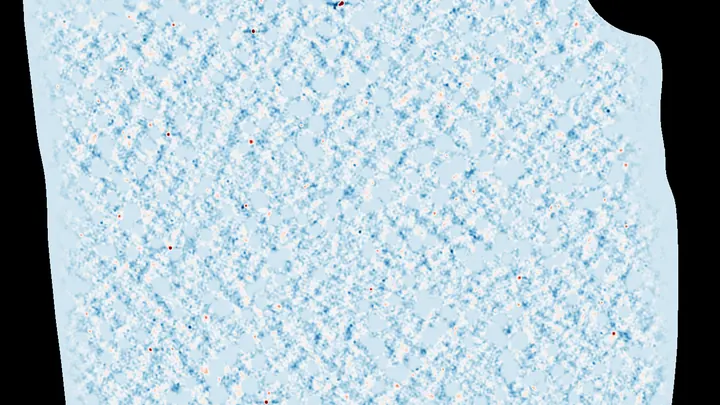
At the South Pole, where the air is dry and transparent to millimeter waves, stands a telescope that looks not at stars but at the oldest light in the universe. This light is the cosmic microwave background — the radiation left over from the Big Bang, filling the entire sky.
Cosmology2026-02-102 minarXiv:2602.10107express
Thermal Map of Galaxy Clusters
In the frozen desert of Antarctica, the SPT-3G telescope peers deep into the universe. Its target is the ancient microwave radiation left over from the Big Bang. But on its way to us, this radiation passes through giant galaxy clusters filled with scorching gas.
HEP Experiment2026-02-191 minarXiv:2602.17184express
How Scientists Measured the 'Character' of Charmed Particles
In a giant particle accelerator, where protons traveling at nearly the speed of light smash into a neon target, charmed baryons are born — particles that live for less than a billionth of a second.
HEP Experiment2026-03-131 minarXiv:2603.13223express
Asymmetry in Decays: How Particles Reveal Their History
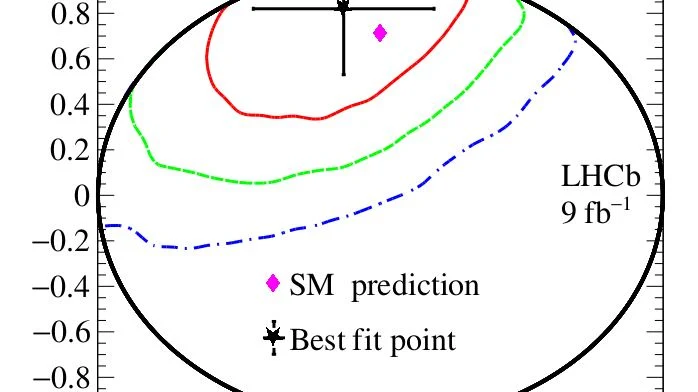
In the LHCb detector, like in a giant camera with billions of 'snapshots,' rare events are captured: how short-lived particles, B mesons, fall apart into lighter ones. One such decay, where a B meson turns into a kaon and a pair of muons, is particularly interesting. In it, as in a mirror, the difference between matter and antimatter may show up.
HEP Experiment2026-03-301 minarXiv:2603.28456express
Two-Charm Baryon Caught for the First Time
In proton collisions at the Large Hadron Collider, physicists have for the first time caught a particle with two charm quarks. It is called Ξcc+ (pronounced "ksi-ksi-plus") and resembles a bead with not one but two heavy nuclei.
HEP Experiment2026-04-072 minarXiv:2604.05701express
The Gamma Angle: How Physicists Catch the Difference Between Matter and Antimatter
Every second, billions of decays happen inside our bodies, and nobody notices. But physicists do: they smash particles in accelerators and watch what fragments they fly into. Hidden in those fragments is the answer to why we exist at all. Right after the Universe was born, there were equal amounts of particles and antiparticles, but today all we see around us is particles.
HEP Experiment2026-04-071 minarXiv:2604.05712express
A 71-degree angle: how physicists catch the asymmetry of matter
Imagine a balance scale with identical weights, yet one pan always tips lower. In the world of elementary particles, this imbalance is called CP violation: particles and their mirror twins (antiparticles) behave slightly differently.
HEP Experiment2026-04-231 minarXiv:2604.21257express
A New Charmed Meson
In the LHCb detector, where protons collide, one unusual track was found among billions of decays. The particle, named $$D_{s1}$$(2933)^+, appears for a moment and immediately decays into other particles. Its lifetime is so short that it cannot be observed directly — only through its decay products can its existence be reconstructed.
HEP Experiment2026-04-291 minarXiv:2604.26784express
Rare decay spotted for the first time
A coin landing on its edge is about as rare as a heavy B meson decaying into a light pion and an electron-positron pair. Over a decade of collider operation, only a handful of such events have accumulated, but physicists have finally managed to spot them. The decay probability is about 2.4×10⁻⁸.
HEP Experiment2026-08-211 minarXiv:2608.21082express
How a Heavyweight Particle Decays
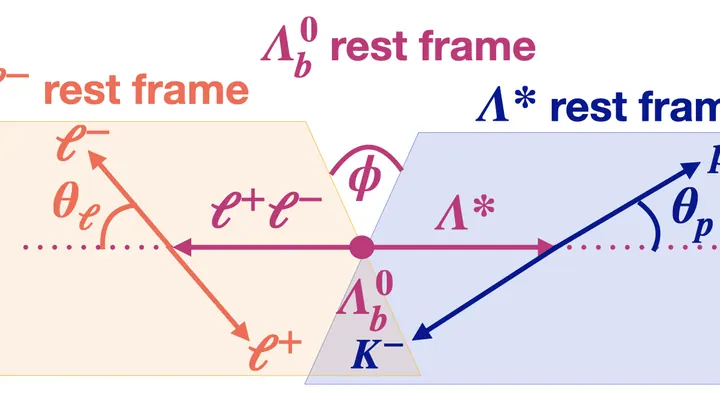
At the Large Hadron Collider, protons are smashed together, and among the debris, a heavyweight particle, the lambda baryon, sometimes appears. It lives for a tiny fraction of a second before decaying into other particles.