How to Catch a Rare Signal in a Sea of Data express

Original: "Demonstration and performance of an online data selection algorithm for liquid argon time projection chambers using MicroBooNE"
· MicroBooNE collaboration, P. Abratenko, D. Andrade Aldana, L. Arellano, J. Asaadi, A. Ashkenazi, S. Balasubramanian, B. Baller, A. Barnard, G. Barr, D. Barrow, J. Barrow, V. Basque, J. Bateman, B. Behera, O. Benevides Rodrigues, S. Berkman, A. Bhat, M. Bhattacharya, V. Bhelande, A. Binau, M. Bishai, A. Blake, B. Bogart, T. Bolton, M. B. Brunetti, L. Camilleri, D. Caratelli, F. Cavanna, G. Cerati, A. Chappell, Y. Chen, J. M. Conrad, M. Convery, L. Cooper-Troendle, J. I. Crespo-Anadon, R. Cross, M. Del Tutto, S. R. Dennis, P. Detje, R. Diurba, Z. Djurcic, K. Duffy, S. Dytman, B. Eberly, P. Englezos, A. Ereditato, J. J. Evans, C. Fang, B. T. Fleming, W. Foreman, D. Franco, A. P. Furmanski, F. Gao, D. Garcia-Gamez, S. Gardiner, G. Ge, S. Gollapinni, E. Gramellini, P. Green, H. Greenlee, L. Gu, W. Gu, R. Guenette, P. Guzowski, L. Hagaman, M. D. Handley, O. Hen, A. Hergenhan, M. Harrison, S. Hawkins, C. Hilgenberg, G. A. Horton-Smith, A. Hussain, B. Irwin, M. S. Ismail, C. James, X. Ji, J. H. Jo, A. Johnson, R. A. Johnson, D. Kalra, G. Karagiorgi, W. Ketchum, A. Kelly, M. Kirby, T. Kobilarcik, K. Kumar, N. Lane, J. -Y. Li, Y. Li, K. Lin, B. R. Littlejohn, L. Liu, S. Liu, W. C. Louis, X. Luo, T. Mahmud, N. Majeed, C. Mariani, J. Marshall, N. Martinez, D. A. Martinez Caicedo, F. Martinez Lopez, M. G. Manuel Alves, S. Martynenko, A. Mastbaum, I. Mawby, N. McConkey, B. McConnell, L. Mellet, J. Mendez, J. Micallef, T. Mohayai, A. Mogan, M. Mooney, A. F. Moor, C. D. Moore, L. Mora Lepin, M. A. Hernandez Morquecho, M. M. Moudgalya, S. Mulleria Babu, D. Naples, A. Navrer-Agasson, N. Nayak, M. Nebot-Guinot, C. Nguyen, L. Nguyen, J. Nowak, N. Oza, O. Palamara, N. Pallat, V. Paolone, A. Papadopoulou, V. Papavassiliou, H. Parkinson, S. F. Pate, N. Patel, Z. Pavlovic, E. Piasetzky, K. Pletcher, I. Pophale, X. Qian, J. L. Raaf, V. Radeka, A. Rafique, M. Reggiani-Guzzo, J. Rodriguez Rondon, M. Rosenberg, M. Ross-Lonergan, I. Safa, D. W. Schmitz, A. Schukraft, W. Seligman, M. H. Shaevitz, R. Sharankova, J. Shi, L. Silva, E. L. Snider, S. Soldner-Rembold, J. Spitz, M. Stancari, J. St. John, T. Strauss, A. M. Szelc, N. Taniuchi, K. Terao, C. Thorpe, D. Torbunov, D. Totani, M. Toups, A. Trettin, Y. -T. Tsai, J. Tyler, M. A. Uchida, T. Usher, B. Viren, J. Wang, L. Wang, M. Weber, H. Wei, A. J. White, S. Wolbers, T. Wongjirad, K. Wresilo, W. Wu, E. Yandel, T. Yang, L. E. Yates, H. W. Yu, G. P. Zeller, J. Zennamo, C. Zhang, Y. Zhang
arXiv:2602.11138 · 2026-02-11 · CC BY 4.0 · 1 min
A particle trap learns to pick out the important stuff on the fly.

The MicroBooNE detector is a large tank of liquid argon that catches particles flying through it. When a particle passes, it leaves a trail of charge and a flash of light. These trails combine into a three-dimensional picture of the event, as if the particle were drawing its path in a transparent cube.

But there are too many such events: hundreds of cosmic muons fly through the detector every second. Recording everything would mean drowning in data. Usually, the selection is done later, on computers, but that is slow and expensive. The new work shows how to teach the detector to select what matters right on the fly, like an experienced chef skimming the foam off a broth without turning off the stove.

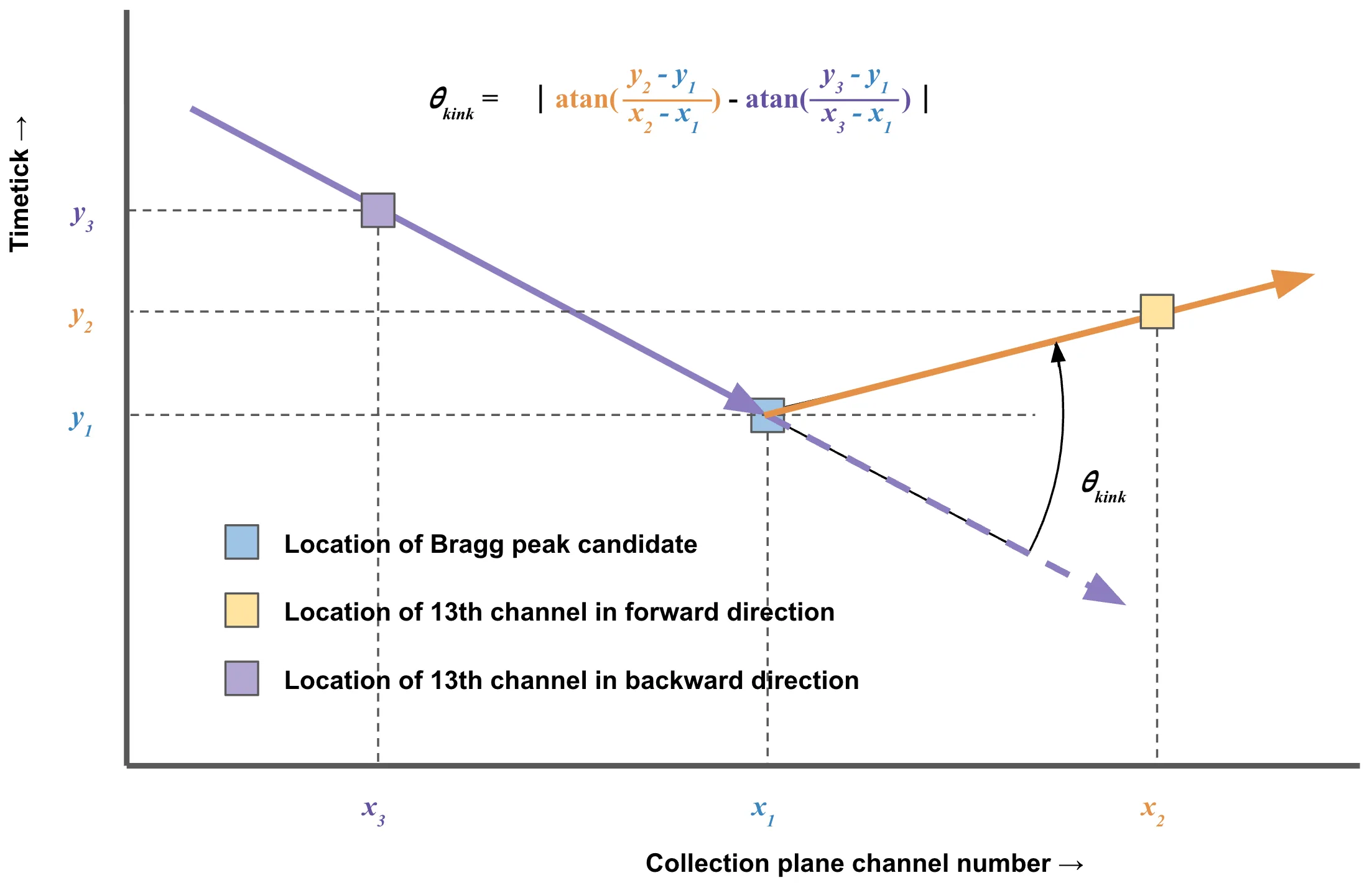
The algorithm looks only at the charge left by the particle in the wire planes and decides in fractions of a second: is this an interesting electron from a stopping muon, or just noise?

Such online selection has been tested for the first time on real data from a liquid argon detector. It works fast and accurately, and it can be transferred to future experiments where the data flow will be even more powerful. It's like teaching a mail filter to tell important letters from spam before they hit your inbox.

Now the detector doesn't just see particles: it learns to hear the whisper of rare events amid the roar of cosmic rays.
The liquid argon in the MicroBooNE detector is cooled to minus 186 degrees Celsius — colder than the surface of Mars.

Scientists
Enrico FermiPaul DiracSubrahmanyan ChandrasekharAlbert EinsteinBarry BarishKip Thorne
Concepts
liquid argon neutrino detection liquid argon dune juno neutrino detection rare event search event selection lz xenonnt neutrino detector particle detection methods particle identification