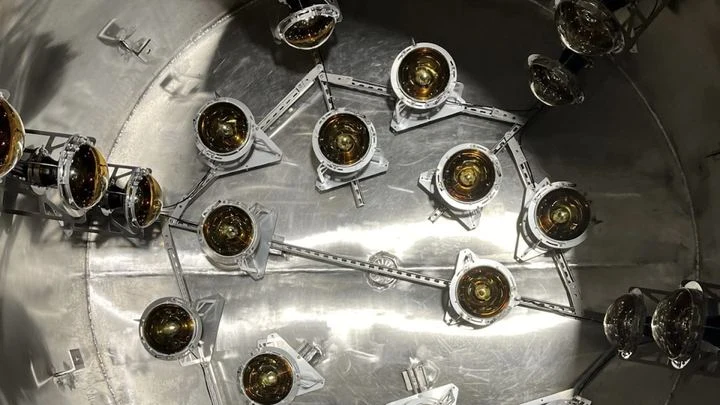
XENONnT is a dark matter detection experiment located in the Gran Sasso National Laboratory in Italy, shielded by over a kilometer of rock. It uses a dual-phase liquid xenon time projection chamber to search for weakly interacting massive particles (WIMPs), a leading dark matter candidate. The detector is designed to observe rare nuclear recoils caused by WIMP collisions with xenon atoms.
History
XENONnT is the successor to XENON1T, which operated from 2016 to 2018. The experiment is an international collaboration led by the University of Zurich and Columbia University.
How it works
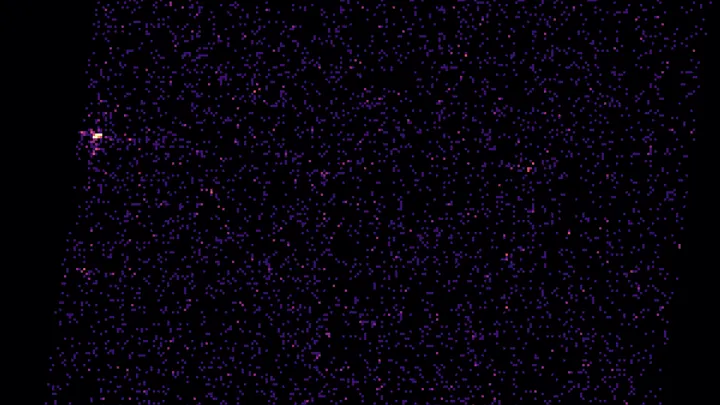
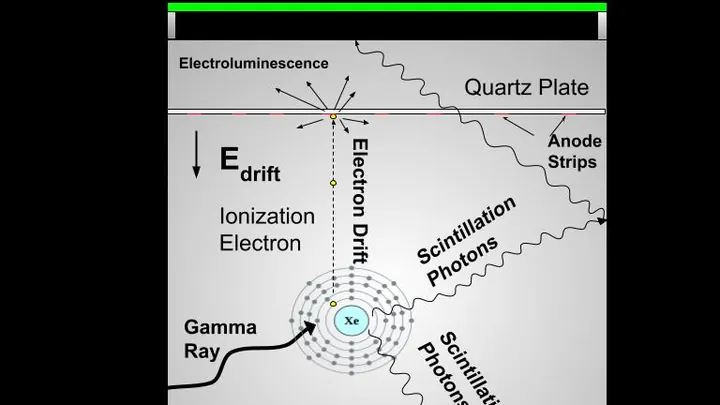
A large volume of liquid xenon is kept at very low temperature. When a particle interacts, it produces a prompt scintillation signal (S1) and, if it ionizes, electrons drift to the top gas phase, creating a secondary signal (S2). The time difference and spatial distribution of these signals allow 3D event reconstruction, distinguishing WIMP-like nuclear recoils from background electron recoils.
In practice
Primarily used for fundamental physics research, searching for dark matter and studying rare processes like neutrinoless double beta decay.
Fun fact
The detector contains about 8.5 tonnes of liquid xenon, which must be kept at -95°C, and the rock overburden reduces cosmic ray muons by a factor of a million.
Deep inside a mountain, where cosmic-ray muons are muffled by a thick layer of rock, stands a detector that catches not light but its absence. Positronium is a tiny atom in which an electron and its antiparticle, the positron, circle each other like a pair of dancers. Usually they come together and vanish in a flash of two or three gamma quanta.
In a tank holding three tons of liquid xenon, buried deep underground, something stirred one day. Not the xenon itself, but one of its atomic nuclei: it received a kick with an energy of 248 thousand electronvolts and recoiled like a billiard ball struck by an invisible cue ball.
No one has ever seen dark matter, but it should pass through detectors like wind through leaves. Sometimes, very rarely, a dark matter particle bumps into an atomic nucleus, and then the detector must catch that jolt. The trouble is that light dark matter particles can hardly move heavy nuclei: it's like trying to knock down a bowling pin by throwing a feather at it.
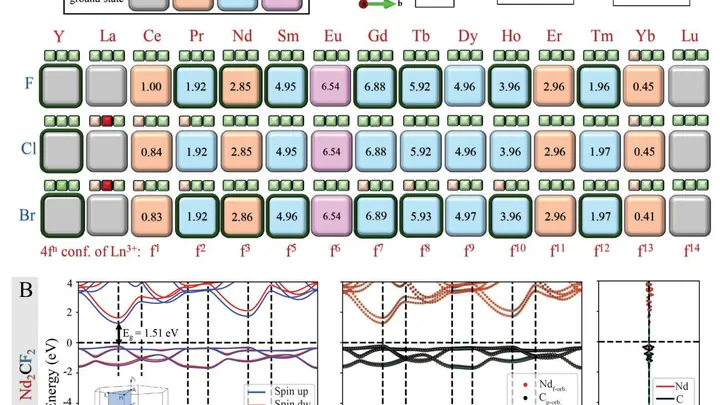
In chemistry's storeroom, records of substances no one thought were special gathered dust. It turns out that among them hide 2D materials — thin as a sheet of paper, but strong and with unexpected properties. Scientists ran a computer search through databases, and it pulled out 38 candidates that had not been recognized as 2D before.
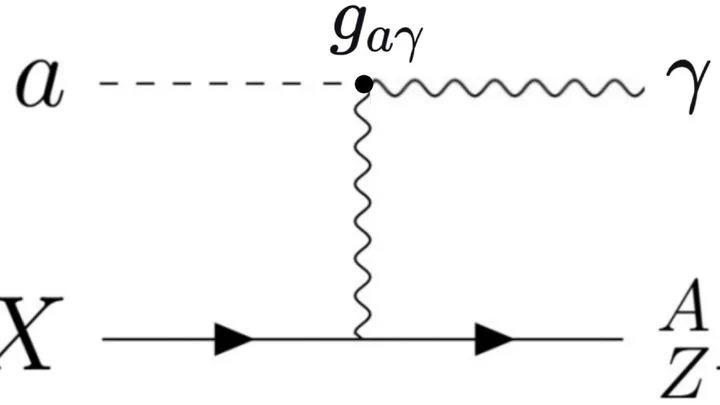
Inside the Sun, reactions can produce light, almost undetectable particles called axions. One such reaction yields axions with an energy of 5.49 MeV, as if each one carried the energy of a tennis ball moving at 100 km/h. These particles pass freely through Earth, but occasionally they might collide with a xenon atom.
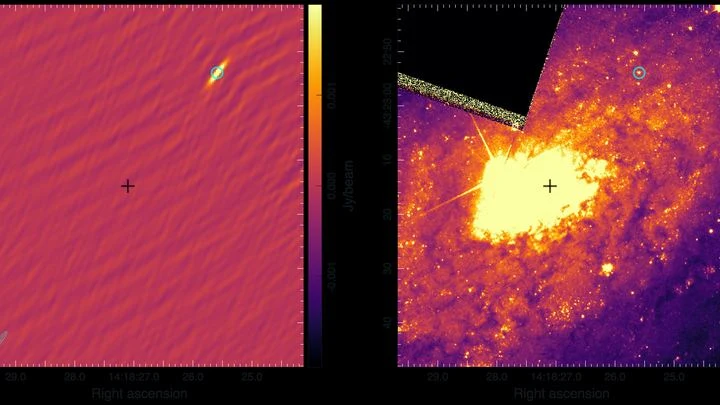
On March 26, 2026, the Chinese-European Einstein Probe observatory caught an X-ray flash that lasted a little over a quarter of an hour. A thousand seconds. The onboard WXT telescope registered a sharp rise in radiation, then a smooth decline, as if someone had screamed into silence, and the echo slowly faded.
Solar neutrinos are tiny particles born in the Sun's core by the trillions every second. They pass through Earth almost without noticing it, and for a long time they were considered absolutely stable. But perhaps they too can "age"—decaying imperceptibly, vanishing on their way to us.
264 kilometres per second — that's how fast the Solar System hurtles through the cloud of dark matter. Its existence was given away by galaxies: they spun too fast to be held by visible mass, and Vera Rubin was first to suspect a hidden scaffolding.
Deep underground, in the silence of a cryostat (a cooled container), lie crystals of lead that once belonged to an ancient Roman ship. This material barely emits background radiation — over two thousand years, unstable isotopes have decayed, leaving it perfectly clean for hunting the rarest events.
At nine in the morning, the DarkSide-50 detector, 1400 meters beneath Gran Sasso, records a weak ionization pulse. By eleven at night, the frequency of such events drops noticeably. This is not an electronics glitch or a seasonal background variation.
A huge pool of clear liquid is hidden deep underground. Inside, there is nothing but a pristine 'broth' that flashes with faint light when an invisible particle flies through. This is the JUNO detector—20,000 tons of liquid scintillator built to hunt for neutrinos.
The main enemy of such a hunt is not darkness but its own noise.
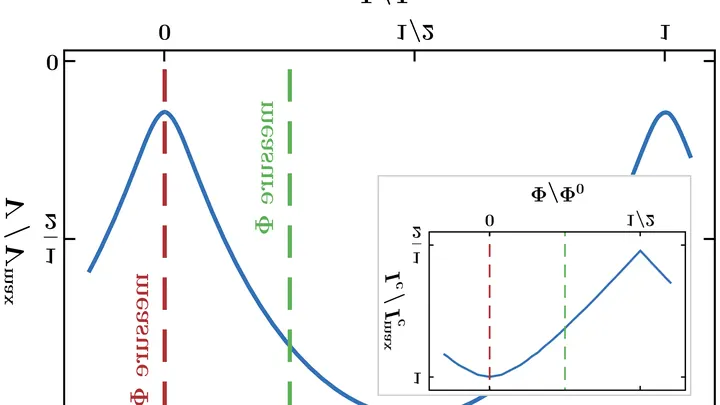
In the pitch darkness of a vacuum chamber, a tiny magnet floats. It touches no walls and loses almost no energy — an ideal sentinel, ready to catch the faintest nudge. Such a sentinel is exactly what you need for axion hunting. These particles are prime suspects in the case of the Universe's hidden mass, which we call dark matter.
Engineers create an alloy for solar concentrators by adding hard particles — like raisins in dough, to help it hold its shape under extreme heat. Too big a raisin and the material cracks. Previously, scientists manually counted these particles on microscope images.
Dark matter detectors are essentially incredibly sensitive microphones, capable of hearing a whisper amid the roar of a rock concert. Their job is to catch the rare nudges from hypothetical dark matter particles, which are thought to occasionally collide with atomic nuclei of ordinary matter.
An ocean permeates all of space, yet remains invisible to us. This ocean is dark matter, and the waves on its surface are particles called axions. They are so light and elusive that they pass through Earth without noticing it. But if these waves crash against a shore made of a special material, they might leave a trace — a tiny electric current.
An old photograph taken at the moment of the universe's birth has been carrying its light to us for nearly 14 billion years. This snapshot is the cosmic microwave background, the cooled echo of the Big Bang. It captures the tiny inhomogeneities from which galaxies later grew.
The story began with a puzzle: in the 1930s, Fritz Zwicky noticed that clusters of galaxies behave as if an enormous invisible mass is hidden within them. Half a century later, Vera Rubin confirmed that stars on the outskirts of galaxies rotate too fast to be held by visible matter alone.
The story began almost a century ago, when Edwin Hubble showed that galaxies are receding, and Fritz Zwicky and Vera Rubin later realized: to explain their motions, invisible mass is needed — dark matter.
Ice, water, steam — phase transitions we all know. But what happens if you squeeze and heat an atomic nucleus itself? Theorists think protons and neutrons inside it 'melt,' releasing smaller building blocks — quarks and gluons.
In a dark room, a glass bead the size of a dust grain hangs on a laser beam. Beneath it are two mirrors: one aluminum, one silver. If axions (light, invisible particles that could make up the mysterious dark matter) whiz by, they exchange with the mirror atoms, and the bead shifts ever so slightly.
Dark matter has eluded direct observation so far, even though its gravity holds galaxies together. One hypothesis: it’s made of axions — ultra-light particles predicted by theory.
Dark matter is invisible, but its gravity governs the motion of galaxies. What it's made of is a mystery. One idea: it consists of ultra-light particles akin to axions.
In 1987, astronomers saw a supernova flare up in a neighboring galaxy — the Large Magellanic Cloud. It was a rare gift: the explosion was close enough to catch not just light but also neutrinos, those nearly undetectable particles that pass straight through Earth.
A flat crystal of charged atoms suspended in an electromagnetic trap behaves like a perfectly calm pond. The slightest breeze, and ripples spread across its surface. This 'pond' catches the splashes from dark matter particles and the ripples of spacetime — high-frequency gravitational waves.
A supernova explosion is the death of a massive star, leaving behind a gas cloud. If there's plenty of hydrogen around, the shock wave spreads like an echo from a distant gunshot.
Conventional dark matter detectors are like a soccer goalkeeper waiting for a powerful shot while the ball barely rolls. The invisible particles filling our galaxy often move too slowly to be noticed by sensitive sensors.
In a distant galaxy, at a distance that light takes 11 billion years to cross, something flashed. The Einstein Probe X-ray telescope caught a brief, needle-prick-like burst: it lasted only a few dozen seconds.
A massive star's explosion is bright but brief. The flash itself lasts weeks, but the dust it heats around it glows in infrared for years. It's like a camera flash illuminating a room, then hot dust particles lingering in the air — only on a cosmic scale.
Deep beneath the Apennine Mountains, in a tank holding three tons of liquid xenon, something gives a barely perceptible shudder every few days. It's a solar neutrino, a ghostly particle born in the Sun's thermonuclear furnace, that has traveled 150 million kilometers through empty space and solid rock to finally collide with a xenon nucleus.
Underground, in a former gold mine, sits a tank of liquid xenon. If a dark matter particle flies through it, the xenon flashes. But it also flashes from ordinary particles, like neutrinos or leftover radioactivity. The task is to tell which flash comes from dark matter and which from noise.
The camera that hunts for tumors works like a highly sensitive camera: it catches the faint glow from a substance that accumulates in diseased cells. In conventional machines, the light is born in a crystal — a solid piece that resembles glass. But a crystal doesn't always convey exactly where the light flashed, so the image comes out slightly blurry.
At the Large Hadron Collider, protons collide at nearly the speed of light. Sometimes they don't smash apart but exchange photons — particles of light. These photons can produce a pair: one particle the detector sees, and another that flies off unnoticed.
In a dark tank holding thirty tons of water, the liquid glows when a ghostly particle streaks through. Neutrinos barely interact with matter, but occasionally they bump into atoms, and a flash is born. To catch it, a special substance, a liquid scintillator, is added to the water to amplify the light.
In a dark mine under the Italian Alps, a tank holds three tons of liquid xenon. When a particle hits it, it knocks faint flashes of light and electron clouds out of the atoms. Following these tracks, physicists hope to see an ultra-rare decay: a xenon-136 nucleus turning into barium-136, emitting two electrons and no neutrinos.
Deep in a Canadian mine, there's a barrel holding 3269 kilograms of liquid argon — a clear fluid that looks like very cold water. This barrel is the DEAP-3600 detector, and its job is to catch dark matter particles, which are thought to permeate the universe but barely interact with ordinary matter.
Titan, Saturn's largest moon, is wrapped in a thick orange haze. It's made of hydrocarbons and other organic molecules that are born when sunlight breaks apart methane and nitrogen in the upper atmosphere.
Deep in the Swiss Alps, there is a vertical shaft that plunges 800 meters down, like two skyscrapers stacked on top of each other. A railway tunnel runs nearby, and trains thunder through it every day. But inside the shaft, it is as quiet as a library at night.
A dark matter detector is like a room where you're trying to hear a whisper while static electricity crackles nearby. This crackle is produced by radon atoms — a radioactive gas that seeps out from materials and air.
The universe is held together by an invisible scaffolding of dark matter. Part of it could be dark photons, ghostly copies of light that pass right through matter. The Dandelion experiment turned a spherical mirror into a super-sensitive ear: it gathers dark photons and translates them into the language of radio waves.