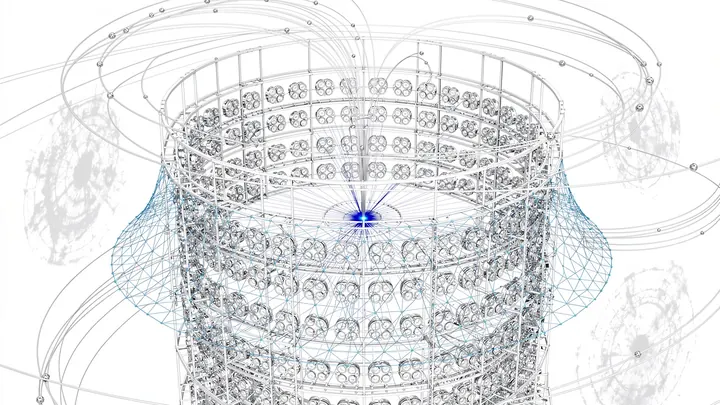
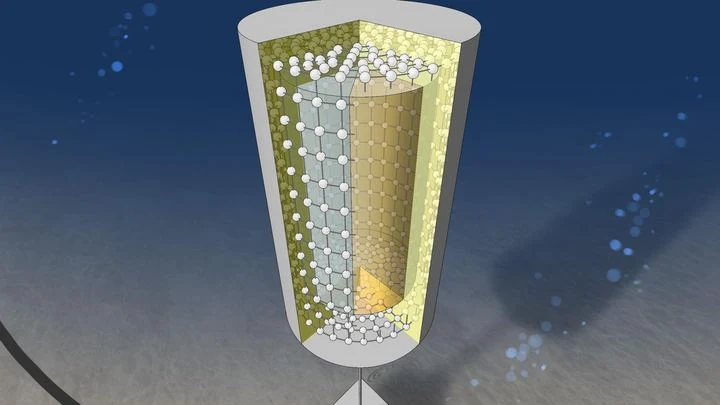
DUNE (Deep Underground Neutrino Experiment) is a next-generation neutrino observatory being built in the United States. It is designed to capture and study neutrinos — nearly massless, electrically neutral particles that rarely interact with matter. The experiment will use a powerful beam of neutrinos produced at Fermilab in Illinois, sent 1,300 kilometers through the Earth to detectors in South Dakota. By comparing neutrino behavior at the source and at the distant detector, scientists hope to answer fundamental questions about why the universe is made of matter rather than antimatter, and how neutrinos fit into the Standard Model of particle physics.
History
DUNE was formally established in 2015 as a merger of earlier proposed experiments (LBNE and LBNO). The project is an international collaboration involving over 1,000 scientists from more than 30 countries. The first detector modules are expected to begin operation in the late 2020s.
How it works
The experiment fires a beam of muon neutrinos from Fermilab toward a massive detector filled with liquid argon. When a neutrino collides with an argon nucleus, it produces charged particles that leave tracks in the liquid argon; these tracks are recorded by sensitive electronics. The detector is located deep underground to shield it from cosmic rays, which would otherwise create background noise. By measuring the types and energies of neutrinos arriving at the far detector, physicists can study neutrino oscillations — the quantum mechanical process by which neutrinos change flavor as they travel.
In practice
Beyond fundamental physics, DUNE's detector technology — liquid argon time projection chambers — is being adapted for use in medical imaging and nuclear non-proliferation monitoring.
Fun fact
The DUNE far detector will hold 70,000 tons of liquid argon, enough to fill about 25 Olympic-sized swimming pools.
Imagine an interpreter at a meeting where everyone speaks a language they don't know. At first, they have to listen to every word, write it down verbatim, and then check against the original. That's how simulations for the IceCube neutrino telescope work: they track every photon born in the Antarctic ice, traveling hundreds of meters to hit a sensor.
The neutron is a particle that usually sits in the atomic nucleus and doesn't disappear. But some theories suggest that occasionally it might transform into its invisible twin — a particle that ordinary detectors can't catch.
Neutrinos are tiny particles that pass through our bodies by the billions every second without touching a single atom. They have a mysterious property: on their way from the Sun or an accelerator, they can change their type, or 'flavor'—for example, turning from an electron neutrino into a muon neutrino.
Buried in Antarctic ice, there's a detector the size of a cubic kilometer. It doesn't catch light but ghostly particles — neutrinos. Yet sometimes, a different beast might flash through: a pair of muons born together and flying apart in a wide fan. No known particle of ordinary matter can paint that pattern.
Measuring distances in the universe is no easy task. Almost all methods rely on light, which can be absorbed by dust, scattered, or distorted along the way. It's like trying to spot a distant lighthouse through fog and haze. Neutrinos are a different story. These ghostly particles pass through anything without noticing obstacles.
High in the mountains, where the air is clear and still, physicists are preparing to catch elusive visitors from space — neutrinos. These particles, like ghosts, pass straight through the Earth, leaving almost no trace. But occasionally a neutrino does slam into an atom, producing a shower of particles that can be seen.
Solar neutrinos are tiny particles born in the Sun's core by the trillions every second. They pass through Earth almost without noticing it, and for a long time they were considered absolutely stable. But perhaps they too can "age"—decaying imperceptibly, vanishing on their way to us.
In 1998, physicists caught neutrinos doing something astonishing: the particle changes its type on the fly. That is only possible if it has mass. This became the only laboratory proof of physics beyond the Standard Model. But exactly how much a neutrino weighs remains a mystery.
A massive star exhausts its fuel, and its core collapses in a fraction of a second. A supernova is born, along with a brief but powerful shower of neutrinos. These particles barely interact with matter, so they fly away freely, carrying information about the catastrophe.
At nine in the morning, the DarkSide-50 detector, 1400 meters beneath Gran Sasso, records a weak ionization pulse. By eleven at night, the frequency of such events drops noticeably. This is not an electronics glitch or a seasonal background variation.
A huge pool of clear liquid is hidden deep underground. Inside, there is nothing but a pristine 'broth' that flashes with faint light when an invisible particle flies through. This is the JUNO detector—20,000 tons of liquid scintillator built to hunt for neutrinos.
The main enemy of such a hunt is not darkness but its own noise.
In the first seconds after the Big Bang, the Universe left us not only light but also something far more elusive — the relic neutrino background. This echo of creation permeates every cubic centimeter, yet we barely notice it.
For almost a century, seismology has been the planet’s chief X-ray, probing the interior through elastic waves. But neutrinos, ghost particles predicted by Wolfgang Pauli, offer a different perspective.
Cosmology is like an orchestra where different sections suddenly start playing out of sync. Measurements of the universe's expansion rate (the Hubble constant) from the early and late universe give different numbers.
In the depths of the ocean, where light never reaches, a plan is taking shape to capture particles that barely interact with anything. Geoneutrinos, tiny messengers from the scorching mantle, are emitted during the decay of uranium and thorium. Their flux carries information about how much heat lies hidden beneath our feet.
An old photograph taken at the moment of the universe's birth has been carrying its light to us for nearly 14 billion years. This snapshot is the cosmic microwave background, the cooled echo of the Big Bang. It captures the tiny inhomogeneities from which galaxies later grew.
Somewhere in the galactic bulge, a massive star lies dormant, ready to trade quiet burning for collapse. Its core will exhaust its fuel, and in a fraction of a second, a neutron star or black hole will be born, releasing 10⁵⁸ neutrinos — almost all the energy of the explosion.
Deep underground in Japan, a huge tank of ultrapure water waits for rare visitors — neutrinos arriving from distant stellar explosions. Such guests are few and far between: over years of observation, Super-Kamiokande registers only a handful of events.
A giant tank of ultrapure water sits deep underground in Japan. Its walls are lined with thousands of light-sensitive sensors that catch faint flashes — the traces of ghostly particles passing through the water.
A translator halfway across the hall suddenly starts rendering the message backwards. That's roughly how a neutrino, a ghost particle that barely notices matter, might behave if it encounters a cloud of ultralight dark matter.
The speed of light in a vacuum is physics' metronome: it sets the rhythm for all processes. If it falters, the familiar harmony collapses. Neutrinos, ubiquitous but almost intangible particles from space, can check if this rhythm ever stumbles under extreme conditions.
Neutrinos are almost elusive particles: they zip through planets without noticing atoms. So every catch is a stroke of luck. Recently, the underwater detector KM3NeT snagged a neutrino with energy millions of times greater than Earth's most powerful accelerators can produce.
A giant sphere filled with liquid flashes when an elusive particle, a neutrino, flies through it. Inside the sphere, like fireflies on a Christmas tree, hang thousands of tubes that catch these flashes. To pinpoint exactly where the flash occurred and how much energy arrived, you need to know the position of each tube to within a millimeter.
A neural network trained on collisions of protons and electrons transferred its skills to a completely different experiment — catching neutrinos. Like a chef who learned French cuisine and then, without preparation, baked an excellent Uzbek plov.
Neutrinos are tiny particles that pass through the planet's bulk like light through a windowpane. Every second, billions of them fly through your pinky fingernail, but catching even one is no easy feat. To do it, scientists dug a two-kilometer-deep mine in Canada and installed the SNO+ detector.
Deep beneath our feet, within the planet's bulk, radioactive elements are slowly decaying. This process spawns tiny particles — geoneutrinos. They pass through the crust, mantle, and core, barely interacting with anything.
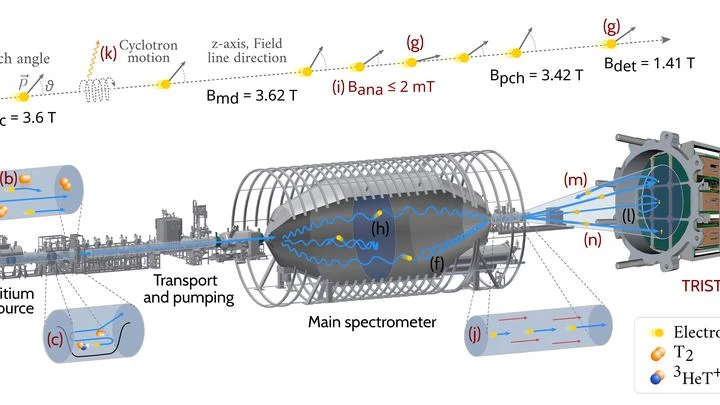
Radioactive tritium decays, emitting an electron. Its energy is almost always the same, but sometimes, just a little less. This shortfall could mean that alongside the ordinary neutrino, another, hidden particle was born.
The Standard Model describes three types of neutrinos, but scientists suspect there is a fourth — the sterile one.
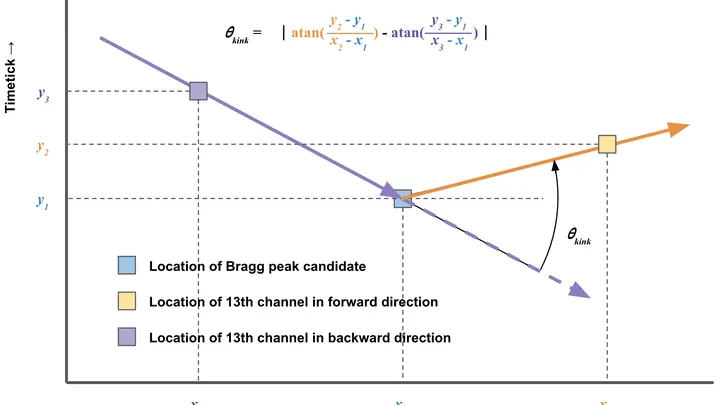
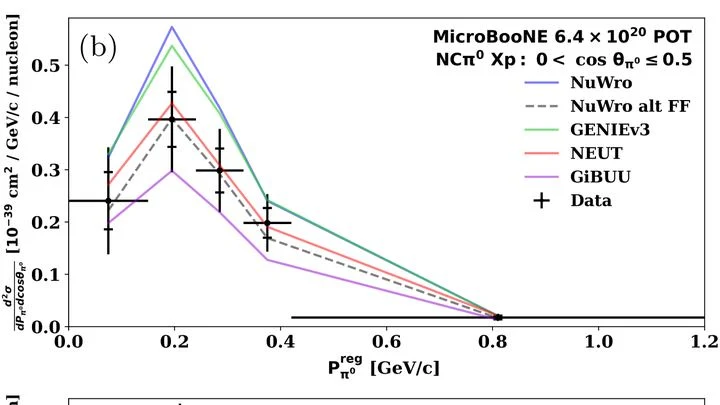
Neutrinos are tiny particles that zip through Earth, barely noticing it. In the MicroBooNE experiment, they are caught in a tank of liquid argon. When a neutrino strikes an argon nucleus, it produces an electron and protons, like splashes from a stone thrown into water.
Neutrinos are ghost particles. They pass through Earth as if it weren't there. To catch even one, physicists build enormous detectors. In the NOvA experiment, such a detector sits in Minnesota. Over years of operation, it has accumulated about a million muon antineutrino interactions.
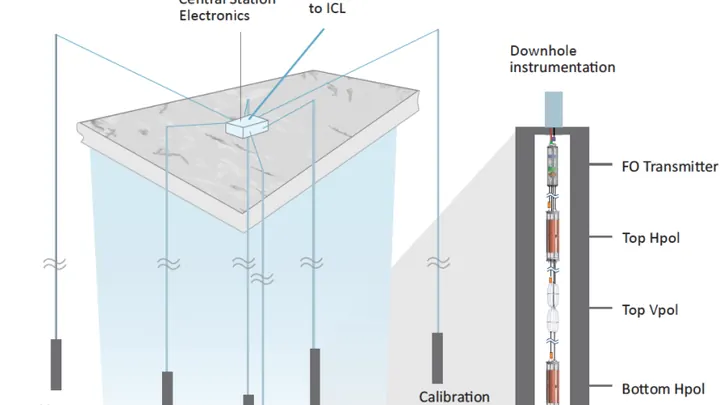
Deep within the Antarctic ice, at depths where sunlight never reaches, antennas hang suspended. They listen not for sounds but for radio waves, waiting for a signal from a particle that is nearly impossible to catch. A neutrino passes through the Earth like a bullet through fog, but occasionally, very rarely, it grazes an ice atom.
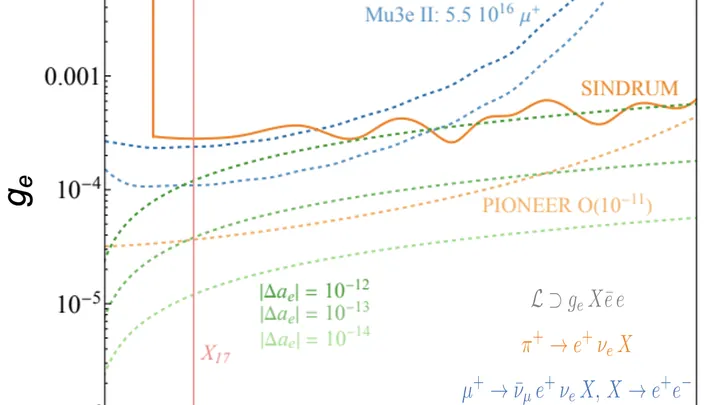
In nuclear transitions of beryllium-8, helium-4, and carbon-12, physicists from the ATOMKI collaboration have been seeing extra events since 2020—as if, when an excited nucleus decays, something else is sometimes born besides the usual photons. The energy of this "something" is always the same: about 17 million electron-volts.
In the first moments after the Big Bang, the universe was a hot soup of particles. Among them could have been neutrinos — very light and nearly elusive particles. Some of them might have been 'sterile': they barely interact with the rest of matter, like a quiet guest at a loud party.
The MicroBooNE detector is a large tank of liquid argon that catches particles flying through it. When a particle passes, it leaves a trail of charge and a flash of light. These trails combine into a three-dimensional picture of the event, as if the particle were drawing its path in a transparent cube.
A bullet that doesn't just pierce one target but leaves marks in several layers of armor. That's roughly how superheavy dark matter behaves, and it's what the DarkSide-50 detector was built to catch for the first time. The usual suspects for dark matter (weakly interacting massive particles, or WIMPs) pass through matter almost unnoticed, occasionally bumping into a nucleus.
In a vast, dark hall, they're searching for a single person who makes almost no sound. That's how physicists hunt for sterile neutrinos — ghostly particles that pass through matter, leaving barely a trace.
In an underground hall at Fermilab, a huge tank holds liquid argon — a transparent fluid at minus 186 degrees. When an invisible neutrino flies into the tank, it occasionally strikes an argon nucleus, and a short track of charged particles flashes.
Every year, in the United States alone, doctors perform more than 16 million scans using the radioactive isotope technetium-99m. It lights up the heart, bones, and lungs in images, helping to find tumors or check blood flow. But the isotope itself has a half-life of only six hours, so you can't stockpile it: you need a steady supply.
Deep inside a dying star eight times heavier than the Sun, a quiet fever begins a few days before the final explosion. The star's core contracts and heats up, releasing neutrinos — tiny particles that barely interact with matter. This stream is like a faint whisper before a loud cry: the supernova hasn't flashed yet, but it's already sending a signal of its imminent demise.