A Beam Ruler for Weak Decays express
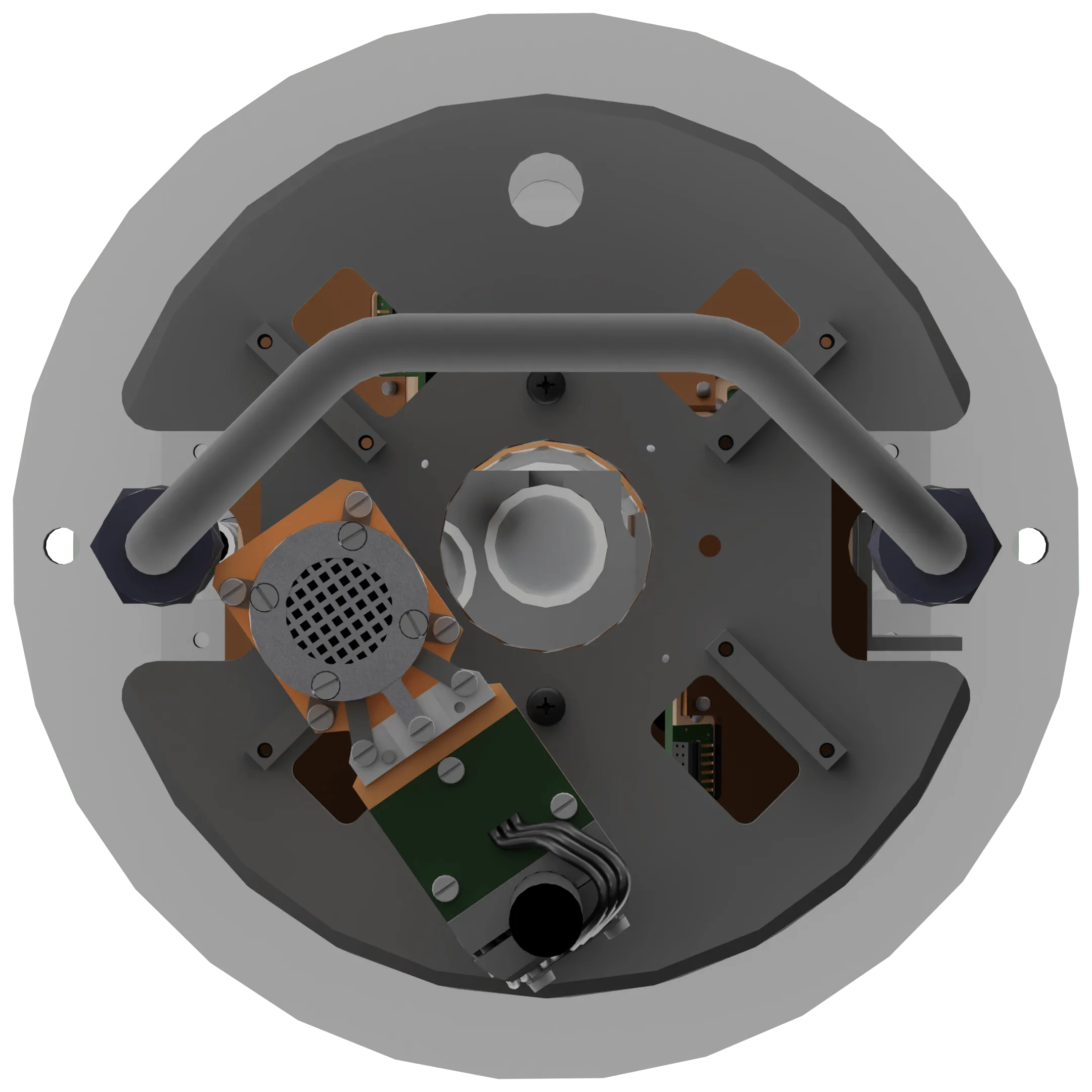
A charged particle beam is like a jet of water from a hose: it can be narrow or diffuse, steady or curved. To know exactly where particles are headed, you need a sensitive screen. In the WISArD experiment at ISOLDE, CERN's accelerator, that screen is a compact detector based on microchannel plates.
The palm-sized device is placed inside a magnetic field of 4 tesla — hundreds of thousands of times stronger than Earth's field. The magnet bends particle trajectories, and conventional monitors start to lie under such conditions. The new detector is not afraid of the field: it records the impact position of each ion with sub-millimeter accuracy. To achieve this, the team had to correct distortions caused by the square shape of the sensitive anode, like a photo stretched at the corners on a pillow.
Why such precision? WISArD studies the beta decay of argon-32 nuclei — one way to probe the weak interaction that governs particle transformations. From the beam shape, scientists reconstruct the angle at which the electron and neutrino fly apart after the decay. If this angle deviates even slightly from predictions, it signals that new forces beyond the Standard Model are at play. The new detector will measure the angle with an uncertainty of 0.1%—enough to catch even a faint hint of new physics.
The 4-tesla magnetic field doesn't hinder the device; it helps: it separates particles of different energies, so the impact position reveals their momentum. It's like a water jet breaking on a grid and splitting into individual drops.
Original abstract
as written by the authors arXiv:2602.12964
We present the development and characterization of a compact low-energy ion beam diagnostic for the WISArD (Weak Interaction Studies with $$\mathrm{^{32}Ar}$$ Decay) experiment at ISOLDE/CERN. The microchannel plate (MCP) detector, which is configured in a Z-stack and has a resistive position sensitive anode, was tested with both stable and radioactive beams. This work focuses on the image reconstruction method, which corrects the pincushion distortion inherent to the square-shaped resistive anode, and investigates the influence of the magnetic field on the detector performance. Our results demonstrate that the detector achieves beam profile measurements with sub-millimeter accuracy, while coping with the spatial and high-magnetic field (4 T) constraints of the experiment. These capabilities meet the precision requirements of the WISArD experiment for extracting the modified beta-neutrino angular correlation coefficient, \~a$$_{\beta u}$$, with an uncertainty of 0.1%.
Microchannel plates were invented for night-vision devices: they amplify faint light, turning a single photon into a cascade of electrons. Now the same plates catch individual ions in accelerators.
In Peter Watts's novel Blindsight, the ship's crew uses particle detectors to study an alien artifact without approaching it — much like the remote beam measurement in WISArD.