CERN, the European Organization for Nuclear Research, is the world's largest particle physics laboratory, operating accelerators like the Large Hadron Collider (LHC) near Geneva. It is where fundamental particles are smashed together at near-light speeds to probe the smallest building blocks of matter and the forces that govern them. The research conducted there has led to landmark discoveries, including the Higgs boson, and continues to shape our understanding of the universe's origins and composition.
History
CERN was founded in 1954 by 12 European nations to foster peaceful nuclear research and prevent brain drain after World War II. Its first accelerator, the Synchrocyclotron, began operations in 1957, and the laboratory has since grown into a global hub for particle physics.
How it works
CERN's accelerators use powerful electromagnets to steer charged particles along circular paths while radiofrequency cavities boost their energy with each lap. When particles collide, detectors record the debris, allowing physicists to reconstruct what happened at the instant of impact. The data are analyzed by massive computing grids, revealing rare events that hint at new physics beyond the Standard Model.
In practice
Beyond fundamental research, CERN's technologies have spawned innovations in medical imaging (PET scans), cancer therapy (hadron therapy), and the World Wide Web, which was invented there in 1989.
Fun fact
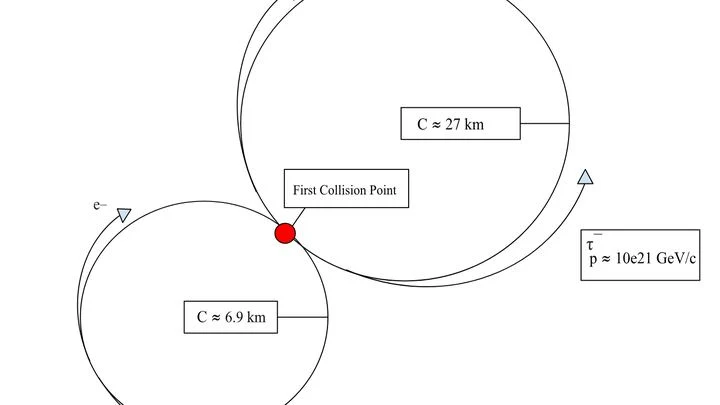
The LHC's main ring is about 27 kilometers in circumference and sits in a tunnel that crosses the border between Switzerland and France, with the two countries' flags painted on the floor at the crossing points.
In the shaft leading to the Large Hadron Collider, an unusual tenant may soon move in: a hundred-meter vertical tube where clouds of strontium atoms will be dropped. Each cloud is cooled to near absolute zero, so the atoms move slowly and in sync, like dancers in slow motion.
Deep inside a neutron star, matter is squeezed so tightly that familiar protons and neutrons give way to new players. Hyperons are born there — particles that harbor a strange quark.
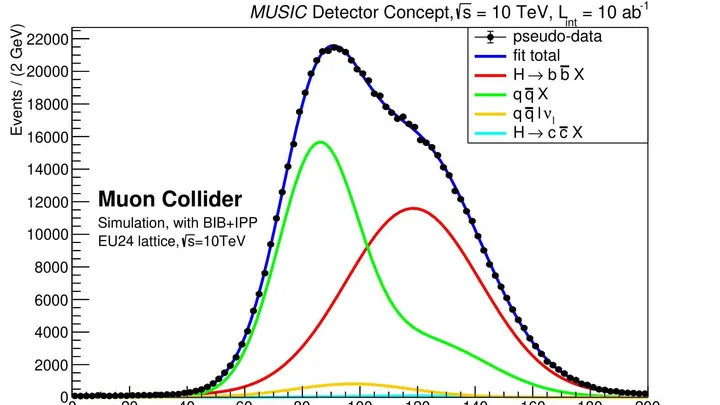
Deep inside the detector at the Large Hadron Collider, protons collide, and for a fleeting moment something heavy is born. It instantly shatters into two Higgs bosons — particles that, like nesting dolls, each hide two pairs of b-quarks.
A stone falls into a pond, and ripples spread across the water. Likewise, light from distant galaxies spreads in all directions — calmly and steadily. But at the center of some galaxies, it's not a stone but a veritable cannon: it fires particles with monstrous force. Astronomers call such objects HSP BL Lac.
The Higgs boson is like a conductor that gives mass to all other particles. Without it, electrons would be massless and atoms would fall apart. But how does the conductor interact with itself? That is the key question a future muon collider aims to answer.
At the Large Hadron Collider, protons collide, and from the flash dozens of particles are born. Among them may be traces of rare processes — for example, the decay of a Standard Model Higgs boson into two W bosons. But these particles fly apart so quickly that their tracks merge into a single wide jet.
A ring road around the Sun, where the traffic is not cars but clumps of matter. The diameter of this road is measured in light-years: it encircles our planetary system at its outer edge, in the Oort Cloud, where the star's weak gravity still holds sway.
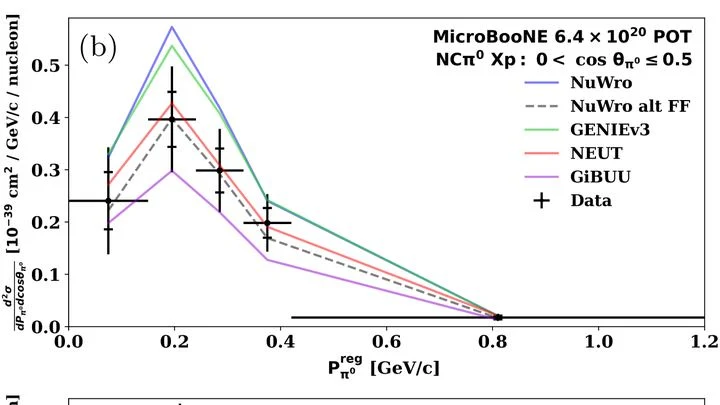
In an underground hall at Fermilab, a huge tank holds liquid argon — a transparent fluid at minus 186 degrees. When an invisible neutrino flies into the tank, it occasionally strikes an argon nucleus, and a short track of charged particles flashes.
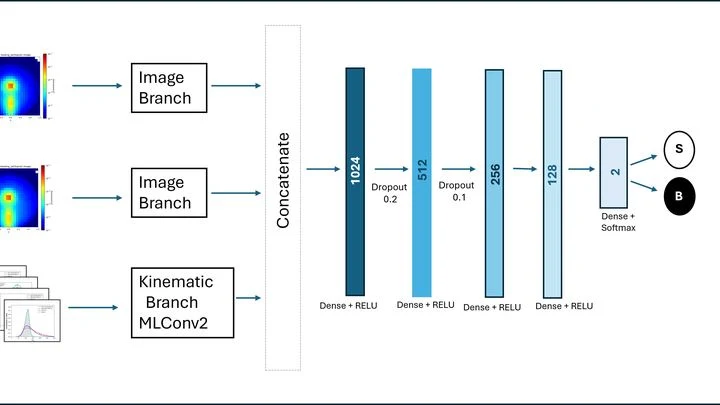
In a collider detector, each proton collision leaves a trail of dozens of particles, like the splash from a stone thrown into water. Making sense of that splash and understanding what exactly happened at the moment of impact is a task that humans can no longer handle alone.
In the first moments after the Big Bang, space boiled. A superheated substance permeating the world gave rise to giant bubbles of a new phase – much like a liquid produces vapor. Collisions of these bubbles accelerated particles to energies unimaginable in Earthly accelerators.
Inside a giant spectrometer in Karlsruhe, shaped like a huge metal barrel, scientists are catching particles that are nearly impossible to catch. Neutrinos are the ghosts of the microcosm: every second, trillions of these particles fly through your body, and you don't even notice. But they do have mass, and scientists want to measure it.
When a massive star exhausts its thermonuclear fuel, its core collapses, and the outer layers are ejected into space at speeds of thousands of kilometers per second. This is how a supernova remnant is born — an expanding cloud of shock-compressed gas spanning light-years.