Beta decay is a fundamental radioactive process in which an unstable atomic nucleus transforms by converting a neutron into a proton (or vice versa), emitting an electron (or positron) and a neutrino. This process is governed by the weak nuclear force, one of the four fundamental forces of nature, and is responsible for the natural radioactivity of many isotopes, such as carbon-14, used in archaeological dating. Beta decay plays a critical role in stellar nucleosynthesis, supernova explosions, and the cooling of neutron stars, as it allows nuclei to adjust their proton-to-neutron ratio toward stability.
History
The process was first observed by Henri Becquerel in 1896, and the term 'beta decay' was coined by Ernest Rutherford. The theoretical explanation involving the neutrino was proposed by Wolfgang Pauli in 1930, and Enrico Fermi developed the first quantitative theory in 1934.
How it works
Inside the nucleus, a down quark in a neutron changes into an up quark via the exchange of a W boson, turning the neutron into a proton. This reaction produces an electron and an antineutrino (or a positron and a neutrino in the inverse process). The emitted particles carry away the excess energy, and the neutrino, being nearly massless and weakly interacting, escapes almost undisturbed. The energy spectrum of the emitted electron is continuous because the energy is shared randomly between the electron and the neutrino, a fact that historically puzzled physicists until the neutrino's existence was proposed.
In practice
Beta decay is used in carbon-14 dating for archaeological and geological samples, in medical imaging via positron emission tomography (PET), and in nuclear reactors where beta decay of fission products contributes to heat generation.
Fun fact
The neutrino emitted in beta decay is so penetrating that a neutrino from a nuclear reactor can pass through a light-year of lead without interacting.
Picture a room where hundreds of people are talking at once while you strain to hear a pin drop. That is essentially how physicists with the PandaX-4T collaboration listened for silence inside 3.7 tonnes of liquid xenon.
Two different orchestras play the same score of damage, but they have different conductors: one brakes before division, the other before DNA replication. Oral cancer and breast cancer receive the same neutron strike, yet respond as if following different conductors.
A ruler for measuring the invisible must be calibrated against something tangible. In particle physics, nuclear models serve as such a ruler, and the decay of technetium-99 provides a tangible benchmark. This artificial isotope lives for 211 thousand years and decays by emitting an electron.
A neutron star is the remnant of an exploded star, compressed so tightly that a teaspoon of its material would weigh as much as a mountain. Inside such an object, protons and neutrons are packed tightly together, and under enormous pressure, hyperons, particles containing a strange quark, can appear.
Atomic batteries powered by plutonium decay have been running pacemakers and space probes for over sixty years. But the raw material is scarce: worldwide, only a few kilograms of plutonium-238 are produced each year, barely enough for the most critical missions.
In 1976, physicists predicted that an electron could do more than just fly past a nucleus: it could slam into it, transferring energy and making the nucleus 'shudder.' They called this effect NEEC — nuclear excitation by electron capture. But for nearly fifty years, no one has managed to observe it in an experiment.
Imagine an hourglass where the sand grains transform into other grains as they fall: that's what unstable atomic nuclei are like. They live for an instant and then decay, ejecting an electron (this is beta decay). In September 2025, theorists and experimentalists gathered under the FRIB Theory Alliance to discuss how to use such decays to probe the structure of matter.
In 1946, proposed a method that revolutionized archaeology: determining age by the decay of radiocarbon. The clock ticks: every 5730 years, half of the atoms vanish. But why so slowly? For a light nucleus, this is an anomaly — typical lifetimes are millions of times shorter. The mystery held for seven decades.
An atomic nucleus is like a crowded bus. To free up space, a group of two protons and two neutrons — a helium nucleus, an alpha particle — exits through the front door: this is alpha decay, described by George Gamow as tunneling under an energy barrier.
Atomic nuclei are wrapped in fluffy electron coats — in such attire, they can't get close enough to embrace. But swap the light coat for a heavy one: a muon, a particle from the standard model, shrinks the cloud by nearly 200 times.
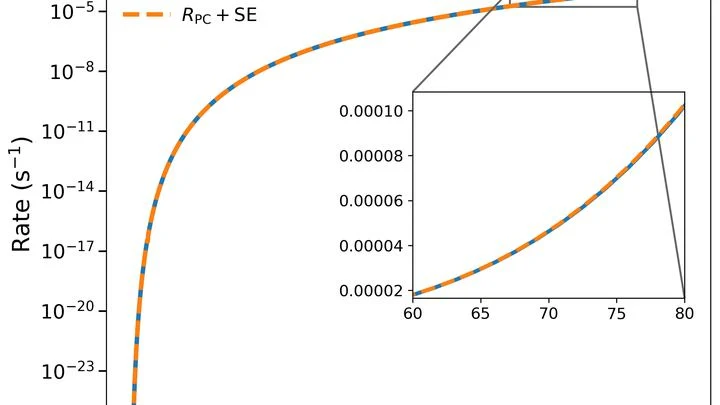
Inside the Sun, invisible nuclear transformations occur every second. One of them is the birth of boron-8: a beryllium-7 nucleus captures a passing proton and momentarily becomes a new element. This step kicks off a chain that ends with the emission of a neutrino — a particle capable of passing straight through Earth.
A neutron star is the dead core of a star that once exploded, compressed to the size of a city. If a normal star is nearby, the neutron star siphons matter from it like a vacuum cleaner. This matter falls onto the surface and forms a crust — a solid layer of neutron-rich atomic nuclei.
A tiny glass sphere floats in a laser beam like a speck of dust in sunlight. Inside it is radioactive lead, which decays from time to time. Each decay ejects charged particles, and the sphere loses or gains a tiny electric charge.
An atomic nucleus isn't always round. It can stretch out like a melon or flatten like a pumpkin. And its size depends on this shape — just as the size of a pie depends on the shape of the dough.
Scientists calculated the shapes and sizes of nuclei of berkelium isotopes — a heavy element produced in reactors.
Inside an atom's nucleus, protons and neutrons stack in layers, like spectators in a packed hall. When a layer is full, the nucleus becomes especially stable — physicists call these 'full rows' magic numbers. One of them, 32, has long been elusive: in nuclei with 32 neutrons, its effect is weak, and in some neighbors it seems absent altogether.
Deep inside a dying star, just before it goes supernova, nuclear reactions determine which chemical elements will be scattered across the cosmos. One such reaction is the collision of an oxygen nucleus with a proton, producing a nitrogen nucleus and an alpha particle (a helium nucleus).
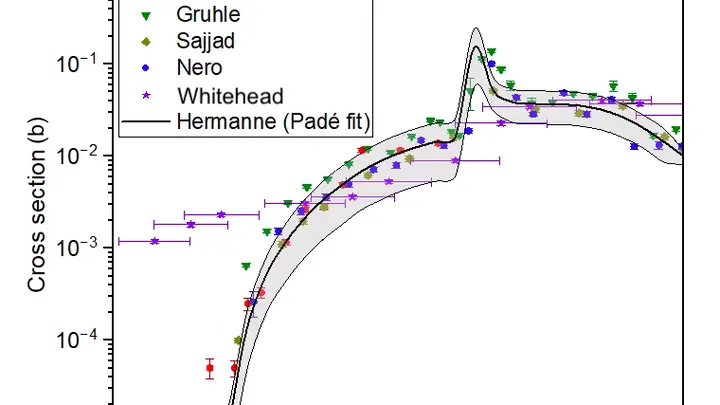
A proton can't be seen as a simple ball. If you hit it with a photon, it can absorb energy and jump into an excited state, like a bell that starts ringing at a certain frequency after being struck. These states are called nucleon resonances, and they live very briefly before decaying into other particles.
In the first minutes after the Big Bang, the Universe was like a blazing hot stove. On it, according to the 'recipe' of the standard theory, hydrogen, helium, and a bit of lithium were supposed to cook. But telescopes see only a third of the lithium that this recipe calls for.
Deep inside stars, light nuclei fuse, giving birth to helium and streams of neutrons. On Earth, we recreate this process by combining deuterium and tritium — special isotopes of hydrogen.