Momentum is a fundamental concept in physics that quantifies the amount of motion an object has. It is defined as the product of an object's mass and its velocity. Because velocity includes direction, momentum is a vector quantity, meaning it has both magnitude and direction. The importance of momentum lies in its conservation: in a closed system, the total momentum before an event (like a collision or explosion) equals the total momentum after, regardless of the internal forces at play. This principle allows physicists to predict the outcomes of interactions without knowing the details of the forces involved.
History
The concept of momentum was formalized by Isaac Newton in his 1687 work 'Principia Mathematica', where he stated it as the 'quantity of motion'. The modern vector formulation and the conservation law were further developed by later mathematicians and physicists, including Leonhard Euler and Jean le Rond d'Alembert.
How it works
Momentum (p) is calculated as p = m × v, where m is mass and v is velocity. When two objects interact, they exchange momentum through forces. Newton's second law can be expressed as the rate of change of momentum being equal to the applied force. In a collision, the total momentum of the system remains constant if no external forces act, which is a direct consequence of Newton's third law: forces between objects are equal and opposite, so their momentum changes cancel out.
In practice
Momentum conservation is used in engineering to design safer vehicles (crash tests), in rocketry to calculate thrust, and in particle physics to analyze collision products in accelerators.
Fun fact
A bullet fired from a gun has a small momentum, but because the gun recoils with equal and opposite momentum, the shooter feels a noticeable kick due to the gun's larger mass moving at a lower velocity.
Units by system: SI: kgms · CGS: gcms · Planck: m pc · natural: mevc
An electron beam is a stream of tiny particles carrying an electric charge. When such a beam hits a material, it doesn't just heat it or knock out atoms: it also gives the surface a slight push, like a jet of water pushing against your palm.
The Kerr-NUT black hole is not just a cosmic vacuum cleaner. It's a solution to Einstein's equations where the hole has mass, rotation, and a strange NUT parameter. This parameter behaves like a magnetic charge for gravity: seemingly invisible, yet it alters the properties of surrounding space.
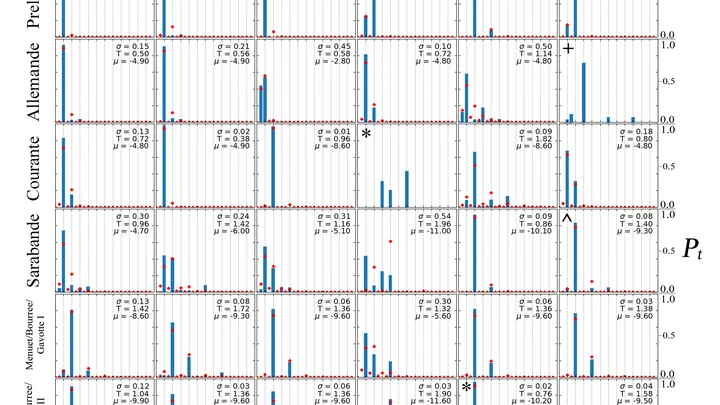
Music relies on repetition: we expect the beat to return, like a chorus coming back. But if you repeat the same thing for too long, it gets boring. The composer seems to walk a tightrope between the familiar and the unexpected.
Scientists translated this balance into the language of physics.
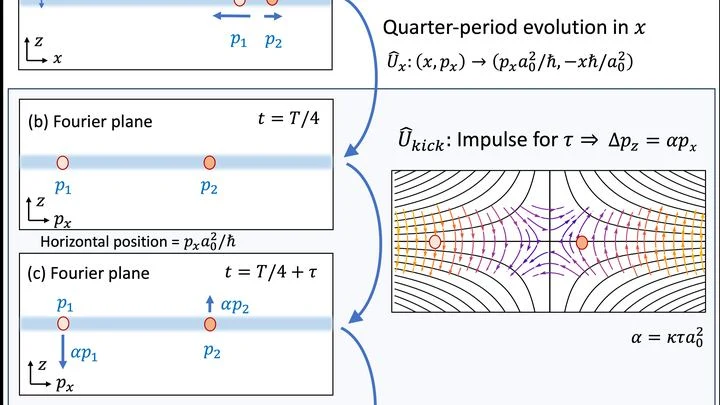
Fireflies flash in a dark forest: you see each flash, but not the flight. A quantum gas microscope can show individual cold atoms, like those fireflies. But until now, it couldn't tell you how fast they're moving.
Now scientists have found a way to fix that.
A raindrop falling to the ground strikes with a certain force. But what if the drop isn't round but elongated like a cigar or flattened like a pancake? It turns out that shape is everything: the impact force can vary by more than a factor of ten just because of how the drop looks at the moment of impact.
Spacetime at ultra-short distances resembles a digital screen: it's not smooth but made of tiny 'pixels.' This minimum length was calculated by Max Planck, and Heisenberg's uncertainty principle explains why the world cannot be continuous: precise measurement always…
In 1935, Einstein, Podolsky, and Rosen proposed a thought experiment that, in their view, exposed the incompleteness of quantum mechanics. Two particles fly apart after interacting, and measuring the momentum of one instantly gives exact knowledge of the other's momentum.
A woven basket holds its shape not because it has a rigid frame, but because each strand is interlaced with its neighbors. Pull one out, and the pattern unravels, leaving a heap of twigs. Quantum mechanics, according to a new paper, works the same way: its elementary objects do not exist independently, but only in interweaving with each other.